






Alaska Sedation Dentistry Licensing & Permit Requirements
In Alaska, your dental license alone does not let you sedate a patient. A dentist who administers moderate (conscious) sedation, IV sedation, deep sedation, or general anesthesia must first hold the matching permit from the Alaska Board of Dental Examiners, issued under 12 Alaska Administrative Code, Chapter 28, with the authority of Alaska Statute 08.36.070. Earning the permit means clearing the training, certification, and DEA requirements for your level. Keeping it means your office passes an on-site inspection every four years, your sedation records survive a board review, and your continuing education and case counts stay current. This guide walks both halves, with every requirement traced to the current rule text.
Recent Updates
Last UpdatedNovember 16, 2026
- Rewrote every requirement against the Board of Dental Examiners' own compiled Dental Statutes and Regulations (12 AAC Chapter 28), replacing third-party aggregator citations with the board's original rule text.
- Added the verified permit training paths in 12 AAC 28.015 and 28.010, the four-year on-site inspection cycle and board-approved inspecting organizations (12 AAC 28.068), and the 48-hour mandatory-reporting rule for a sedation death or hospitalization (12 AAC 28.080).
- Corrected the nitrous oxide and minimal-sedation exemptions to the actual 12 AAC 28.065 standard (the 25 percent oxygen fail-safe and the single FDA-labeled home-use dose), and confirmed that the sedation-record rules in 28.060(d) apply to adult moderate sedation, not only to patients under 13.
- Added the biennial renewal, airway continuing education, and 25-case requirements for the Moderate Sedation permit (12 AAC 28.015(h)), and direct links to the board's permit information and the primary statute PDF.
- Alaska regulates sedation through the Board of Dental Examiners under 12 AAC Chapter 28, with authority from AS 08.36.070. Permits are named by the depth of sedation, not a numbered Level 1 to 4 ladder.
- Two permits gate the deeper work: a Moderate Sedation permit (12 AAC 28.015) for conscious and IV sedation, and a Deep Sedation or General Anesthesia permit (12 AAC 28.010). A deep-sedation permit also covers moderate sedation.
- Nitrous oxide needs no permit if the system guarantees at least 25 percent oxygen, and a single FDA-labeled home-use dose of an oral drug is exempt minimal sedation for adults (12 AAC 28.065).
- The moderate permit's board-approved CE route is at least 60 hours of instruction plus 20 individually managed patients, with ACLS; the deep-sedation permit requires AAOMS membership or a CODA-accredited oral surgery or dental anesthesiology program.
- The permit is kept with the paperwork: a four-year on-site inspection (12 AAC 28.068), a 48-hour death-or-hospitalization report (12 AAC 28.080), 25 sedation cases a renewal cycle, and a timely, itemized sedation record (12 AAC 28.060).
What This Guide Covers
- Who issues sedation permits in Alaska
- The Alaska sedation permit categories
- How to earn or upgrade each permit
- What the permit requires you to monitor
- Documentation and reporting duties
- Continuing education and renewal
- Inspections and keeping the permit
- Frequently asked questions
- Related guides and neighboring states
- Sources
Who issues sedation permits in Alaska
Sedation dentistry in Alaska is regulated by the Alaska Board of Dental Examiners, the state body inside the Division of Corporations, Business and Professional Licensing that licenses dentists and issues every sedation and anesthesia permit. The board, not any national organization, decides who may sedate, approves the organizations that inspect offices, and takes disciplinary action. The rules live in 12 Alaska Administrative Code, Chapter 28, Article 1, under the authority of Alaska Statute 08.36.070, and every requirement below traces to a section of that chapter. To reach the board directly, the licensing staff can be contacted at (907) 465-2550.
Important
The ADA writes the standard; the board writes the law. The American Dental Association publishes sedation guidelines that Alaska relies on, and 12 AAC 28.060 even adopts the ADA and AAP guidelines by reference. But the ADA is a professional association, not a government agency. It does not license you, inspect you, or discipline you. Your permit, your office inspection, and any sanction all come from the Alaska Board of Dental Examiners under Chapter 28. Treat the ADA guidelines as best practice and Chapter 28 as the law you are held to. The real federal layers are separate: the DEA for your controlled-substance registration and logs, and HIPAA for how the records are stored.
To apply, you work through the board's own process. Both the Moderate Sedation permit application and the Deep Sedation or General Anesthesia permit application are downloaded from the board's licensing pages, and each requires a completed form, signed affidavits that your facility meets the chapter's requirements, proof of a current DEA registration, and the applicable fee set in 12 AAC 02.190. The board advises allowing six to eight weeks for processing, and the current form and fee are updated periodically, so pull them straight from the board rather than trusting a number on a CE provider's page.
Source: Alaska Board of Dental Examiners | Alaska Dental Statutes and Regulations, 12 AAC Chapter 28
The Alaska sedation permit categories
Alaska names its sedation categories by depth rather than by a "Level" number, and the permit requirement reflects how deeply the patient is sedated, not just which drug or route is used. Here is the full ladder, each rung with its governing section of Chapter 28.
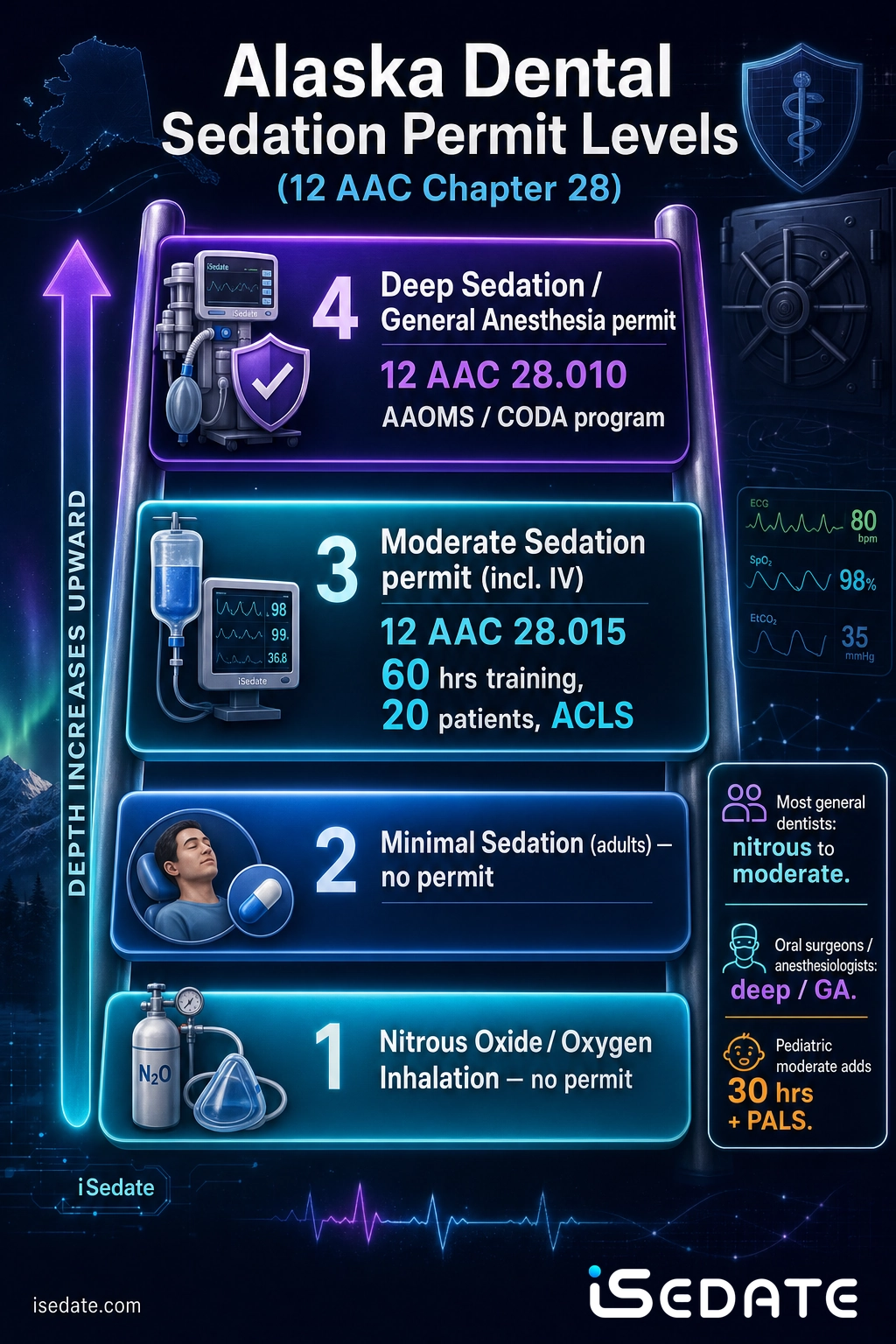
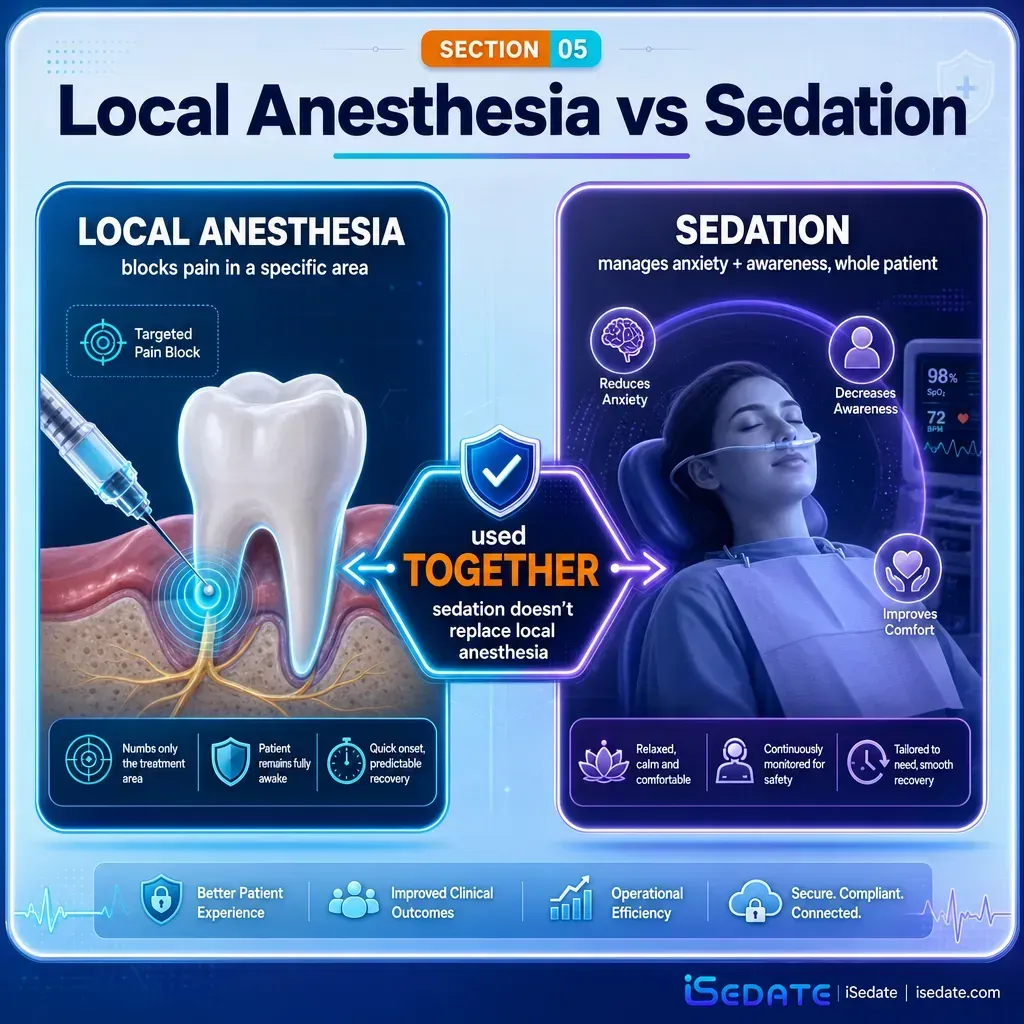
Nitrous oxide / oxygen inhalation (no permit). Nitrous oxide is the lightest form of anxiety control, where the patient stays fully responsive. Under 12 AAC 28.065, administering nitrous oxide to a patient of any age does not require a sedation permit as long as the delivery system contains a mechanism that guarantees at least a 25 percent oxygen concentration at all times. That oxygen fail-safe is the condition the statute actually sets, so confirm any additional training expectation directly with the board rather than assuming it maps to the permit rules below.
Minimal sedation for adults (no permit, with limits). A single oral medication given to achieve minimal sedation is exempt from the permit requirement under 12 AAC 28.065 when the patient is 13 or older, the dose stays within the FDA's recommended home-use labeling, and no second drug is added. You may combine that single dose with nitrous oxide and oxygen. The moment you add a second drug, exceed the home-use dose, or sedate a patient under 13 with minimal sedation, you need a permit.
Moderate Sedation permit (12 AAC 28.015). Required for moderate sedation by any route, including the IV route, where the patient responds purposefully to verbal or tactile stimulation and keeps their own airway. Conscious Sedation is the common term for this moderate level, and this is the workhorse permit for a dentist who provides genuine conscious and IV sedation. The rule also bars a moderate-permit holder from using any agent with so narrow a margin that it is likely to produce deep sedation, naming ketamine, propofol, brevital, and sodium pentothal.
Deep Sedation or General Anesthesia permit (12 AAC 28.010). The top tier. It authorizes deep sedation and general anesthesia, where the patient is not easily aroused or is unconscious and may need airway support. A general anesthesia permit holder does not also need a moderate permit. This tier is largely the province of dental anesthesiologists and oral and maxillofacial surgeons, and for most general dentists it is out of scope. A certified registered nurse anesthetist or an anesthesiologist may also administer these levels under a written agreement with the dentist, per 12 AAC 28.030.
Source: 12 AAC 28.010, 28.015, and 28.065 (Alaska Dental Statutes and Regulations)
How to earn or upgrade each permit
Each category has its own bar: a training path, resuscitation certification, a DEA registration, and, for moderate sedation, a count of individually managed live patients. You move up the ladder by meeting the next category's requirements and applying to the board. The figures below come straight from the current rules.
| Permit / category | Route / depth | Training path | Live patients | Resuscitation |
|---|---|---|---|---|
| Nitrous oxide (no permit) | Inhalation, lightest | 25% oxygen fail-safe required (28.065) | Not applicable | Confirm with board |
| Minimal sedation, adults (no permit) | Single oral drug, anxiolysis | FDA home-use dose only (28.065) | Not applicable | Confirm with board |
| Moderate Sedation (12 AAC 28.015), 13+ | Moderate / conscious, incl. IV | CODA program training, or 60-hour board-approved CE course | 20 individually managed patients (CE route) | ACLS |
| Moderate Sedation, patients under 13 | Pediatric moderate | Above plus 30 hours pediatric coursework (28.027) | Plus 20 patients under age 13 | ACLS + PALS |
| Deep Sedation / GA (12 AAC 28.010) | Deep sedation / general anesthesia | AAOMS membership, or CODA oral surgery or dental anesthesiology program | See 28.010 (confirm with board) | ACLS (PALS for under 13) |
The Moderate Sedation permit: conscious and IV sedation
The workhorse permit for most sedation dentists is the Moderate Sedation permit under 12 AAC 28.015. To treat patients 13 and older, you satisfy the training requirement one of two ways. The first is completing moderate-sedation training consistent with the ADA's teaching guidelines while enrolled in a dental program accredited by the Commission on Dental Accreditation (CODA) or a post-doctoral university or teaching-hospital program. The second, the route most practicing dentists take, is a board-approved continuing education course of at least 60 hours of instruction plus administration of sedation for at least 20 individually managed patients to establish competency in moderate sedation and airway management. You also hold a current DEA registration and current ACLS, and the permit must be in hand before you sedate.
Treating patients under 13 with moderate sedation raises the bar. Under 12 AAC 28.015, that path adds 30 hours of board-approved pediatric coursework required by 12 AAC 28.027, administration of sedation for at least 20 individually managed patients under age 13 under the supervision of a qualified sedation provider, and current PALS in addition to ACLS. The permit the board issues states that it covers patients under 13, so a dentist already holding an adult-only moderate permit must complete that additional pediatric training before sedating younger patients.
The Deep Sedation or General Anesthesia permit
Under 12 AAC 28.010, this top-tier credential sits at the top of the ladder and carries the heaviest entry requirements. Beyond the completed application, facility affidavit, DEA registration, and resuscitation certification (ACLS for adults, PALS for patients under 13, or both for any age), an applicant for an initial permit must document that they are a member of the American Association of Oral and Maxillofacial Surgeons, completed a CODA-accredited advanced program in oral and maxillofacial surgery, or completed a CODA-accredited advanced program in dental anesthesiology. For a general dentist, that puts this tier out of reach without formal anesthesiology or oral-surgery training, which is why it belongs to anesthesiologists and oral surgeons.
Myth, Busted
Myth: A dental license and a weekend course are enough to start running IV sedation in Alaska.
Fact: IV moderate sedation requires a Moderate Sedation permit, and the board-approved CE route demands at least 60 hours of instruction plus 20 individually managed patients, current ACLS, and a DEA registration before the permit issues, per 12 AAC 28.015.
The gap between light oral anxiolysis and genuine IV sedation is where dentists most often misjudge the rules, because IV titration adds both a longer training path and a standing inspection obligation the exempt levels never trigger.
For every category, the application, the current fee, and any added requirement are set by the board and change periodically. Do not rely on a number you read on a CE provider's page. Confirm the exact forms, fees, and current training requirements with the Alaska Board of Dental Examiners before you file. If your charting system also handles oral and IV sedation records, the iSedate anesthesia record software is built to match these permit categories.
Source: 12 AAC 28.010 and 28.015 (Alaska Dental Statutes and Regulations)

What the permit requires you to monitor
A permit is permission plus obligation. Once you administer deep sedation or general anesthesia, 12 AAC 28.061 requires specific monitoring and equipment in addition to the baseline rules in 28.060:
- Respiration: an end-tidal carbon dioxide monitor used to monitor respiration, plus an electrocardiographic monitor in the facility.
- Airway readiness: a laryngoscope with a selection of blades, endotracheal tubes and connectors, a supra-glottic airway device, tonsillar or pharyngeal suction, and endotracheal tube forceps.
- Vascular access: a secured intravenous line maintained throughout the procedure, unless poor patient cooperation prevents it.
- Staffing: the provider stays in the operatory to monitor continuously until the patient is responsive, a qualified practitioner remains on the premises until discharge, and when the treating dentist is also the anesthesia provider, a second trained person monitors the patient at all times.
Moderate sedation follows the ADA and AAP guidelines that Alaska adopts by reference in 12 AAC 28.060, along with the facility and emergency-equipment standards in that section, which require an automated external defibrillator within reach in 60 seconds and a stocked emergency drug kit. For the full clinical breakdown of what to monitor and chart at each depth, see the companion guide on Alaska sedation vitals monitoring, charting, and reporting requirements.
Source: 12 AAC 28.060 and 28.061 (Alaska Dental Statutes and Regulations)
Documentation and reporting duties
Holding a permit also means holding a set of documentation and reporting duties, and these are exactly what a board review examines.
What the sedation record must contain
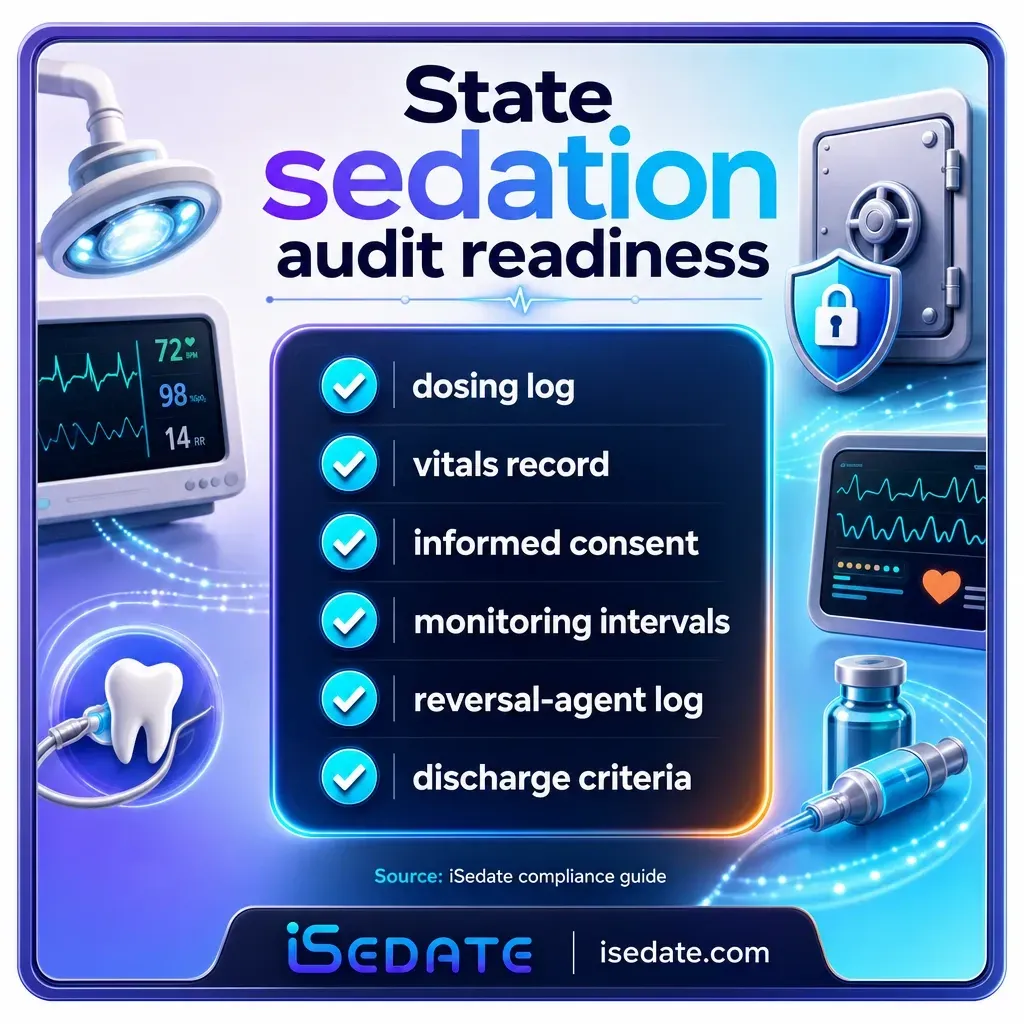
- Baseline vital signs recorded before a controlled substance is administered and before discharge (12 AAC 28.060(d)(1)).
- A timely sedation and anesthesia record with blood pressure, heart rate, respiration, and blood oxygen saturation (28.060(d)(3)).
- Every drug given with its dosage, the time administered, and the route, plus the length of the procedure and the patient's temperature (monitored constantly if depolarizing or volatile agents are used).
- Any complications from the anesthesia or sedation, the discharge decision and discharge entry, and written and verbal post-operative instructions carrying a 24-hour emergency number that reaches the provider directly (28.060(d)(5)-(8)).
These itemized record rules in 28.060(d) apply when deep sedation, general anesthesia, or moderate sedation is administered at any age (and to minimal sedation for patients under 13), so the adult moderate-sedation record is held to the same standard, not a lighter one. The facility must also log an emergency training exercise at least twice each calendar year, signed and dated with a board checklist, under 28.060(e)(8).
Reporting a death or hospitalization. Separate from the chart, 12 AAC 28.080 sets a hard clock. If a patient dies or experiences sedation or anesthesia complications requiring hospitalization or emergency room care during or immediately after sedation or general anesthesia, the treating dentist must submit a written or electronic report to the board no later than 48 hours after learning of the death or hospitalization. The report has to describe the patient, everyone present, the facility, the medical history, the sedation type and drug dosages, and a timed narrative of how the symptoms evolved.
Source: 12 AAC 28.060 and 28.080 (Alaska Dental Statutes and Regulations)
Continuing education and renewal
Your sedation permit is tied to your Alaska dental license. Under 12 AAC 28.015, a moderate or minimal sedation permit is renewed when the dentist's license is renewed, and it lapses or expires on the date the license does. The renewal itself carries real continuing-education and case requirements that a lapse of the permit does not forgive.
iSedate Renewal Tip
Track your 25 sedation cases as you go. To renew a Moderate Sedation permit, 12 AAC 28.015(h) requires, each biennial licensing period, four or more contact hours of continuing education in hands-on advanced airway management, four contact hours covering topics such as venipuncture, IV or enteral sedation, physiology, pharmacology, nitrous oxide, or patient monitoring, and completion of at least 25 moderate sedation cases. A pediatric permit holder needs at least 10 of those 25 cases to be patients under 13. The board can audit your continuing-education records, so log the cases and courses as you complete them instead of reconstructing them at renewal.
A lapsed permit can be reinstated if it has been lapsed more than 60 days but less than two years, with a renewal application, the fee in 12 AAC 02.190, and evidence of the continuing education and sedation cases required for renewal. Confirm your current cycle, contact-hour totals, and resuscitation requirements directly with the Alaska Board of Dental Examiners so your permit never lapses at renewal.
Source: 12 AAC 28.015 and 28.026 (Alaska Dental Statutes and Regulations)
Inspections and keeping the permit
This is where a permit is kept or lost. Under 12 AAC 28.068, a dentist who holds a Deep Sedation or General Anesthesia permit, or a Moderate Sedation permit covering patients under 13, must obtain an on-site inspection at least once every four years at the location where sedation or anesthesia is provided. The inspection has to be performed by a board-approved organization, and the chapter names them: the Accreditation Association for Dental Offices (AAFDO), the American Association of Oral and Maxillofacial Surgeons (AAOMS), the American Association for Accreditation of Ambulatory Surgery Facilities (AAAASF), the Accreditation Association for Ambulatory Health Care (AAAHC), or a substantially equivalent organization the board approves. The board publishes its own Sedation On-Site Inspections page for the current process.
If an inspection report finds the equipment, facilities, or personnel training inadequate, the board allows a follow-up inspection within 90 days, and if the office still falls short, the board may deny or refuse to renew the permit. When a reviewer opens your file, they are checking the record, not your intentions. A board review turns on whether your timely, itemized sedation record is complete and contemporaneous: a missing time stamp, a recovery interval that stretched past five minutes, a drug given but not logged with its dose and route, a discharge that was never documented. The dentist can perform the sedation flawlessly and still lose on the paperwork.
That is the failure point worth engineering out. A vitals and drug log written by hand during a live case, between titrating a drug and watching an airway, is exactly where records go incomplete, and incomplete records are what a board inspection and a malpractice claim both attack. SedationVault captures live patient vitals and the drug log automatically into a timely, Alaska-aware sedation record, holding the itemized contents that 12 AAC 28.060 demands and keeping the monitoring data with the record instead of on a separate strip that can go missing. When the board or an inspector asks for the file, a complete record is a one-click export. See how it maps to Alaska's rules on the dental sedation compliance page.
Book a demo of SedationVault See SedationVault pricingSource: 12 AAC 28.068 and 28.070 (Alaska Dental Statutes and Regulations) | Alaska Board of Dental Examiners, Sedation On-Site Inspections
Frequently asked questions
What sedation permits does Alaska require?
How many training hours do you need for a moderate or IV sedation permit in Alaska?
Does Alaska inspect dental sedation offices?
What must an Alaska dentist report after a sedation death or complication?
Does nitrous oxide need a permit in Alaska?
Related guides and neighboring states
This guide is part of the iSedate state-by-state series on sedation licensing. For the companion Alaska guide, see the Alaska sedation vitals monitoring, charting, and reporting requirements. Alaska is a non-contiguous state with no bordering states to cross-reference, so to compare another jurisdiction's rules, start from the full Sedation Dentistry Licensing & Permit Requirements by State hub.
Sources
- Alaska Board of Dental Examiners (board, permit applications, fees, contact)
- Alaska Dental Statutes and Regulations, 12 AAC Chapter 28 (the board's compiled rule text, including 28.010, 28.015, 28.026, 28.030, 28.060, 28.061, 28.065, 28.068, 28.070, and 28.080; authority AS 08.36.070)
- Alaska Board of Dental Examiners, Sedation On-Site Inspections (12 AAC 28.068)
This guide summarizes Alaska sedation permit rules for general information and is not legal advice. Permit categories, training, monitoring, recordkeeping, reporting, inspections, and renewal are drawn from 12 AAC Chapter 28 as compiled in the Alaska Board of Dental Examiners' Dental Statutes and Regulations, current as of November 2026, under the authority of AS 08.36.070. Application forms, the current fee schedule in 12 AAC 02.190, processing times, and any added requirement are set by the board and should be confirmed directly with the Alaska Board of Dental Examiners before you act.