






Maine Sedation Dentistry Licensing & Permit Requirements
In Maine, your dental license alone does not let you provide moderate or deeper sedation. A dentist who administers moderate sedation, deep sedation, or general anesthesia must first hold the matching permit from the Maine Board of Dental Practice, issued under 02-313 of the Code of Maine Rules, Chapter 14 and authorized by Title 32, Section 18379 of the Maine statutes. Getting the permit means meeting the training, certification, and live-patient requirements for your level. Keeping it means your sedation records survive a Board inspection. This guide walks both halves: how a Maine dentist gets a sedation or anesthesia permit, and what it takes to keep it.
Recent Updates
Last UpdatedNovember 16, 2026
- Verified every rule and figure against the Maine Board of Dental Practice's own pages and the official statute, and replaced aggregator citations with the original state sources.
- Added the Board's four permit codes (MSE, MSP, DSA, and the itinerant permit) and direct links to the license-types and application-and-forms pages.
- Added the two-year renewal cycle, the criminal history records check, and the pediatric (age 12 and under) minimal-sedation permit rule.
- Added current Board contact details for confirming forms and fees.
- Maine requires no sedation permit for minimal sedation, including nitrous oxide, for most adults, then issues four permits under 02-313 CMR Chapter 14: Moderate Sedation Level I (Enteral, MSE), Moderate Sedation Level II (Parenteral, MSP), Deep Sedation/General Anesthesia (DSA), and an itinerant deep sedation/GA permit.
- A higher permit covers the levels below it: an MSP holder may also provide Level I and minimal sedation, and a DSA holder may provide every lower level.
- The jump to IV is the big step: Level I reports a classroom course plus adult and pediatric case experience and ACLS; Level II reports a larger didactic load, live adult IV cases, pediatric cases, ACLS, and capnography, each confirmed with the Board.
- For moderate and deeper Conscious Sedation, Maine requires a time-oriented anesthesia record with vitals documented at least every 5 minutes and a discharge score such as the Modified Aldrete scale.
- Every permit is non-transferable and site-specific, renews with your dental license every two years, and carries the Board's right to inspect your equipment, personnel, procedures, and records.

What This Guide Covers
- Who issues sedation permits in Maine
- The Maine permit levels
- How to get or upgrade each permit
- What the permit requires you to monitor
- Reporting obligations tied to your permit
- Renewal and continuing education
- Inspections and record reviews
- Keeping the permit: audit-ready records
- Frequently asked questions
- Related guides and neighboring states
- Sources
Who issues sedation permits in Maine
Sedation dentistry in Maine is regulated by the Maine Board of Dental Practice, the licensing authority within the Department of Professional and Financial Regulation that licenses dentists and issues every sedation and anesthesia permit. The Board decides who may sedate, inspects practices, and takes disciplinary action. Its authority to do so is written into state law: Title 32, Section 18379 directs the Board to adopt, by rule, the qualifications a dentist must meet to obtain a sedation or general anesthesia permit. Those qualifications and the day-to-day standards live in 02-313 CMR Chapter 14, "Rules for Use of Sedation and General Anesthesia," and every requirement below traces to the statute or that chapter.
Important
The ADA writes the standard; the Board writes the law. The American Dental Association publishes sedation guidelines, and Chapter 14 adopts and incorporates those guidelines by reference, but the ADA is a professional association, not a government agency. It does not license you, inspect you, or discipline you. Your permit, your inspections, and your sanctions all come from the Maine Board of Dental Practice under Chapter 14 and Title 32. Treat the ADA guidelines as the incorporated standard and Chapter 14 as the rule you are held to.
Permits are not purely a matter of logging hours with a course provider. Chapter 14 requires individual Board approval before an initial permitting course and before your live-patient experiences, so the pathway runs through the Board from the start. Application forms and the current fee schedule are set by the Board and change periodically, so confirm the exact forms and current fees on the Board's Applications and Forms page before you file.
Source: Maine statute Title 32 Section 18379 | 02-313 CMR Chapter 14
The Maine permit levels
Maine names its permits by depth and route, and the level reflects how deeply the patient is sedated, not just which drug is used. The Board's own license-types page lists them by code. Here is the full ladder, from lightest to deepest.
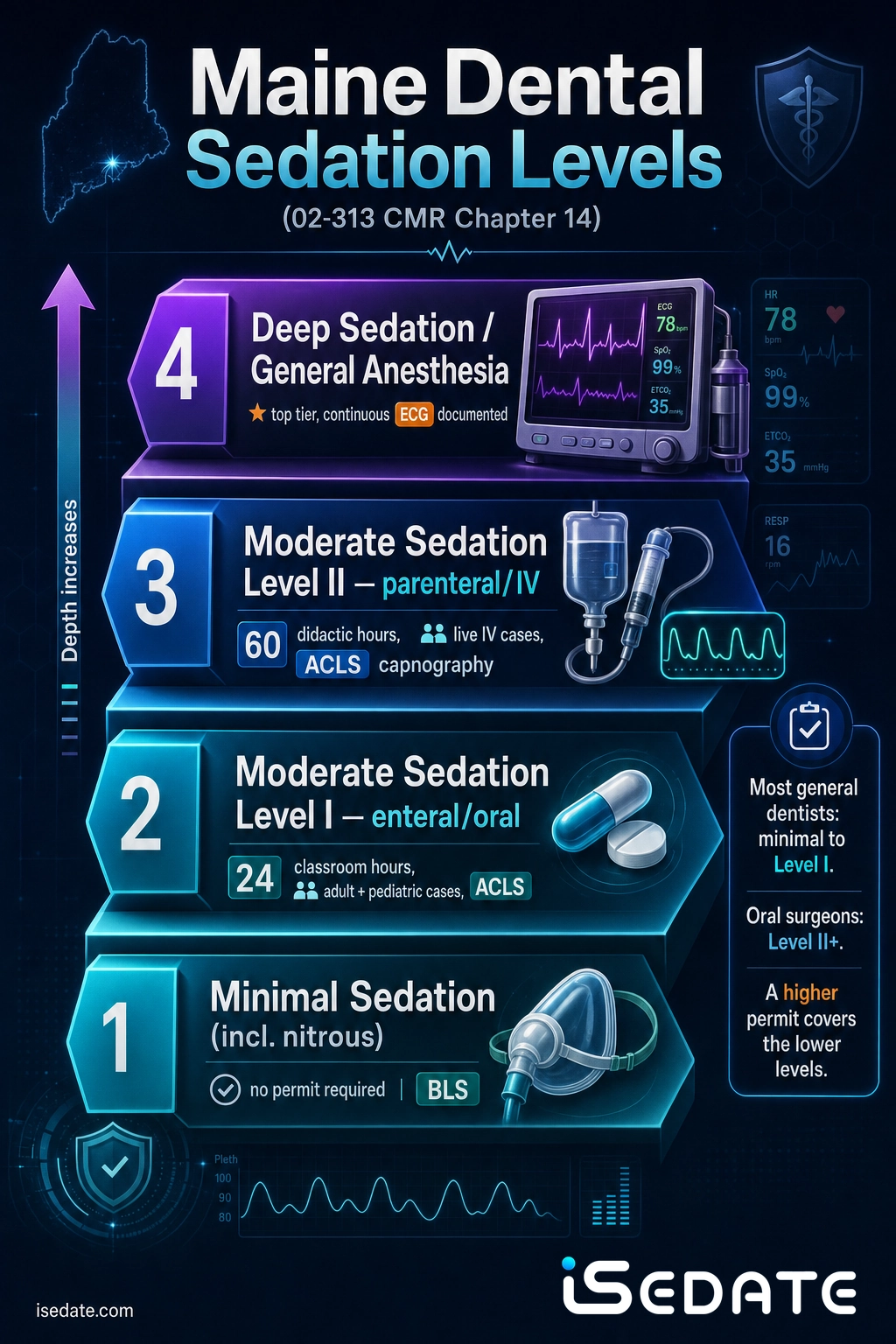
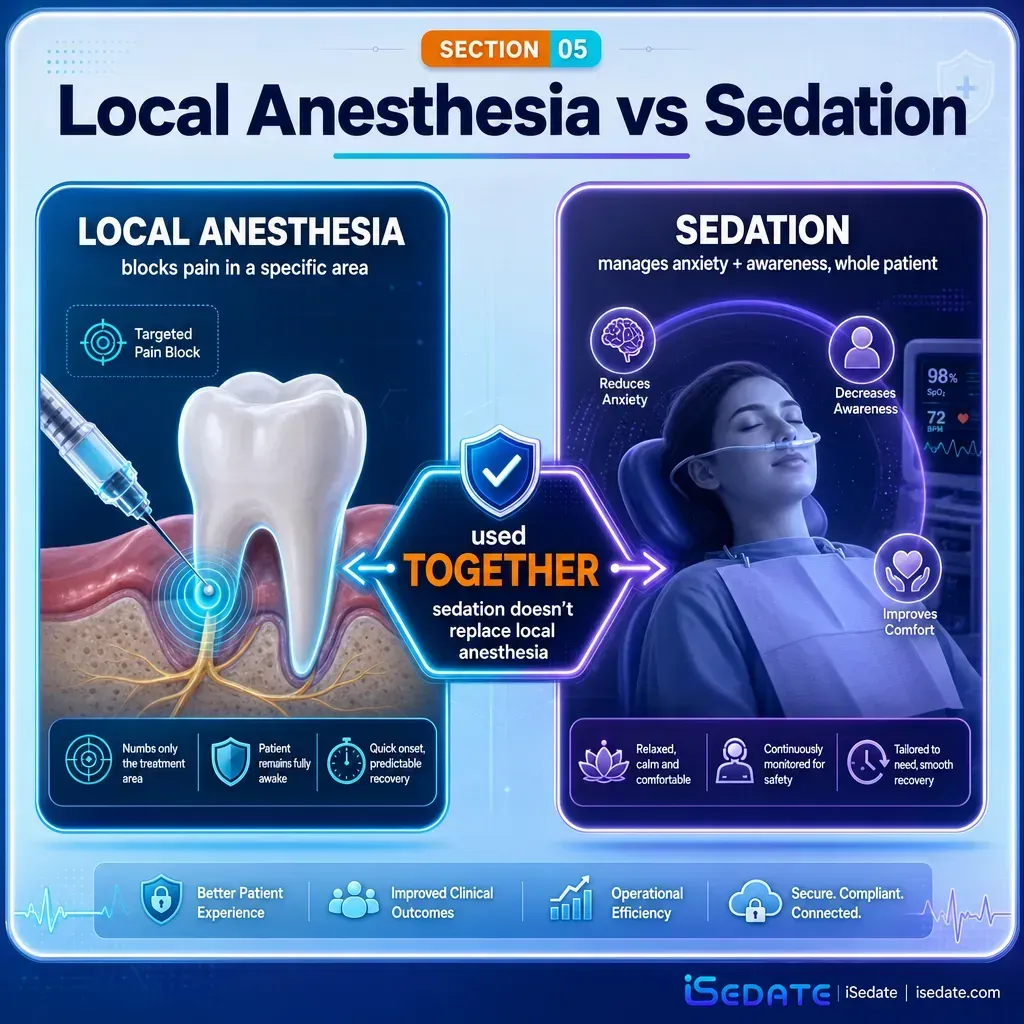
Minimal sedation (no permit required for most adults). Minimal sedation, including nitrous oxide and oxygen, is the lightest form of anxiety control, where the patient stays responsive and keeps their own airway. Maine does not require a sedation permit at this level for most adult patients, though the Board expects basic life-support (BLS) readiness appropriate to the care.
Moderate Sedation Level I, Enteral (MSE). Authorizes moderate Conscious Sedation by the enteral route, meaning oral or other non-injection routes. The patient responds purposefully to verbal or tactile stimulation and maintains their own airway. This is the workhorse permit for general dentists who provide real oral Conscious Sedation.
Moderate Sedation Level II, Parenteral (MSP). Authorizes moderate sedation that includes the parenteral route: IV sedation and other injected routes. Because IV sedation carries faster onset and higher risk, Level II sits above Level I and carries heavier training, monitoring, and equipment requirements, including end-tidal carbon dioxide (capnography) monitoring. This is where oral surgeons and sedation-trained dentists typically operate.
Deep Sedation or General Anesthesia (DSA). The top tier. It authorizes deep sedation and general anesthesia, where the patient is not easily aroused or is unconscious and may need airway support. Chapter 14 requires continuous electrocardiograph monitoring documented for every case at this level and limits the dentist to one deeply sedated patient at a time. This permit is largely the province of dental anesthesiologists and oral and maxillofacial surgeons, so a general dentist should treat it as out of scope and work directly from Chapter 14 with the Board if pursuing it. Maine also issues an itinerant deep sedation/GA permit for a traveling provider who sedates in another dentist's office under a written agreement.
Myth, Busted
Myth: Nitrous oxide and minimal sedation never require a permit in Maine, so a pediatric case is always fine on your dental license.
Fact: Under 02-313 CMR Chapter 14, a dentist who gives minimal sedation to a patient age 12 or under must first hold a Moderate Sedation permit if they prescribe a preoperative sedative or combine methods, such as an oral sedative plus nitrous oxide.
Pediatric patients reach moderate sedation at lower doses and drug combinations, which is why Maine pulls these cases up a level. Confirm how the provision applies to your sedation protocol with the Board.
One feature of Maine's structure is worth knowing: the levels nest. A Level II (Parenteral) permit holder may also perform Level I (Enteral) and minimal sedation, and a Deep Sedation/General Anesthesia permit holder may perform all the lower levels. The higher the permit you hold, the wider the range of sedation you are authorized to provide. Every permit is also non-transferable and site-specific, so a separate application is required for each practice location.
Source: Maine Board of Dental Practice license and permit types | 02-313 CMR Chapter 14 (levels and scope)
How to get or upgrade each permit
Each permit has its own bar to clear: documented education and training, life-support certification, and, for moderate sedation, a count of managed clinical cases. You move up the ladder by meeting the next level's requirements, obtaining Board approval for the course and live-patient experiences, and applying. The figures in the table below reflect the training pathway reported by sedation course providers for Maine's levels; the Board sets the binding requirements, so confirm every number with it before you rely on it.
| Level (code) | Route / depth | Reported training | Reported live patients | Life support |
|---|---|---|---|---|
| Minimal Sedation | Nitrous / minimal, lightest | No permit; course per ADA guidance | Not applicable | BLS |
| Moderate Level I (MSE) | Enteral (oral) only | ~24 classroom hours | 10 adult cases (3 live) + 4 live pediatric | ACLS |
| Moderate Level II (MSP) | Parenteral / IV | ~60 didactic hours | 20 live adult IV cases + 4 live pediatric | ACLS; capnography required |
| Deep Sedation / GA (DSA) | Deep sedation / general anesthesia | CODA-accredited program (confirm with Board) | See Chapter 14 | BLS, ACLS, PALS for pediatric; continuous ECG documented |
Minimal sedation
For most adult patients, the lightest tier needs no sedation permit in Maine, nitrous oxide included. The Board frames life-support readiness through its emergency and personnel standards, with BLS appropriate at the minimal and nitrous level. This is the most accessible entry point for a general practice adding light anxiety control, subject to the pediatric exception above.
Level I (MSE): oral Conscious Sedation
To hold a Moderate Sedation Level I (Enteral) permit, the reported pathway is roughly 24 hours of instructive classroom training, a set of adult case experiences including live cases, live pediatric experience, and current ACLS, with Board approval before the course and before the live-patient experiences. You take the required coursework through an approved sedation CE provider, such as a continuing-education course mapped to Maine's requirements, then document the training and clinical experience on the Board's supervised-clinical-experience registration form. This permit lets you provide genuine oral Conscious Sedation but stops short of the IV route.
Level II (MSP): adding IV sedation
Upgrading to a Moderate Sedation Level II (Parenteral) permit is the biggest step a general dentist or oral surgeon takes. The reported pathway is a 60-hour didactic course, a larger set of live adult IV cases and live pediatric cases, current ACLS, and an end-tidal carbon dioxide (capnography) monitor. The live clinical requirement climbs because IV titration demands hands-on competence a classroom cannot replicate.
What every applicant submits
Across all three permit types, the Board's license-types page lists a common core: documentation of your education and training, documented proof of life-support certification, and a signed certification form attesting to the required equipment, personnel, procedures, techniques, and documents. Maine also requires a criminal history records check for all applicants. Payment is by check or money order to the Treasurer, State of Maine, or by credit card with the authorization form. Faxed applications are not accepted; approved permits are emailed to the address on your application.
For every level, the application, the current fee schedule, the exact training hours and case counts, and any exam requirement are set by the Board and updated periodically. Do not rely on a number you read on a course provider's page. Confirm the exact forms and current requirements on the Maine Board of Dental Practice Applications and Forms page before you file.
Source: Maine Board of Dental Practice license and permit types | Applications and Forms

What the permit requires you to monitor
A permit is permission plus obligation. Once you hold a moderate sedation permit, Chapter 14 sets the monitoring standard you must meet for every case, and it escalates with depth:
- Consciousness: for moderate sedation, continuous monitoring of the patient's level of consciousness.
- Oxygenation: continuous oxygen saturation by pulse oximetry at every permitted level.
- Ventilation: continuous respiratory status, with end-tidal carbon dioxide (capnography) monitoring at moderate sedation and above.
- Circulation: continuous heart rate and intermittent blood pressure taken at least every 5 minutes, with continuous ECG for moderate patients who have significant cardiovascular disease and for all deep sedation or general anesthesia cases.
The jump from Level I (Enteral) to Level II (Parenteral/IV) and up to deep sedation is where the monitoring load increases: capnography becomes required and continuous ECG moves from conditional to mandatory. For the full clinical breakdown of what to monitor and chart at each depth, see our companion guide on Maine sedation vitals monitoring, charting, and reporting requirements.
Source: 02-313 CMR Chapter 14 (patient monitoring)
Reporting obligations tied to your permit
Holding a permit also means holding a set of documentation duties, and these are exactly what a Board review examines.
The time-oriented anesthesia record
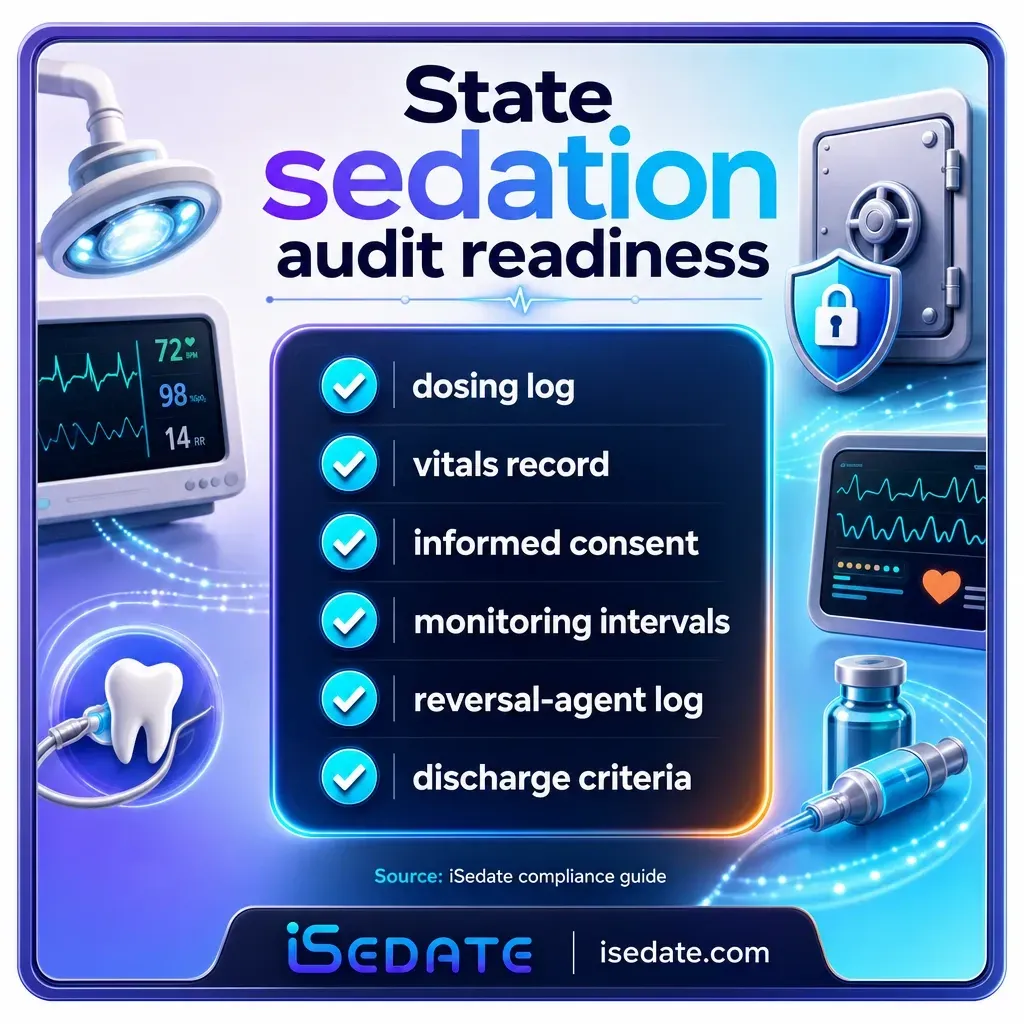
For moderate sedation, deep sedation, or general anesthesia, Chapter 14 requires a time-oriented anesthesia record. It must include the times anesthesia commenced and ended, each drug or anesthetic agent (including oxygen) with its dosage, route, and time given, and blood pressure, heart rate, oxygen saturation, and respiratory rate recorded at least every 5 minutes.
Baseline exam and discharge documentation
Before anesthesia, the dentist must document a physical examination with an airway assessment and baseline heart rate, blood pressure, respiratory rate, and oxygen saturation. At the end, the condition of the patient at discharge must be charted with objective data or a scale such as the Modified Aldrete scoring system, not a subjective note. Emergency-protocol training records must also be maintained and available for inspection, and the Board may deny or refuse to renew a permit and take disciplinary action under the Maine Dental Practice Act for rule violations.
Source: 02-313 CMR Chapter 14 (records and enforcement)
Renewal and continuing education
Your sedation permit is tied to your Maine dental license and renews on the same two-year cycle. Under Chapter 14, renewal requires an attestation of continued compliance with the equipment, personnel, and procedure standards in the ADA sedation guidelines, plus current life-support certification appropriate to your level (BLS for minimal and nitrous, ACLS for moderate, deep, and general anesthesia, and PALS where pediatric deep sedation applies). The Board allows a late renewal up to 90 days after expiration with a late fee; after 90 days, a separate reinstatement application is required.
iSedate Renewal Tip
Keep your life-support cards and sedation CE in one file that matches your dental-license renewal date. The specific continuing-education hours sit in the Board's Chapter 13 rules and are updated periodically, so confirm your current CE count and renewal cycle with the Maine Board of Dental Practice rather than relying on a third-party figure, and renew online early. Online submission does not automatically renew a license, so watch for the Board's confirmation.
Inspections and record reviews
This is where a permit is kept or lost. Maine builds the inspection right into the permit itself. Under Chapter 14, by obtaining a sedation permit (or filing a sedation-provider notification), a dentist agrees to allow the Board or its agents access to the dental practice to inspect and evaluate the equipment, personnel, procedures, techniques, and documents, to ensure they comply with the ADA sedation guidelines and the chapter. The Board may perform a quality-assurance review at its discretion.
When a reviewer opens your file, they are checking the record, not your intentions. A Board review turns on whether your time-oriented anesthesia record is complete, contemporaneous, and intervaled correctly, with the drug log, the 5-minute vitals, and the discharge score all present. The sedation can be flawless and the permit can still be challenged if the paperwork has holes.
Source: 02-313 CMR Chapter 14 (Board inspection and access)
Keeping the permit: audit-ready records
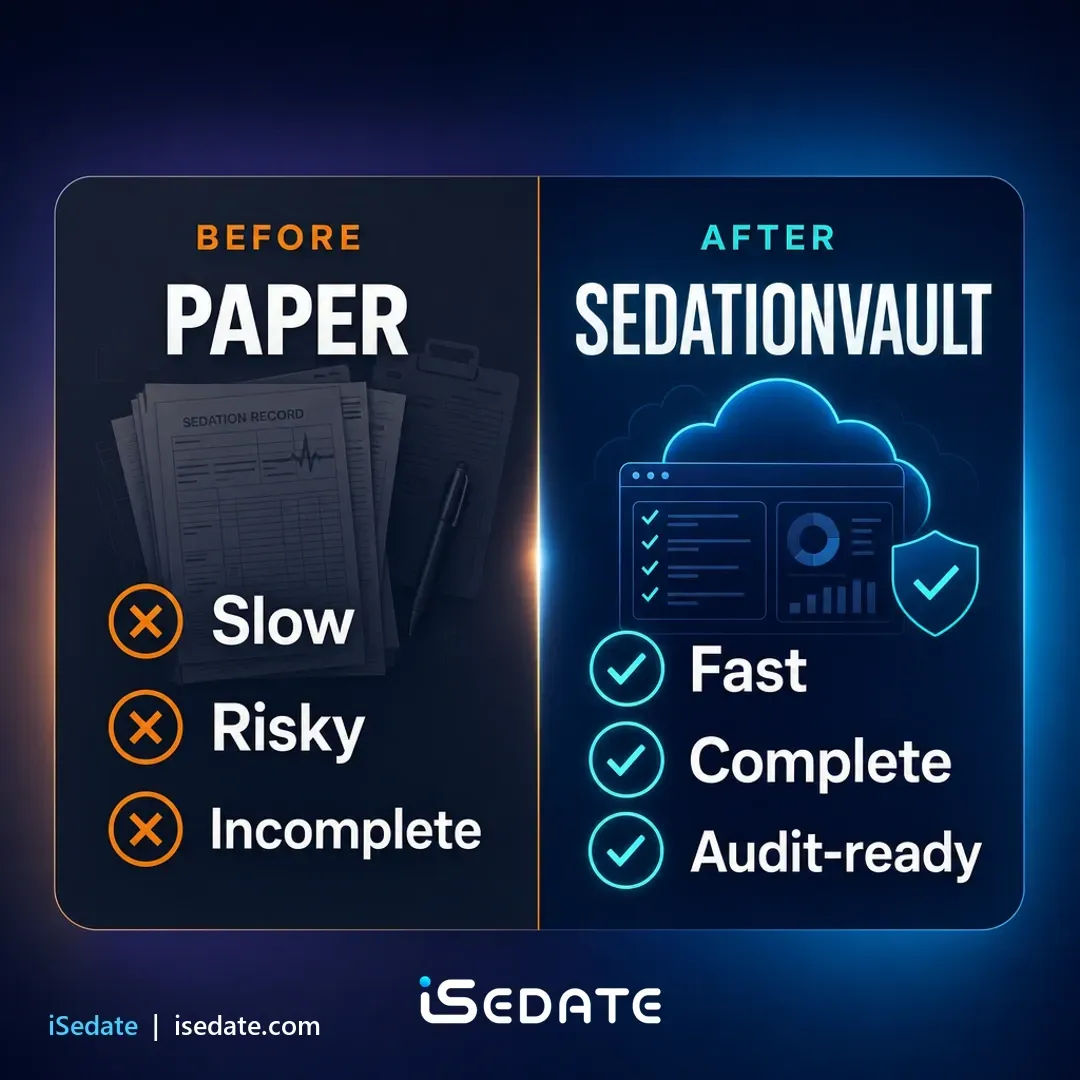
Everything above points to one truth: getting the permit is a one-time hurdle, but keeping it is a daily documentation discipline. A vitals log written by hand every few minutes, between titrating a drug and watching an airway, is exactly where records go incomplete, and incomplete records are what a Board inspection and a malpractice claim both attack. Maine's 5-minute interval leaves even less slack than states that allow 10.
SedationVault removes that failure point. It captures live patient vitals and the drug log automatically into a time-oriented, Maine-compliant anesthesia record, holding the 5-minute interval that Chapter 14 demands, so the record writes itself while you focus on the patient. When the Board asks for the file, a complete record is a one-click export, not a scramble through paper. See how it maps to Maine's rules on our dental sedation compliance and anesthesia record software pages.
Book a demo of SedationVault See SedationVault pricingFrequently asked questions
What sedation permits does Maine offer?
What is required to get an IV sedation permit in Maine?
How much does a Maine dental sedation permit cost, and how often do you renew it?
Does minimal sedation or nitrous oxide ever need a permit in Maine?
Is a Maine sedation permit transferable between offices?
Related guides and neighboring states
What to Read Next
Licensed, or planning to be, in a neighboring state? Compare the rules next door, and use the national overview to see how Maine stacks up:
Sources & How We Verified This Guide
- Maine Board of Dental Practice, License and Permit Types (permit codes, eligibility, renewal, contact)
- Maine Board of Dental Practice, Applications and Forms (sedation applications, checklists, certification forms)
- Maine Revised Statutes, Title 32, Section 18379: Sedation and general anesthesia permits
- 02-313 CMR Chapter 14: Rules for Use of Sedation and General Anesthesia (official Maine Secretary of State text)
This guide summarizes Maine sedation permit rules for general information and is not legal advice. The permit levels and codes, scope ladder, non-transferable and site-specific framing, two-year renewal, criminal history records check, monitoring parameters, time-oriented anesthesia record, 5-minute vitals interval, discharge-score requirement, pediatric (age 12 and under) provision, and Board inspection access are drawn from the Maine Board of Dental Practice's own pages, Title 32 Section 18379, and 02-313 CMR Chapter 14 as cited. The specific training hours and live-patient counts reflect the training pathway reported by course providers and, along with current application forms, the permit fee schedule, exact continuing-education hours, and the deep sedation or general anesthesia training specifics, are set by the Maine Board of Dental Practice and should be confirmed directly with the Board (phone 207-287-3333; [email protected]) before you act.