






New Hampshire Sedation Dentistry Licensing & Permit Requirements
In New Hampshire, your dental license alone does not let you sedate a patient. Before the first dose of moderate (conscious) sedation, deep sedation, or general anesthesia, a dentist must hold the matching permit from the New Hampshire Board of Dental Examiners, issued under N.H. Administrative Code Part Den 304. Getting the permit means meeting training, certification, and clinical-case requirements for your depth of sedation and passing a facility inspection. Keeping it means your sedation records survive a board review. This guide walks both halves: how a New Hampshire dentist earns a sedation or anesthesia permit, and what it takes to keep it.
Recent Updates
Last UpdatedNovember 16, 2026
- Re-verified every rule citation against New Hampshire's own administrative-rules text (Den 100-500) after the August 3, 2025 reorganization of Part Den 304.
- Replaced third-party legal-aggregator citations with the state's official rules source and the Board of Dental Examiners' own pages.
- Added the current permit categories defined in the amended rule, including the moderate sedation permit with pediatric qualification and the facility permit.
Key Takeaways
- New Hampshire licenses sedation by depth, not just the drug or route, under Part Den 304, which was amended and reorganized effective August 3, 2025.
- The current rule defines a general anesthesia / deep sedation / moderate sedation permit, a moderate sedation only permit (13 and older), a moderate sedation with pediatric qualification permit, and a pediatric minimal sedation permit, plus a separate path for a licensed anesthesiologist or CRNA.
- Moderate (Conscious) Sedation commonly requires a formal course, supervised live clinical cases, and current ACLS; confirm the exact hours with the board, since the education rules changed in the 2025 amendment.
- For sedation, a time-oriented anesthesia record is required under Den 304.09(a)(2), with monitoring standards at Den 304.08(a) and morbidity and mortality reporting at Den 304.13.
- The board can inspect your facility and review your sedation records, and incomplete records are where permits get challenged.

What This Guide Covers
- Who issues sedation permits in New Hampshire
- The New Hampshire permit tiers
- How to get or upgrade each permit
- What the permit requires you to monitor
- Reporting obligations tied to your permit
- CE and renewal
- Inspections and record reviews
- Keeping the permit: audit-ready records
- Frequently asked questions
- Sources
Who issues sedation permits in New Hampshire
Sedation dentistry in New Hampshire is regulated by the New Hampshire Board of Dental Examiners, administered under the state's Office of Professional Licensure and Certification (OPLC). The board, not any national body, decides who may sedate, inspects the facilities where sedation happens, reviews the records, and takes disciplinary action. The rules live in N.H. Administrative Code Part Den 304, "Use of General Anesthesia and Sedation by Dentists," and every requirement below traces to that part as amended and reorganized effective August 3, 2025.
Myth, Busted
Myth: If you only use nitrous oxide or a light oral pill, New Hampshire has nothing to say about it.
Fact: New Hampshire regulates sedation by depth of sedation. Moderate (conscious) sedation requires a permit, and the current rule even defines a pediatric minimal sedation permit, so your obligations depend on how deep you take the patient and how old that patient is.
The safest read is to match your permit to the deepest sedation you intend to provide and the youngest patient you intend to treat, then confirm the current requirement with the board.
Important
The ADA writes the standard; the board writes the law. The American Dental Association publishes sedation guidelines that New Hampshire and most states lean on, but the ADA is a professional association, not a government agency, and its guidelines are not federal law. New Hampshire gives the 2016 ADA guidelines legal force only because its own rule incorporates them by reference at Den 304.08(a). The ADA does not license you, inspect you, or discipline you. The federal layers that do apply to your drugs and data are the DEA (controlled-substance logs), HIPAA, and any payer or accreditation body you opt into, such as CMS or The Joint Commission. Your permit, your inspection, and your sanctions all come from the New Hampshire Board of Dental Examiners under Part Den 304.
To apply for a permit, you work through the board's own application process under the OPLC. Application forms, the current fee schedule, and the board's direct contact details are set by the board and change periodically, so confirm the exact forms and current fees with the Board of Dental Examiners before you file.
Source: New Hampshire Board of Dental Examiners (OPLC) | N.H. Admin. Code Part Den 304 (official rules)
The New Hampshire permit tiers
New Hampshire organizes its sedation permits by the depth of sedation the dentist is authorized to provide, not just the drug or the route. Here is the ladder, from lightest to deepest, with the part of the rule that governs each level.
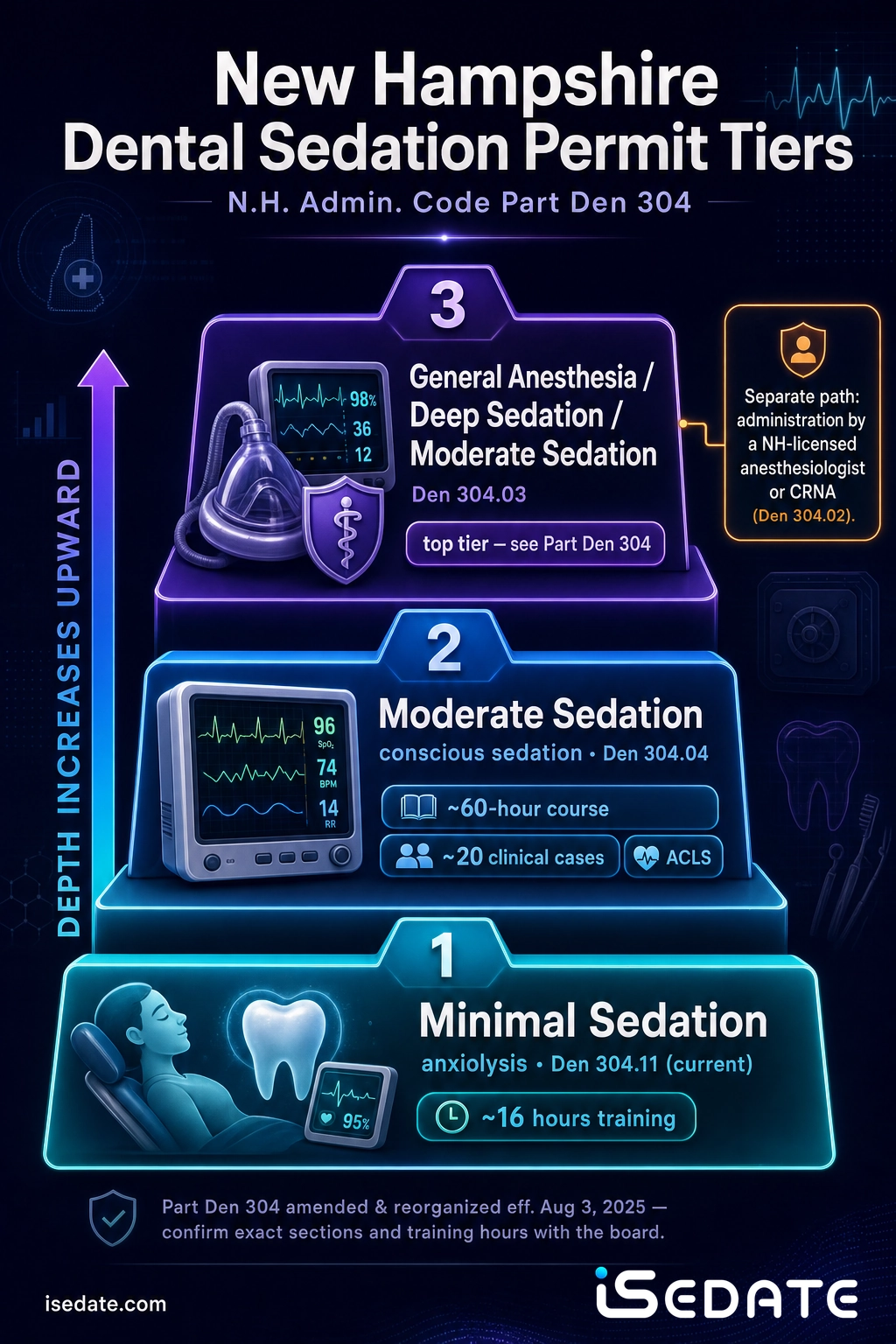
Minimal sedation (anxiolysis). A light oral or nitrous regimen where the patient responds normally to verbal command and airway and cardiovascular function are unaffected. New Hampshire has historically not required a permit for adult minimal sedation, and in the current reorganized rule minimal sedation sits at Den 304.11. The amended rule does define a separate pediatric minimal sedation permit for minimal sedation of patients under 13, so confirm the current requirement for the ages you treat.
Moderate sedation, or Conscious Sedation. Here the patient responds purposefully to verbal or tactile stimulation and keeps their own airway. This is the workhorse permit for a general practice that does real conscious sedation. The current rule distinguishes a moderate sedation only permit for patients 13 and older from a moderate sedation permit with pediatric qualification that extends to patients of all ages, so the permit you pursue depends on whether you sedate children.
General anesthesia and deep sedation. The top credential, where the patient is not easily aroused or is unconscious and may need airway support. New Hampshire packages this as a combined general anesthesia, deep sedation, and moderate sedation permit, and it carries the heaviest training, monitoring, and record requirements. This tier is largely the province of dental anesthesiologists and oral and maxillofacial surgeons, so for most general dentists it is out of scope.
Anesthesiologist or CRNA path. Separately, Part Den 304 provides for sedation or general anesthesia administered exclusively by a New Hampshire-licensed anesthesiologist or CRNA (Den 304.02), a common arrangement when a visiting anesthesia provider manages the airway while the dentist operates. The current rule also permits the facility itself, through a facility permit and a facility hosting arrangement, so the room where sedation happens is credentialed too.
Confirm the Section Numbers
Part Den 304 was reorganized when it was amended effective August 3, 2025, and several subsections moved. Minimal sedation, for example, is now at Den 304.11, and the monitoring and record rules sit at Den 304.08 and Den 304.09. Treat the permit categories above as stable, but confirm the exact current section that governs your tier against the current Part Den 304 rules before you rely on a specific citation.
Source: N.H. Admin. Code Part Den 304 (permit definitions, Den 304.01)
How to get or upgrade each permit
Each tier has its own bar to clear: a set amount of training, resuscitation certification, and, for moderate sedation, a count of supervised live clinical cases. You move up the ladder by meeting the next tier's requirements, passing a facility inspection, and applying to the board. The figures below are the ones commonly reported for New Hampshire, with an important caveat that follows the table.
| Permit tier | Depth | Training (commonly cited) | Live clinical cases | Resuscitation |
|---|---|---|---|---|
| Minimal sedation | Minimal / anxiolysis | About 16 hours of training | Not specified here | Confirm with board |
| Moderate (Conscious) Sedation | Moderate / conscious | About a 60-hour course | About 20 clinical cases | ACLS required |
| General anesthesia / deep sedation / moderate sedation | Deep sedation / general anesthesia | See Part Den 304 (confirm with board) | See Part Den 304 | ACLS required |
Confirm the Training Numbers
Treat the hours and case counts above as a starting point, not a final answer. They are the figures commonly reported for New Hampshire, but the sedation education requirements were exactly what the 2024 and 2025 rulemaking addressed, and Part Den 304 was amended effective August 3, 2025. The didactic hours, the clinical-case count, and how moderate and deeper training are bundled may have shifted in the current rule, so confirm the current hours, cases, and certifications directly with the New Hampshire Board of Dental Examiners.
The minimal sedation permit
Minimal sedation is the most accessible level and the usual first step for a general practice adding light oral or nitrous sedation. New Hampshire's commonly cited figure is roughly 16 hours of training. Because minimal sedation moved to Den 304.11 in the reorganized rule and the amended rule defines a dedicated pediatric minimal sedation permit, check that section for the current exact requirement and whether a permit applies to your patient ages.
The moderate sedation permit
Moderate sedation is the real jump. New Hampshire's commonly cited requirement is a formal didactic course reported at roughly 60 hours, supervised management of about 20 live clinical patients, and current ACLS certification. The live-patient requirement exists because titrating a patient to moderate sedation safely demands hands-on competence a classroom cannot replicate. If you treat children, the current rule routes you to the moderate sedation permit with pediatric qualification rather than the 13-and-older moderate sedation only permit.
Resuscitation Standard
The top-tier permit
The combined general anesthesia, deep sedation, and moderate sedation permit is the top credential and carries the heaviest training, monitoring, and record requirements. Its specifics run beyond the scope of this guide, so if you are pursuing it, work directly from Part Den 304 with the board.
Where to train and how to apply
Sedation training for the permit is completed through an approved course provider; a widely used option for the New Hampshire pathway is DOCS Education's New Hampshire sedation course, which maps its hours to the state's permit levels. Once you have the training and resuscitation certification, you apply to the board on the form for your permit type. The OPLC publishes a separate application for the general anesthesia and deep sedation permit, the moderate sedation (unrestricted) permit, and the moderate sedation (restricted) permit, and each permit is tied to a facility inspection. Inspection and evaluation fees apply and are set by the board, so do not rely on a number you read on a course provider's page. Confirm the exact forms and current fees with the New Hampshire Board of Dental Examiners before you file.
Source: N.H. Admin. Code Den 304.05 (application procedures and evaluations) | DOCS Education: New Hampshire sedation training

What the permit requires you to monitor
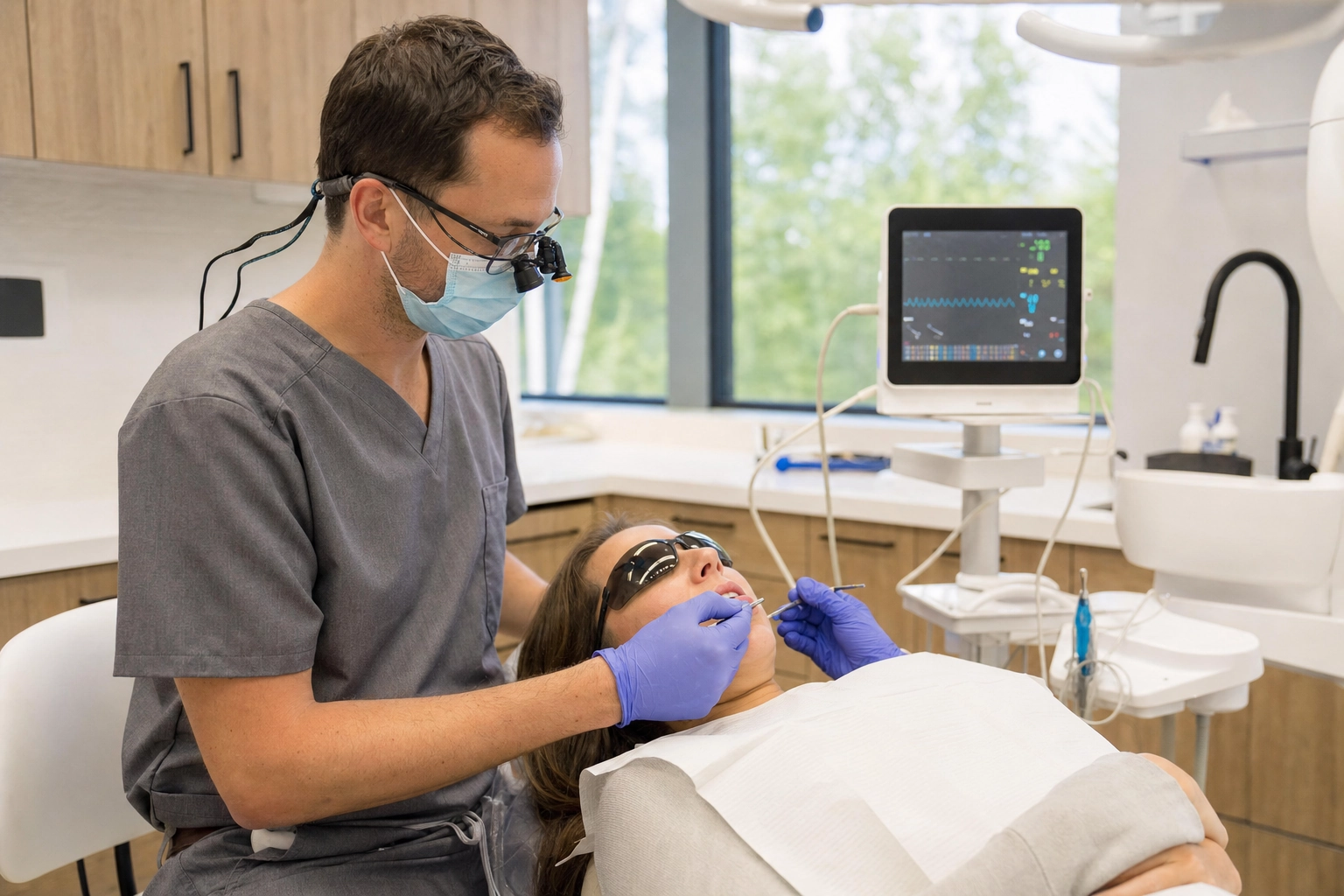
A permit is permission plus obligation. Once you hold a sedation permit, New Hampshire's monitoring standard applies through Den 304.08(a), which incorporates the 2016 ADA "Guidelines for the Use of Sedation and General Anesthesia by Dentists" by reference, along with the 2019 AAP guidelines for pediatric patients. Reading that together with the record rule, the dentist continually monitors four systems:
- Consciousness: the level of sedation and the patient's responsiveness, continually assessed.
- Oxygenation: oxygen saturation measured continuously by pulse oximetry, with skin and mucosal color observed.
- Ventilation: ventilation evaluated continually through chest excursion, auscultation, or capnography as the incorporated guideline provides.
- Circulation: blood pressure and heart rate evaluated continually, with electrocardiographic monitoring as the standard for deeper sedation.
Because Den 304.08(a) routes the clinical detail to the 2016 ADA guidelines, the exact parameters you record are the ones that guideline prescribes for the depth of sedation you provide. For the full clinical breakdown of what to monitor and chart at each depth, see the companion guide on New Hampshire Sedation Vitals Monitoring, Charting & Reporting Requirements, and the national overview in our hub, Sedation Dentistry Licensing & Permit Requirements by State.
Source: N.H. Admin. Code Den 304.08(a) (monitoring standards)
Reporting obligations tied to your permit
Holding a permit also means holding a set of documentation and reporting duties, and these are exactly what a board review examines.
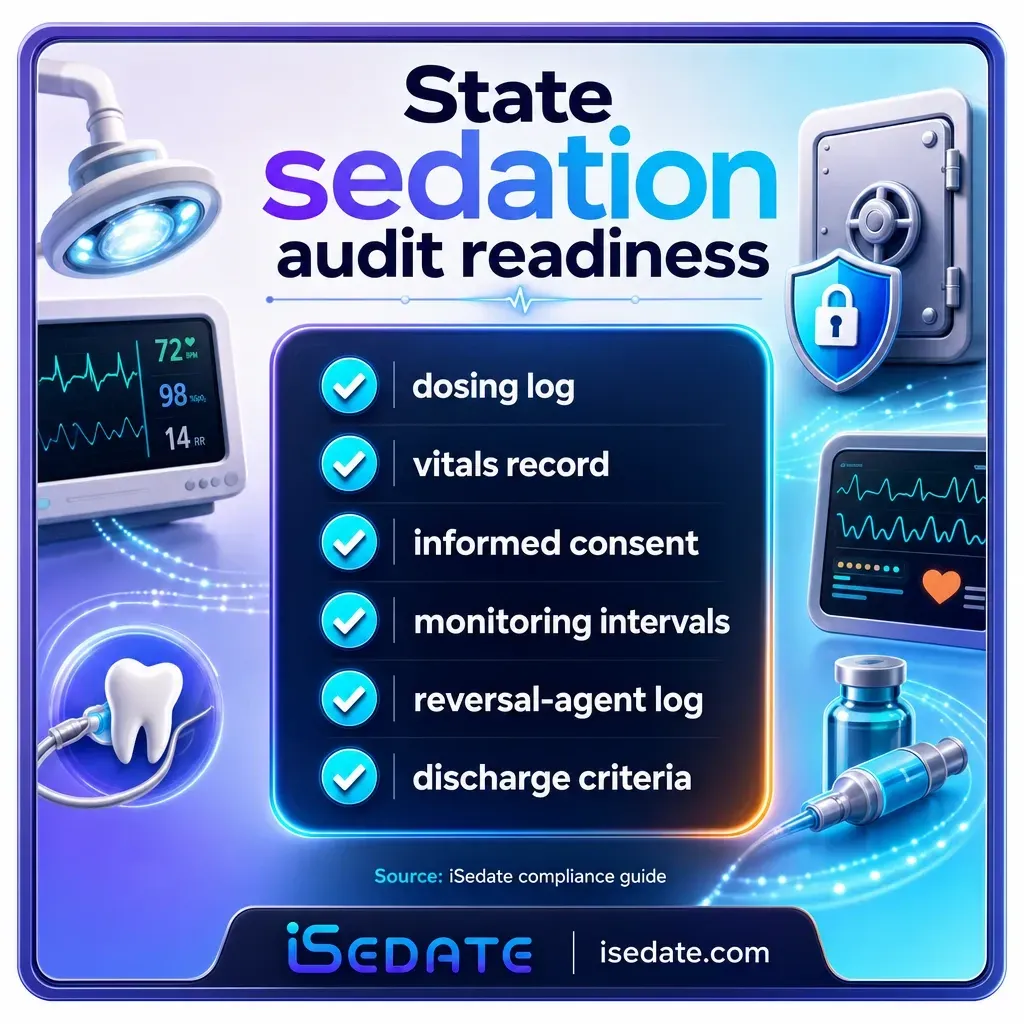
The anesthesia record. Under Den 304.09(a)(2), a written anesthesia record must be maintained for sedation and anesthesia. It must document the date of the procedure, the patient's NPO status, the availability of a responsible adult escort, time-oriented monitoring of oxygenation, ventilation, and circulation under Den 304.08(a), and every drug and dose administered with its administration time. Den 304.09(a)(3) also calls for an anesthetic emergency record.
What Your Record Must Capture
Morbidity and mortality reporting. Under Den 304.13, morbidity and mortality reports are required, so a serious adverse event connected to sedation triggers a reporting obligation to the board, and rule violations can lead to disciplinary action. The specific reporting triggers, the exact timeline for written notice, and the penalty schedule are set by the board, so confirm the current details directly with the New Hampshire Board of Dental Examiners.
Source: N.H. Admin. Code Den 304.09 (anesthesia record), Den 304.13 (morbidity and mortality reports)
CE and renewal
Your sedation permit is tied to your New Hampshire dental license, and the board expects permit holders to stay current in the resuscitation certifications and the sedation experience or continuing education appropriate to their tier. New Hampshire's renewal provision is commonly stated as documenting a number of sedation cases per year or a set number of hours of sedation continuing education per biennium; under the prior numbering this was stated as six cases per year or four hours of sedation CE per biennium. Because the exact current renewal cycle and CE hours are set by board rule and were affected by the August 3, 2025 reorganization, they are not reproduced here as a hard figure. Confirm your current renewal cycle, sedation CE hours, and resuscitation-certification requirements directly with the New Hampshire Board of Dental Examiners so your permit never lapses at renewal.
Inspections and record reviews
This is where a permit is kept or lost. The permits that authorize moderate and deeper sedation carry the heaviest scrutiny, because that is where the risk is. New Hampshire's rule gives the board authority to inspect sedation facilities and equipment and to evaluate treatment cases involving the deeper forms of pain and anxiety control, and the current rule even credentials the room itself through a facility permit. Permit application procedures and evaluations are governed by Den 304.05.
When a reviewer opens your file, they are checking the record, not your intentions. A board review turns on whether your time-oriented anesthesia record is complete, contemporaneous, and carries every element Den 304.09(a)(2) names. In other words, a dentist can perform the sedation correctly and still lose on the paperwork, which is the most avoidable way a permit gets challenged.
Source: N.H. Admin. Code Den 304.05 (application procedures and evaluations)
Keeping the permit: audit-ready records
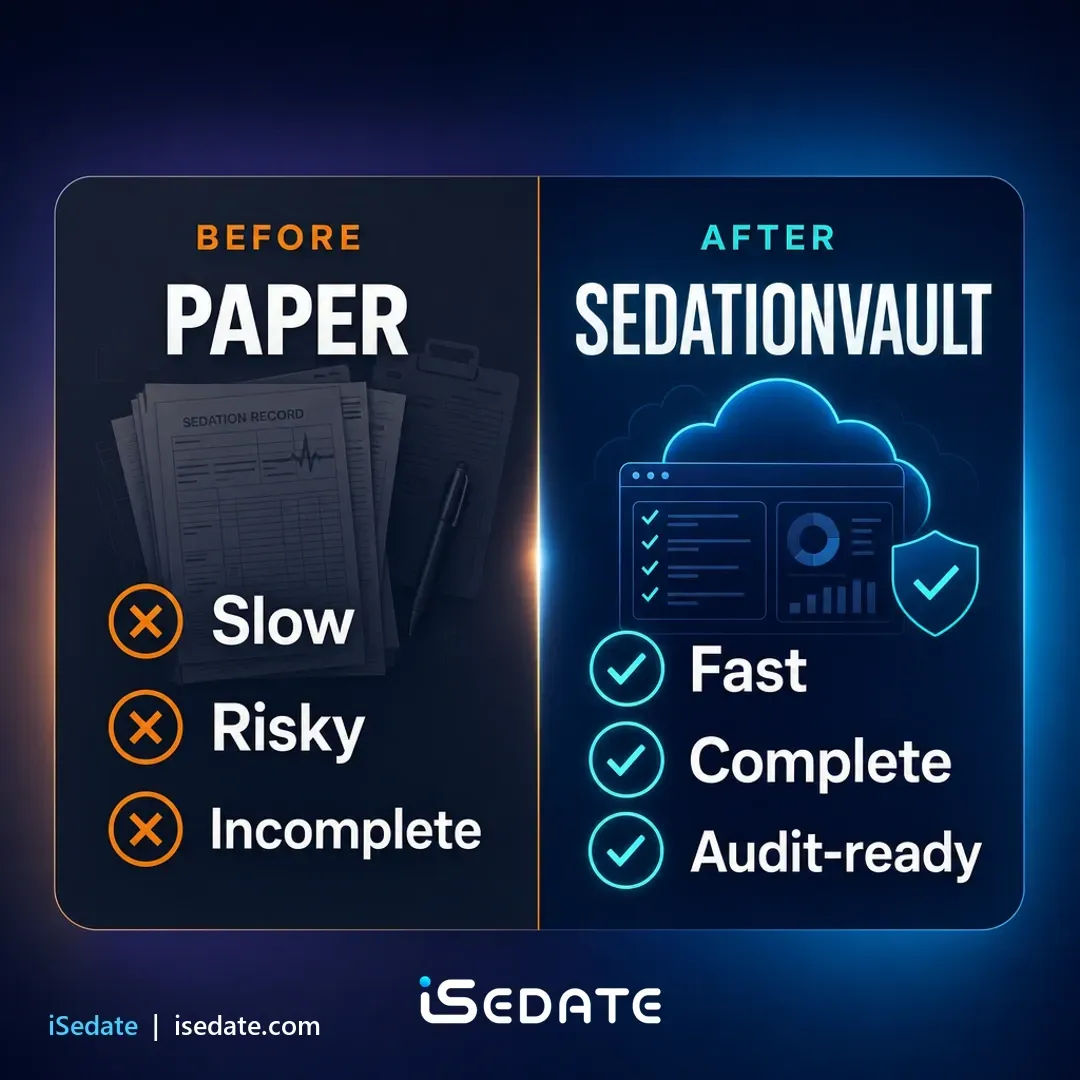
Everything above points to one truth: getting the permit is a one-time hurdle, but keeping it is a daily documentation discipline. A manual anesthesia record written by hand during a live case, between titrating a drug and watching an airway, is exactly where records go incomplete, and incomplete records are what a board review and a malpractice claim both attack.
SedationVault by iSedate removes that failure point. It captures live patient vitals and the drug log automatically into a time-oriented, New Hampshire-aligned anesthesia record that carries the oxygenation, ventilation, and circulation monitoring, the administration times, and the date, NPO, and escort fields that Den 304.09(a)(2) demands, so the record builds itself while you focus on the patient. When the board asks for the file, a complete record is a one-click export, not a scramble through paper. See how it maps to the rule on the dental sedation compliance and anesthesia record pages.
Book a Demo of SedationVault See SedationVault PricingNew Hampshire Sedation Permit Essentials
- Licensing body: New Hampshire Board of Dental Examiners (under the OPLC).
- Governing rule: N.H. Admin. Code Part Den 304, amended and reorganized effective August 3, 2025.
- Permits by depth: pediatric minimal sedation; moderate sedation only (13+); moderate sedation with pediatric qualification; combined general anesthesia / deep sedation / moderate sedation; plus the anesthesiologist or CRNA path (Den 304.02).
- Record rule: time-oriented anesthesia record, Den 304.09(a)(2); monitoring standard, Den 304.08(a).
- Reporting: morbidity and mortality reports, Den 304.13 (confirm the exact timeline with the board).
Frequently asked questions
What sedation permits does New Hampshire offer?
How much training do you need for a moderate sedation permit in New Hampshire?
Do you need a permit for minimal sedation in New Hampshire?
How do you apply for a New Hampshire sedation permit?
How do you renew a New Hampshire sedation permit?
What records must you keep for a sedated patient in New Hampshire?
Related guides and neighboring states
Licensed in a neighboring state, or building a multi-state sedation practice? Sedation permit rules change at every border, so start from the guide for your state:
- Massachusetts Sedation Dentistry Licensing & Permit Requirements
- Maine Sedation Dentistry Licensing & Permit Requirements
- Vermont Sedation Dentistry Licensing & Permit Requirements
- Sedation Dentistry Licensing & Permit Requirements by State (all 50 states)
Sources
Sources and Fact-Checking
- N.H. Admin. Code, Den 100-500 (current official rules): Part Den 304, including Den 304.01 permit definitions, Den 304.05 application procedures, Den 304.08 monitoring standards, Den 304.09 anesthesia record, Den 304.11 minimal sedation, and Den 304.13 morbidity and mortality reports
- New Hampshire Board of Dental Examiners (Office of Professional Licensure and Certification): applications, permits, and facility inspections
- OPLC dental moderate sedation (unrestricted) permit application and moderate sedation (restricted) permit application
- DOCS Education: New Hampshire sedation training pathway and commonly cited training hours
This guide summarizes New Hampshire sedation permit rules for general information and is not legal advice. The permit categories, the record rule (Den 304.09), the monitoring standard (Den 304.08(a), incorporating the 2016 ADA guidelines and 2019 AAP guidelines), and morbidity and mortality reporting (Den 304.13) are drawn from Part Den 304 as amended effective August 3, 2025. Training hours, clinical-case counts, resuscitation requirements, application forms, fees, the routine inspection schedule, the renewal cycle, continuing-education hours, the exact penalty and reporting timelines, and the board's direct contact details are set by the New Hampshire Board of Dental Examiners, were affected by the recent reorganization, and should be confirmed directly with the board before you act.