






Healthcare Compliance Software Market Statistics (2026): Market Size, Cloud Shift & the Automation Wave
The global healthcare compliance software market is worth roughly USD 3 to 5 billion and growing near 13% a year, faster than most healthcare software categories. Behind that growth is a single shift: compliance is moving from a manual, checklist chore to an automated, audit-ready system. For sedation providers, whose records face the sharpest scrutiny in the building, that shift is not abstract, it is the direction their own documentation is heading.
- The global healthcare compliance software market is roughly USD 3 to 5 billion in 2024 to 2025, growing at about 11 to 13% CAGR (Precedence; TBRC; Verified Market Research; Mordor Intelligence).
- The U.S. market is estimated near USD 1.38 billion in 2025, projected to reach about USD 4.9 billion by 2035 (Precedence Research).
- Cloud-based deployment holds roughly 52 to 56% of the market and grows fastest, at 15 to 17% CAGR (Precedence; Mordor).
- Hospitals hold roughly 59 to 67% of the market, but specialty and outpatient clinics are the fastest-growing segment (Precedence; Mordor).
- Policy and procedure management is the largest category at about 23 to 25% of the market (Precedence; Mordor).
- Roughly 91% of U.S. hospitals now run portions of their infrastructure in the cloud (Mordor Intelligence).
- The shift from manual to automated compliance is the core growth driver, the same logic that turns a sedation record into a compliance system in iSedate's SedationVault.
What's in This Guide
1 Market Size: Reading Past the Outlier
Healthcare compliance software is the category of tools that help healthcare organizations meet regulatory, legal, and ethical mandates, HIPAA, OSHA, medical coding standards, accreditation requirements, by automating and centralizing the work. It is one of the faster-growing healthcare software categories, and unlike some markets, the credible estimates broadly agree.
Most analysts cluster the 2024-to-2025 global figure between roughly USD 3 billion and USD 5 billion: Precedence at USD 3.8 billion, TBRC at USD 3.22 billion, Verified Market Research at USD 3.14 billion, Mordor at USD 3.92 billion, and others near USD 4.8 billion. That is unusually tight agreement for a market-size question, which makes the one outlier worth naming.
One figure to disregard. A single widely circulated report places this market at USD 21.15 billion, roughly five times the consensus of every other analyst. When one estimate sits that far outside a tight cluster, it usually reflects a broader category definition or an error, not a better measurement. We use the consensus range (USD 3 to 5 billion) and flag the outlier rather than average it in. As always, read the definition behind the number.
Source: Precedence Research healthcare compliance software market | Verified Market Research
See sedation compliance in SedationVault2 Why It's Growing: Manual to Automated
The core growth driver is a single transition: healthcare organizations are abandoning manual compliance methods for automated software. The reasons are structural and permanent.
When data volume grows more than fivefold in seven years, manual compliance simply cannot keep up. Layer on stricter enforcement, HIPAA, HITECH, the False Claims Act, escalating breach risk, and board-level scrutiny of fraud and waste, and automated compliance stops being optional. The reframing that market analysts emphasize is important: compliance platforms are increasingly treated as strategic risk-mitigation tools rather than regulatory checklists.
iSedate Analysis: The reframe that matters for sedation
"Compliance as risk mitigation, not a checklist" is exactly how sedation documentation should be understood. A sedation record filled out to satisfy a rule is a checklist. A sedation record built to prove, on demand, that vitals were monitored, drugs were logged, and emergency equipment was checked is risk mitigation, the difference a malpractice carrier or licensing board cares about. The healthcare compliance software market is growing because the industry is making this exact mental shift, and sedation is one of the settings where it matters most.
Calculation and interpretation original to iSedate.
Source: Mordor Intelligence on compliance automation drivers
See iSedate's SedationVault3 The Cloud Shift
As with dental and anesthesia software, deployment model is the clearest directional signal, and compliance software is going the same way: to the cloud.

Cloud is winning compliance for the same reasons it won charting: subscription pricing replaces capital expense, updates deploy without on-site IT, and, crucially for compliance specifically, when a regulation changes, providers receive the patch without downtime. Certified cloud providers are now explicitly recognized as able to meet HIPAA and GDPR security mandates, removing the last hesitation for compliance officers. A cloud-native, HIPAA-compliant sedation record sits squarely inside this trend rather than fighting it.
Source: Precedence Research deployment analysis | Mordor Intelligence cloud adoption data
See HIPAA-compliant cloud records4 Who's Buying: Hospitals to Clinics
The end-user data tells the same story every healthcare software category tells: hospitals lead, but the growth is moving toward smaller settings.

By category, policy and procedure management leads at roughly 23 to 25% of the market, with accreditation and audit tooling growing quickly. The pattern is by now familiar from earlier reports in this series: the technology matures in high-volume hospital settings, then diffuses outward and downward to specialty and outpatient clinics as cloud economics lower the cost of entry. Office-based sedation practices, dental and oral surgery, sit at the leading edge of that diffusion.
iSedate Analysis: Sedation is where compliance and specialty-clinic growth intersect
Two of this market's clearest trends point at the same place. Specialty and outpatient clinics are the fastest-growing end-user segment, and compliance is shifting from checklist to strategic system. Office-based sedation providers are specialty clinics with unusually high compliance stakes, boards and carriers examine their sedation records closely. They sit precisely where the market's fastest-growing customer segment meets its highest-stakes compliance need. A sedation platform built as a compliance system, not a chart, is the natural product of that intersection.
Calculation and interpretation original to iSedate.
Source: Mordor Intelligence end-user segmentation | Precedence Research category data
See SedationVault for oral surgeons5 What This Means for Sedation Compliance
Every trend in this market converges on a single conclusion for sedation providers: the record you keep is becoming a compliance instrument, and the tools to make it one are arriving.
Consider the alignment. The market is growing because manual compliance cannot handle modern data and scrutiny, and sedation is a high-scrutiny, time-intensive documentation task. Cloud is winning because it is cheaper, updatable, and HIPAA-certifiable, exactly what a small sedation practice needs. Specialty and outpatient clinics are the fastest-growing buyers, and office-based sedation is squarely in that segment. The healthcare compliance software market is not a distant enterprise category; it describes the pressures on a dental or oral surgery practice running sedation.
iSedate Analysis: A compliance system for the sedation visit
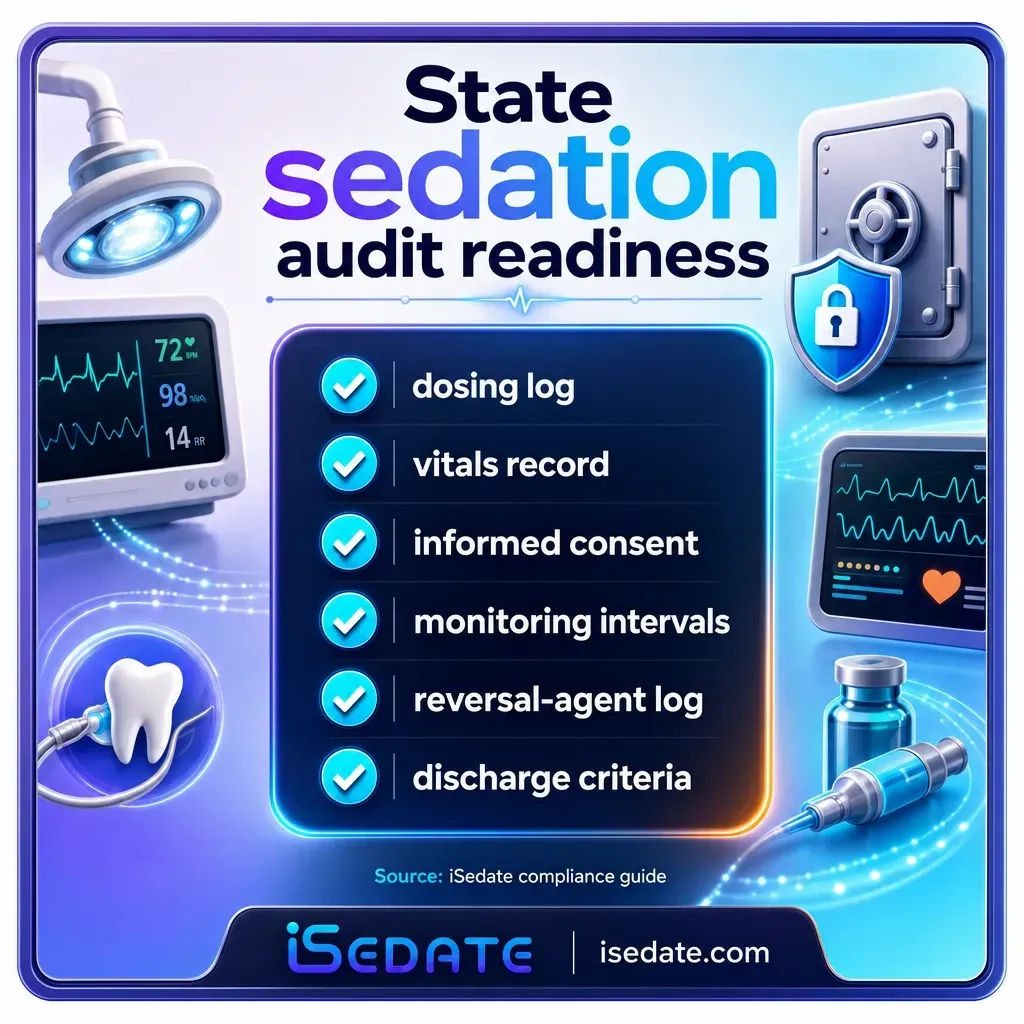
iSedate's SedationVault applies this market's logic to the sedation visit specifically. Rather than a chart that happens to be digital, it functions as a compliance system: it captures vitals automatically from compatible monitors such as Edan, MindRay, and Criticare, logs drug administration, tracks provider licenses and certifications, oversees emergency equipment, and produces audit-ready board reports, then exports a clean PDF into whatever record the practice already keeps, whether Dentrix, Eaglesoft, or Open Dental. It is cloud-native and HIPAA-compliant by design, matching the deployment model the broader compliance market has chosen. Reference figures for the founders' own practice reflect thousands of documented sedation procedures, a practice-level dataset, not a nationwide claim.
Calculation and interpretation original to iSedate.
Framed this way, a Sedation Intelligence System is what healthcare compliance software looks like when it is purpose-built for the sedation visit, provable safety rather than a filled-in form. As compliance automation moves from hospitals into specialty clinics, the sedation record is one of the places it lands with the most impact.
Source: Precedence Research market trends | Mordor Intelligence compliance-as-strategy analysis
Book a SedationVault demo6 Summary Table: Every Statistic at a Glance
| Statistic | Figure | Source | Year |
|---|---|---|---|
| Global healthcare compliance software market | ~USD 3.8B | Precedence Research | 2025 |
| Global market projection | ~USD 13.2B by 2035 | Precedence Research | 2035 |
| Global market CAGR | ~13% | Precedence Research | 2026-2035 |
| Analyst consensus range (2024-25) | ~USD 3-5B | Multiple firms | 2024-2025 |
| U.S. market size | ~USD 1.38B | Precedence Research | 2025 |
| U.S. market projection | ~USD 4.9B by 2035 | Precedence Research | 2035 |
| Cloud-based deployment share | ~52-56% | Precedence / Mordor | 2025 |
| Cloud segment CAGR | ~15-17% | Precedence / Mordor | 2026-2031 |
| U.S. hospitals using cloud infrastructure | ~91% | Mordor Intelligence | 2025 |
| Hospital share of market | ~59-67% | Precedence / Mordor | 2025 |
| Fastest-growing end-user segment | Specialty/outpatient clinics | Mordor Intelligence | 2025 |
| Largest category (policy & procedure mgmt) | ~23-25% | Precedence / Mordor | 2025 |
| Healthcare data volume by 2025 | ~175 zettabytes | IDC | 2025 |
| North America market share | ~45-52% | Precedence / Mordor | 2025 |
Frequently Asked Questions
How big is the healthcare compliance software market?
Why is healthcare compliance software growing so fast?
Is healthcare compliance software cloud-based?
Who uses healthcare compliance software the most?
Does compliance software apply to sedation and anesthesia?
Methodology & Sources
Market research sources: Precedence Research, The Business Research Company (TBRC), Verified Market Research, Mordor Intelligence, ConsAINSights, and Business Research Insights for market size, segmentation, and deployment data. Supporting data: IDC (healthcare data volume, cited via Mordor Intelligence).
Note on market-size figures: analyst estimates for the global healthcare compliance software market cluster tightly between roughly USD 3 billion and USD 5 billion for 2024 to 2025. One report (Market Research Future) cites approximately USD 21 billion, roughly five times the consensus; this figure is treated as an outlier and excluded from the stated range, likely reflecting a broader category definition. Segment shares vary modestly across firms and are presented as ranges where they differ. This article covers the broad healthcare compliance software market; for dental-specific software and record data, see the companion reports in this series. Statistics reflect the most recent available data as of 2026 and will be refreshed annually.
Media & press usage: Journalists and researchers are welcome to cite these statistics with attribution to iSedate and a link to this page. The iSedate Analysis boxes contain original interpretation unique to this article.