






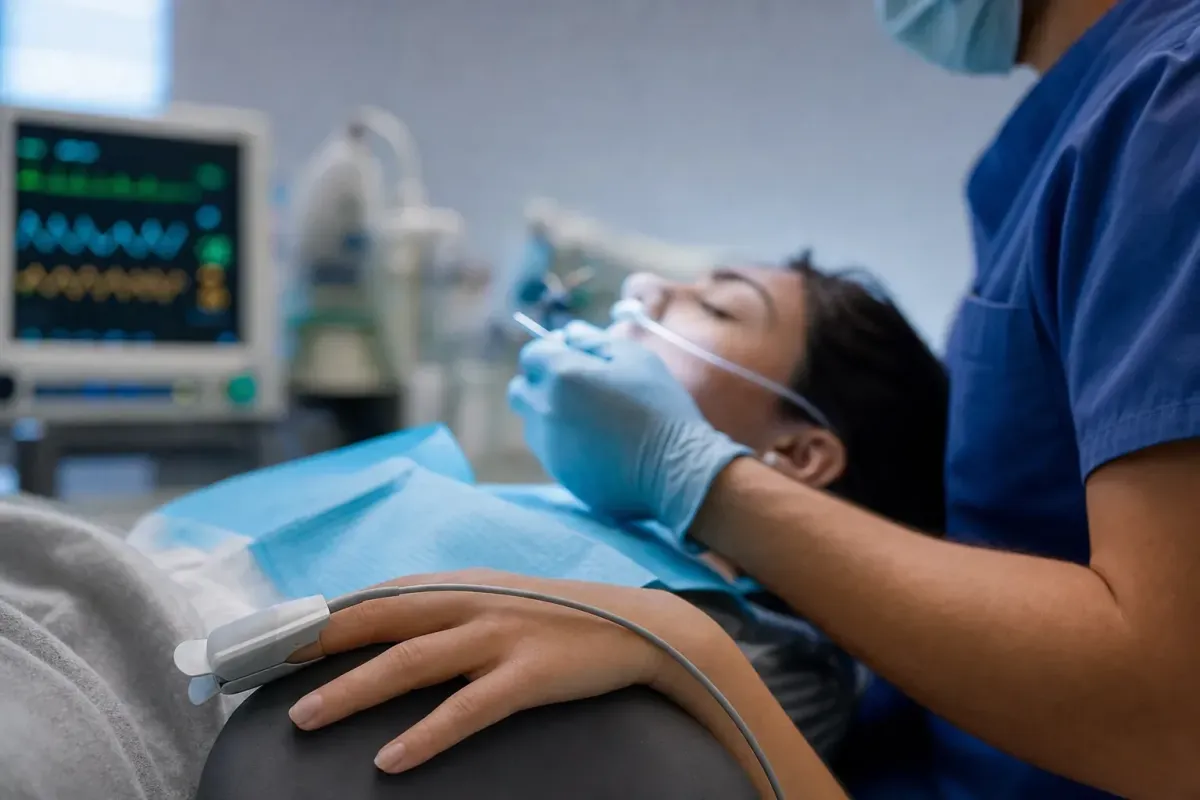
Hypoxia and Respiratory Depression Event Statistics (2026): What Sedation Data Shows
In a series of 2,221 moderate-sedation cases for periodontal and implant surgery, a hypoxemic event occurred in 5.3% of sedations and none required reversal, yet in higher-risk patients the rate can exceed 60%. Hypoxia and respiratory depression are the events most likely to turn a routine sedation into an emergency, and the data below shows how often they happen, what triggers them, and why detection method changes the numbers.
- In a 2,221-case periodontal and implant sedation series, at least one hypoxemic event (SpO2 at or below 90%) occurred in 5.3% of sedations, with no reversals needed.
- In higher-risk patients (deep IV sedation, intellectual disabilities), hypoxemic episodes occurred in 62% of patients, showing how sharply risk scales with patient selection.
- Older age and higher midazolam dose were significant predictors of hypoxemia; BMI did not reach significance in that series.
- Definitions vary: hypoxemia is defined anywhere from SpO2 below 90% to a conservative early-warning 94 to 95% threshold, which explains much of the variation between studies.
- Respiratory depression was 17.6 times more likely to be detected with capnography than without (Waugh et al. meta-analysis).
- Capnography monitoring lowered hypoxemia incidence (RR 0.76) and detected apnea far earlier (RR 2.60) across 14 RCTs of procedural IV sedation.
- The oxyhemoglobin curve is sigmoidal: once saturation reaches ~92%, it can fall very fast in an apneic or obstructed patient, which is why early warning matters.
What's in This Guide
01 How Often Hypoxemia Happens
The honest answer is that hypoxemia rates during sedation span a very wide range, and the range itself is the useful information. In healthy, well-selected patients undergoing moderate sedation, serious events are uncommon. In medically complex or deeply sedated patients, desaturation is far more frequent. A large retrospective series of 2,221 moderate-sedation cases for periodontal and dental implant surgery gives one of the cleanest office-relevant benchmarks.
That study concluded moderate sedation for periodontal and implant surgery is a safe intervention, with hypoxemic events that were both uncommon and manageable. Compare that to the other end of the spectrum: a study of deep intravenous sedation in patients with intellectual disabilities recorded more than one hypoxemic episode in 62% of patients. Same underlying event, very different populations, and the gap between 5.3% and 62% is almost entirely explained by sedation depth and patient risk profile.

Source: Journal of Dental Anesthesia and Pain Medicine (2,221 sedations) | Journal of Intellectual Disability Research (deep sedation study)
See IV sedation charting in SedationVault
02 Why the Numbers Disagree: Definitions
Before comparing any two hypoxemia statistics, you have to check how each study defined the event. There is no single universal threshold, and small changes in definition produce large changes in reported incidence. This is not a flaw in the research; it is a feature to understand when reading it.
A study using SpO2 at or below 90% sustained for two minutes will report far fewer events than one flagging any dip to 94%. In one dental IV sedation quality-assurance review of 3,500 cases, researchers defined safe saturation as 94% and higher precisely because it is hypoxemia that poses the greatest risk of morbidity or mortality in an otherwise healthy ASA I and II population, so a conservative threshold buys earlier warning. When a headline says "hypoxemia occurred in X% of cases," the threshold behind that X matters as much as the number itself.
Two studies can report wildly different hypoxemia rates for similar patients simply because one used a 90% threshold and the other used 94%, or because one required the drop to be sustained and the other counted transient dips. Always read the definition before comparing numbers. A higher reported rate under a conservative threshold can actually reflect safer, earlier-warning practice, not a more dangerous technique.

Source: Analysis of Oxygen Saturations in Dental IV Sedation, 3,500 cases (NCBI) | Hypoxemia During Procedural Sedation in Adults (NCBI)
See how SedationVault documents sedation compliance
03 What Drives the Risk
The risk factors for hypoxemia are consistent across the literature, and most are identifiable before a case begins. The 2,221-case periodontal series ran a logistic regression to isolate what actually predicted hypoxemia, and two variables stood out.
Older age and higher total midazolam dose both independently raised hypoxemia risk, while BMI did not reach statistical significance in that particular series, though obesity and obstructive sleep apnea are well-established risk factors elsewhere. The broader pattern is straightforward: anything that further depresses respiratory drive or compromises the airway raises the odds. That includes higher ASA physical status, multi-drug regimens, obesity, and sleep apnea. Because these factors are knowable in advance, they are exactly what a pre-sedation assessment is designed to surface.
The 2,221-case series identified both age (OR 1.022 per year) and total midazolam dose (OR 1.118 per unit) as independent predictors of hypoxemia. Read together, these are not either-or risks, they compound. An older patient receiving a higher titrated dose carries both elevated odds simultaneously, which is why the highest-risk populations in the literature (older, deeply sedated, medically complex) reach hypoxemia rates above 60% while healthy moderate-sedation patients stay near 5%.
Sources: Journal of Dental Anesthesia and Pain Medicine periodontal sedation series; Journal of Intellectual Disability Research deep-sedation study. Calculation and interpretation original to iSedate.

Source: Journal of Dental Anesthesia and Pain Medicine (predictors of hypoxemia)
See digital pre-sedation intake forms
04 Detection: Capnography vs Pulse Oximetry
How you monitor determines how much respiratory depression you actually see. Pulse oximetry has been the sedation standard for decades and reliably catches oxygen desaturation, but it is a lagging indicator: saturation falls only after ventilation has already been compromised for some time. Capnography measures exhaled CO2, so it reflects ventilation in real time and flags trouble earlier.
A systematic review and meta-analysis of 14 randomized trials of procedural IV sedation found that capnography monitoring lowered the incidence of hypoxemia (RR 0.76) and oxygen desaturation episodes (RR 0.79), and detected apnea substantially earlier (RR 2.60) than standard monitoring. The authors specifically noted the clinical relevance for dentistry: training dental providers on capnography would help reduce adverse events during intravenous sedation. In a pediatric prospective study, using pulse oximetry alone would have caught only 53 respiratory depression episodes, while pulse oximetry combined with capnography identified 93.
| Study / setting | Finding | Detail |
|---|---|---|
| Waugh et al. meta-analysis | 17.6x | Respiratory depression more likely detected with capnography |
| 14-RCT IV sedation review (dental relevance) | RR 0.76 | Lower hypoxemia incidence with capnography |
| Same review, apnea detection | RR 2.60 | Earlier apnea detection with capnography |
| Qadeer et al. endoscopy trial | 46% vs 69% | Hypoxia rate, capnography vs control (SpO2 <90%, 15s) |
| Beitz et al. colonoscopy trial | 38.9% vs 53.2% | Desaturation, capnography vs conventional |
| Pediatric prospective study | 93 vs 53 | Respiratory depression episodes caught (combined vs oximetry alone) |
One honest caveat: not every dental trial shows a benefit. A randomized trial of microstream capnography during midazolam conscious sedation for oral surgery found no statistically significant difference in hypoxemia between the capnography and control groups (34.4% vs 39.2%). The weight of evidence favors capnography for earlier detection, but the size of the benefit depends on baseline risk, supplemental oxygen use, and how the monitor is acted upon.

Source: Capnography in Procedural IV Sedation meta-analysis (PubMed) | Capnography vs Pulse Oximetry, pediatric sedation (NCBI)
See continuous vitals in the anesthesia record
05 Why Early Warning Matters
The reason detection speed matters comes down to physiology. The relationship between oxygen saturation and blood oxygen content is not linear. It follows the oxyhemoglobin dissociation curve, which is relatively flat at high saturations and then steepens sharply. Once saturation reaches roughly 92% and below, it can fall very rapidly in a patient who is apneic or whose airway is obstructed.
This is why the same event can be trivial or catastrophic depending only on how early it is caught. Most respiratory events, when detected, resolve with simple stepwise measures: verbal stimulation to prompt a breath, airway repositioning, supplemental oxygen, and rarely bag-mask ventilation. The problem is never the intervention, which is well understood, it is the recognition. Continuous monitoring exists to compress the time between a physiologic change and the clinician noticing it, and a recorded monitoring trace both drives that recognition in the moment and documents it afterward.
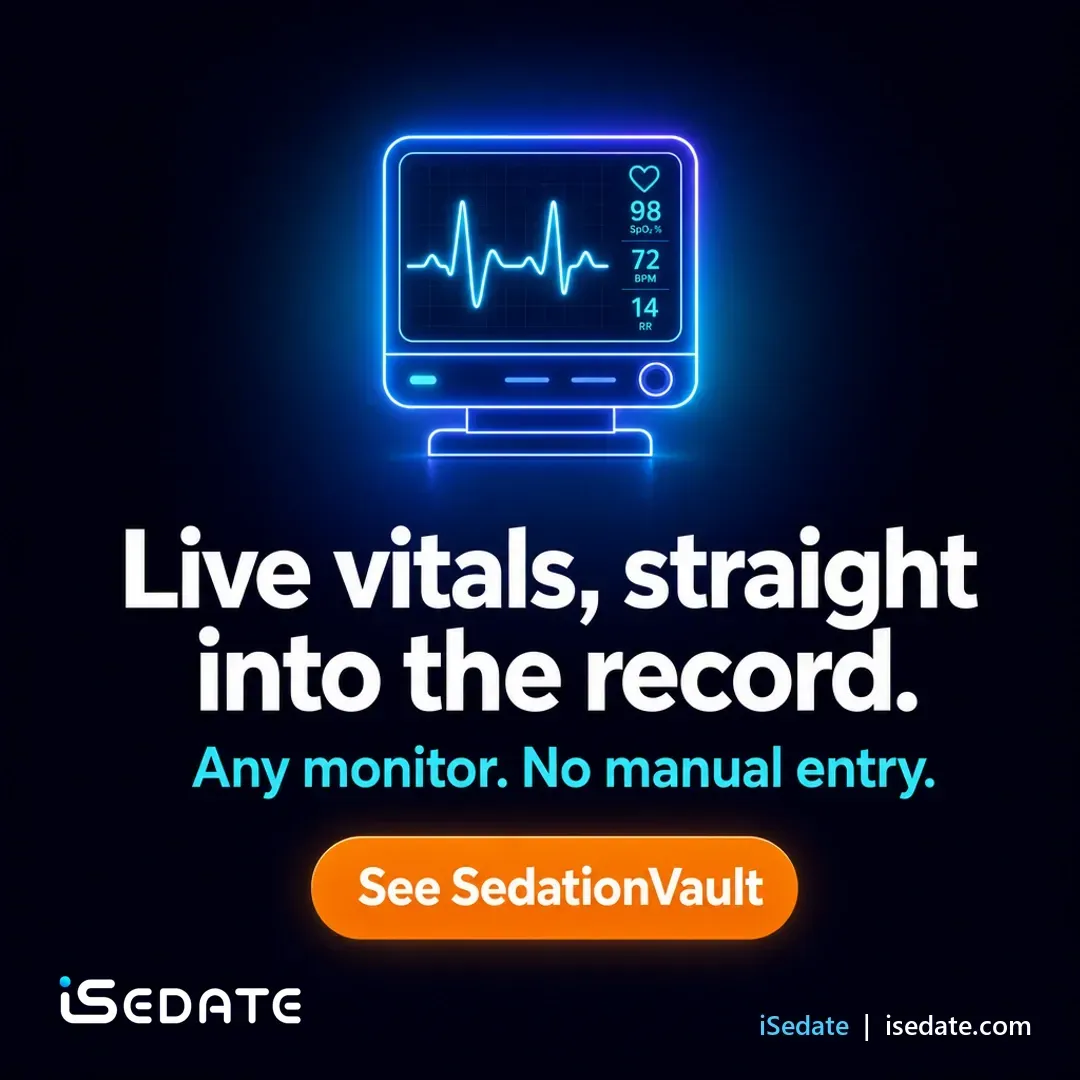
Catching a desaturation early keeps a patient safe. Recording the full monitoring trace proves the standard of care was met if a case is ever reviewed. iSedate's SedationVault captures live vitals from compatible monitors, including Edan, MindRay, Criticare, and more (the Edan X10 is a common example), building a continuous, time-stamped record of every case and producing a one-click, audit-ready PDF. The clinical benefit and the compliance benefit come from the same continuous data stream.

Source: Analysis of Oxygen Saturations in Dental IV Sedation (NCBI) | Capnography vs Pulse Oximetry, pediatric sedation (NCBI)
See SedationVault
06 Summary Table: Every Statistic
| Statistic | Figure | Source | Year |
|---|---|---|---|
| Hypoxemic event rate, moderate periodontal sedation | 5.3% | J. Dental Anesthesia & Pain Medicine (n=2,221) | 2025 |
| Sedations with more than one hypoxemic event | 1.0% | J. Dental Anesthesia & Pain Medicine | 2025 |
| Reversal medications administered (2,221 cases) | 0 | J. Dental Anesthesia & Pain Medicine | 2025 |
| Age as predictor of hypoxemia | OR 1.022/yr | J. Dental Anesthesia & Pain Medicine | 2025 |
| Midazolam dose as predictor of hypoxemia | OR 1.118 | J. Dental Anesthesia & Pain Medicine | 2025 |
| Hypoxemia in deep IV sedation, high-risk patients | 62% | J. Intellectual Disability Research | 2025 |
| Respiratory depression detection with capnography | 17.6x more likely | Waugh et al. meta-analysis | 2010 |
| Hypoxemia incidence with capnography (14 RCTs) | RR 0.76 | Clinical Oral Investigations meta-analysis | 2020 |
| Oxygen desaturation with capnography (14 RCTs) | RR 0.79 | Clinical Oral Investigations meta-analysis | 2020 |
| Earlier apnea detection with capnography | RR 2.60 | Clinical Oral Investigations meta-analysis | 2020 |
| Hypoxia rate, capnography vs control (endoscopy) | 46% vs 69% | Qadeer et al. | 2009 |
| Desaturation, capnography vs conventional (colonoscopy) | 38.9% vs 53.2% | Beitz et al. | 2012 |
| Respiratory events caught, combined vs oximetry alone | 93 vs 53 | Pediatric prospective study (NCBI) | 2025 |
| Hypoxemia, oral surgery midazolam RCT (no sig. diff.) | 34.4% vs 39.2% | Microstream capnography RCT | 2018 |
| Common hypoxemia definition threshold | SpO2 <90% | Multiple procedural sedation studies | 2021 |
| Conservative dental early-warning threshold | SpO2 94-95% | Dental IV sedation QA (n=3,500) | 2011 |
| Point where desaturation accelerates | ~92% | Dental IV sedation QA (sigmoidal curve) | 2011 |
07 Frequently Asked Questions
How common is hypoxemia during dental sedation?
What SpO2 level counts as hypoxemia in sedation?
What are the biggest risk factors for hypoxemia during sedation?
Does capnography detect respiratory depression before pulse oximetry?
Is hypoxemia during dental sedation usually dangerous?
All figures trace to primary or peer-reviewed sources. Because hypoxemia definitions vary between studies, figures are reported alongside their thresholds where relevant. Sources include:
- "Predictors of hypoxemia during moderate sedation for periodontal surgery: a series of 2,221 sedations." Journal of Dental Anesthesia and Pain Medicine (2025)
- Kawauchi et al. "Impact of Obesity on Hypoxemia During Deep Dental Sedation." Journal of Intellectual Disability Research (2025)
- "Capnography monitoring in procedural intravenous sedation: a systematic review and meta-analysis." Clinical Oral Investigations (2020, 14 RCTs)
- Waugh JB et al. capnography meta-analysis (respiratory depression detection)
- "Non-Invasive Capnography Versus Pulse Oximetry for Early Detection of Respiratory Depression During Pediatric Procedural Sedation." Prospective observational study (NCBI, 2025)
- "Analysis of Oxygen Saturations Recorded During Dental Intravenous Sedations: A Retrospective Quality Assurance of 3,500 Cases" (NCBI)
- Qadeer et al. (2009) and Beitz et al. (2012) procedural sedation capnography trials
- "Microstream capnography during conscious sedation with midazolam for oral surgery: a randomised controlled trial" (NCBI)
- "Hypoxemia during procedural sedation in adult patients: a retrospective observational study" (NCBI)
Hypoxia is the sedation event that most rewards early detection and a complete record. iSedate's SedationVault captures live vitals, surfaces respiratory trends as they develop, and produces audit-ready documentation for every case. To see how it works in your practice, book a demo.