







Paperless & Digital Dental Records Statistics (2026): Errors, Safety & the Move Off Paper
In a 2025 head-to-head study, reviewers reading electronic dental records caught 100% of patients' critical systemic conditions, while those reading paper records missed medication use, anticoagulant therapy, and drug allergies. Going paperless is not just tidier. The research says it is measurably safer, yet the highest-risk record in a sedation practice is usually the last one still on paper.
- In a 2025 comparative study, electronic records produced zero oversights of systemic conditions while paper records led to missed medications, anticoagulants, and allergies (Scarano et al., BioMed Research International).
- A systematic review found electronic records reduce documentation errors and patient waiting time compared to paper across outpatient clinics (NCBI/PMC).
- Digital records cut recording and reporting time significantly, improving both accuracy and cost-effectiveness (Scarano et al., 2025).
- A full paper-to-digital transition typically takes three to six months for an established practice (ekimit; industry guidance).
- Dental record retention is state-governed, commonly 7 to 10 years for adults, with minor records often kept to age 25 to 28 (The Doctors Company; state statutes).
- The legal standard carriers repeat: "if it was not recorded, it was not done" (MLMIC; The Doctors Company).
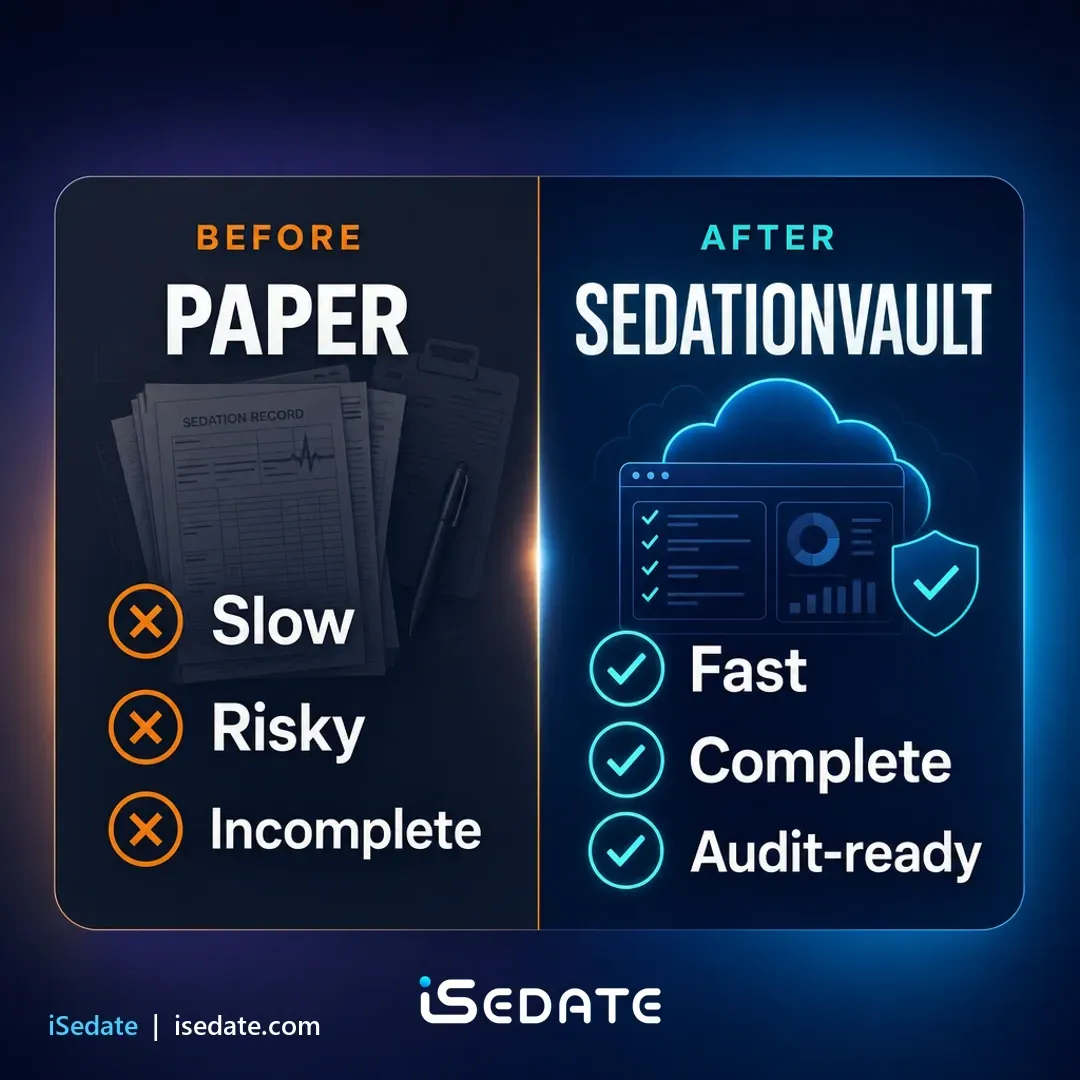
- Sedation vitals are frequently the last paper record in an otherwise paperless practice, the exact gap iSedate's SedationVault closes.
What's in This Guide
1 Digital vs Paper: The Accuracy & Safety Data
Most paperless coverage argues from convenience: less clutter, faster filing, lower supply cost. Those are real, but they undersell the point. The strongest case for digital records is clinical safety, and it is now backed by controlled research rather than vendor assertion.
A 2025 comparative study published in BioMed Research International assigned 200 patient records to either paper or electronic format and had dental reviewers identify the correct treatment for each. The results were not close. Reviewers using electronic records identified critical systemic conditions rapidly and with no oversights. Reviewers using paper records took longer and missed important health information, including antiresorptive medication use, anticoagulant therapy, and penicillin allergy, exactly the kind of oversight that turns into a sedation or surgical adverse event.

iSedate Analysis: From records to sedation safety
The Scarano study measured what happens when a reviewer must spot a drug allergy or anticoagulant use from a record. Now apply that to sedation. A missed anticoagulant or a missed allergy is not a paperwork problem during oral or IV sedation, it is a patient-safety event. If paper records produce oversights on routine medical-history review, the risk compounds in a time-pressured sedation workflow where the same information must be right in real time. This is why iSedate treats sedation documentation as a safety system, not a form.
Calculation and interpretation original to iSedate.
Source: BioMed Research International comparative study | NCBI record of the study
See how SedationVault protects the record2 Documentation Errors & Legibility
The accuracy gap traces to specific, well-documented failure modes of paper. A systematic review of electronic medical record implementation across outpatient clinics found that EMRs reduce documentation errors and cut patient waiting time compared with paper-based systems.
The mechanisms are unglamorous but decisive. Typed notes are legible where handwriting is not. Structured data-entry fields and pick lists enforce completeness that a blank paper line does not. Digital signatures and patient-entered intake remove the transcription step where errors creep in. Electronic prescribing with interaction checks catches conflicts a paper pad cannot.
Qualitative research on paper records in dental settings reaches the same conclusion from the other direction. Studies of practices still on paper identify recurring themes: inefficiency and poor accessibility, problems with accuracy, legibility, and record integrity, and continuity-of-care and patient-safety risks. The people using paper are not defending it; they are documenting why they want out.
Myth: "Handwritten notes are fine if the clinician is careful." Careful clinicians still produce illegible, incomplete, or misfiled paper records, because the failure modes are structural, not personal. Legibility, enforced completeness, and misfiling are properties of the medium. The research is consistent: the problem is paper, not the person holding the pen.
Source: NCBI systematic review on EMR error reduction | Qualitative study of manual dental records
Explore digital anesthesia records3 The Paper-to-Digital Transition
The move off paper is a project, not a switch. Understanding the realistic timeline helps practices commit rather than stall.
The practices that succeed treat digitization as a practice-improvement initiative: they plan the workflow, train staff on the live system rather than a demo, and decide up front what happens to legacy paper (secure storage or destruction under retention rules). The ones that struggle treat it as an IT install and are surprised when staff revert to old habits.

One point matters specifically for sedation providers. You do not have to digitize the entire practice before you digitize the record that carries the most liability. Sedation documentation can be captured cleanly on its own and exported into whatever chart the practice keeps, so a provider can close the highest-risk gap first without waiting for a full paperless conversion.
Source: ekimit paper-to-digital transition guide
Book a SedationVault demo4 Retention Law & the Defensible Record
Digital records do not just read better, they retain better. And retention is a legal obligation with real teeth, governed primarily by state law with federal baselines layered on top.
| Retention Standard | Typical Requirement | Source |
|---|---|---|
| Adult dental records (common range) | 7 to 10 years from last visit | The Doctors Company; state statutes |
| Minor patient records (common range) | Until age 25 to 28 | Holt Law 2026 guide; carriers |
| HIPAA compliance documentation | 6 years | HIPAA |
| Medicare Advantage / managed care | Often 10 years | CMS contracts |
| Malpractice carrier recommendation | Frequently exceeds state minimums | Malpractice carriers |
The practical takeaway: retention rules vary by state, and the record you keep must still be usable years later. Paper degrades, gets misfiled, and consumes physical space that scales badly. Digital records with HIPAA-compliant cloud storage stay retrievable, searchable, and intact for the full statutory window, which for a sedation adverse event could be a decade or more after the procedure.
Retention is the floor, not the ceiling. Keeping a file for 10 years means nothing if the file cannot support the treatment it documents. A preserved but incomplete record does not protect a practice; it preserves the evidence of the documentation gap. Completeness at the time of treatment is what a retained record needs, and that is far easier to enforce digitally.
Source: The Doctors Company on record retention | MLMIC dental records legal perspective
See HIPAA-compliant record storage5 Why Records Are Your Legal Shield
Every malpractice-defense source converges on one idea, stated almost identically across carriers: the record is the practitioner's primary evidence, and an absent or incomplete record is nearly impossible to defend.
The adage every malpractice carrier repeats: "If it was not recorded, it was not done." Relying on a practitioner's general habit and practice to prove the standard of care was met, without documentation, often fails to convince a jury. Judges and juries treat entries made at or near the time of the event as highly reliable evidence.
A claim can arrive years after treatment, long after memory fades. At that point the chart is the case. A carefully prepared record can even lead a plaintiff's attorney to decline a case from the outset, sparing the practitioner the cost and stress of a defense. This is the provable-safety principle in its clearest form: safety that is documented is defensible, and safety that is merely asserted is not.

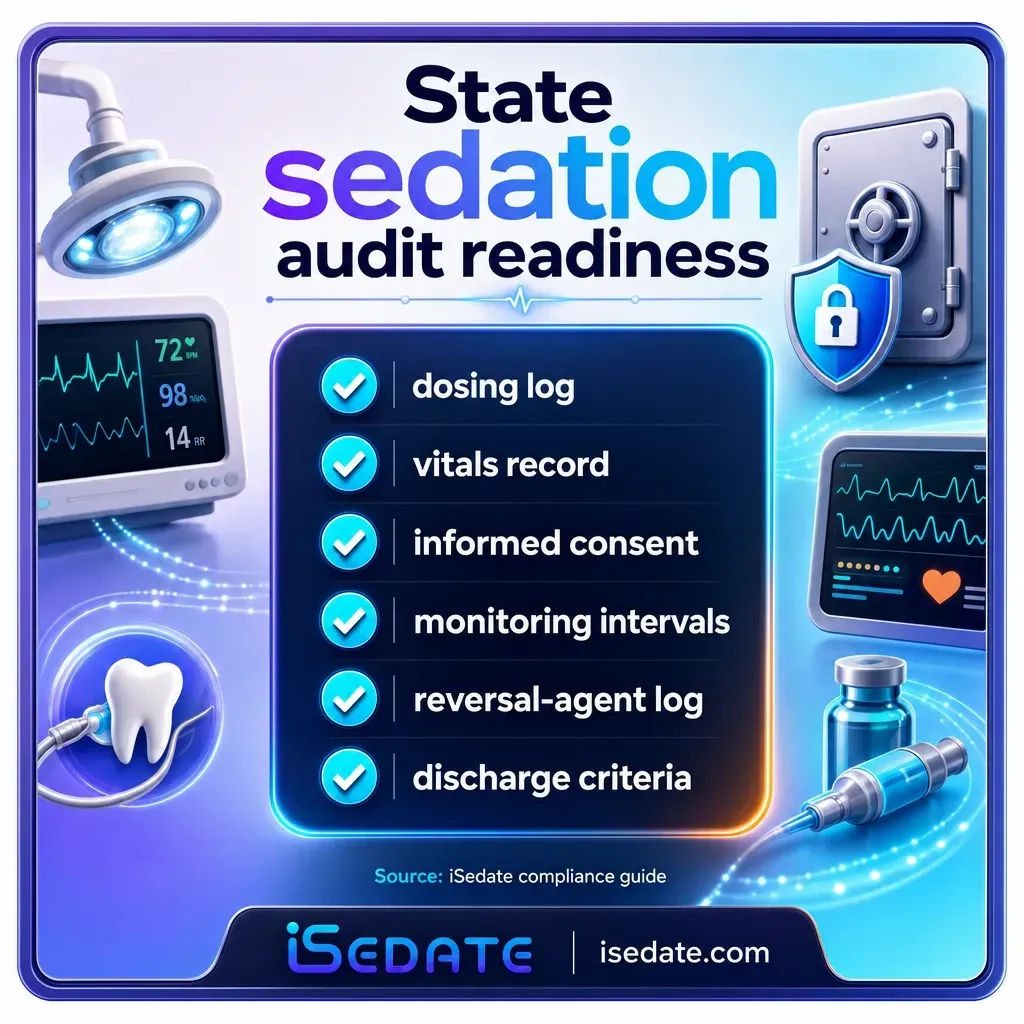
For sedation and anesthesia specifically, the defensible record is demanding. It needs time-stamped vitals across the procedure, drug administration logs, emergency-equipment checks, and consent, all legible, complete, and retrievable. That is a tall order on paper under time pressure, and a natural fit for a purpose-built digital system.
Source: The Doctors Company on defensible records | Dental record-keeping for malpractice defense
See sedation compliance documentation6 The Last Paper Record: Sedation
Here is the pattern that repeats across otherwise-modern practices. Intake goes digital. Charting goes digital. Imaging goes digital. And sedation vitals are still recorded by hand on a clipboard during the procedure, then filed loose or transcribed later, if at all.
It happens because sedation documentation is a different workflow from everything else in the practice. General practice management systems were not built to capture time-based vitals from a monitor during an active procedure, so when the practice went paperless, sedation quietly stayed on paper. The result is that the record carrying the most legal and clinical weight is frequently the least digitized one in the building.
iSedate Analysis: Closing the last gap first
Everything in this article points the same direction. Paper records produce oversights (Scarano 2025). Documentation errors fall under digital systems (systematic review). The defensible record demands completeness and legibility (malpractice carriers). Sedation is the workflow where all three pressures peak, and it is usually the last one on paper. The rational move is to digitize that record first, not last. iSedate's SedationVault captures sedation vitals directly, builds the audit-ready report, and exports a clean PDF into the chart the practice already keeps, whether that is Dentrix, Eaglesoft, or Open Dental. Reference figures for the founders' own practice reflect thousands of documented sedation procedures, a practice-level dataset, not a nationwide claim.
Calculation and interpretation original to iSedate.
Treated as a Sedation Intelligence System rather than a digital form, the sedation record becomes proof: drug inventory, license and certification tracking, emergency-equipment oversight, and board-ready reporting, all captured the first time and retrievable for the full retention window.
Source: BioMed Research International EHR vs paper study | Qualitative research on manual dental records
See SedationVault for oral surgeons7 Summary Table: Every Statistic at a Glance
| Statistic | Figure | Source | Year |
|---|---|---|---|
| Systemic conditions identified via EHR | 100% | Scarano et al., BioMed Research Int'l | 2025 |
| Oversights among EHR reviewers | 0 | Scarano et al. | 2025 |
| Paper-record reviewer outcome | Missed meds, anticoagulants, allergies | Scarano et al. | 2025 |
| Recording/reporting time under EHR | Significantly reduced | Scarano et al. | 2025 |
| EMR effect on documentation errors | Reduced vs paper | NCBI systematic review | 2005-2020 |
| EMR effect on patient waiting time | Reduced vs paper | NCBI systematic review | 2005-2020 |
| Paper-to-digital transition duration | 3-6 months | ekimit; industry guidance | 2026 |
| Adult dental record retention (common) | 7-10 years | The Doctors Company | 2026 |
| Minor record retention (common) | Until age 25-28 | Holt Law; carriers | 2026 |
| HIPAA compliance doc retention | 6 years | HIPAA | 2026 |
| Managed care record retention (often) | 10 years | CMS contracts | 2026 |
| HIPAA Security Rule civil penalty cap | $1.5M per violation category/yr | HHS / HIPAA | 2026 |
| Paper-record themes in qualitative study | Inefficiency, legibility, safety risk | NCBI/PMC qualitative study | 2025 |
| Malpractice documentation standard | "If not recorded, not done" | MLMIC; The Doctors Company | 2026 |
| Sedation record status in paperless practices | Often last on paper | iSedate analysis | 2026 |
Frequently Asked Questions
Are digital dental records more accurate than paper records?
How long does it take a dental practice to go paperless?
How long must dental records be retained?
Why do digital records matter for malpractice defense?
Do paperless practices digitize their sedation records?
Methodology & Sources
This article prioritizes peer-reviewed and institutional primary sources. Peer-reviewed research: Scarano et al., "A Digital Clinical Records Versus Paper Records in Dental Practice: A Comparative Study," BioMed Research International (Wiley), 2025; systematic review of EMR implementation and documentation-error reduction, published via NCBI/PMC (studies 2005-2020); qualitative study of manual dental records using sociotechnical systems theory, NCBI/PMC. Legal and retention sources: The Doctors Company, MLMIC, and published state retention statutes and 2026 compliance guides. Regulatory baselines: HIPAA Privacy and Security Rules (HHS).
Note on scope and SERP: search results for this topic skew toward how-to guides rather than statistics roundups. This article deliberately leads with controlled research and legal-standard data that the guide content underuses, and is scoped to records, the paper-to-digital transition, and patient-safety outcomes. For dental software market size and adoption behavior, see the companion reports in this series. Statistics reflect the most recent available data as of 2026 and will be refreshed annually.
Media & press usage: Journalists and researchers are welcome to cite these statistics with attribution to iSedate and a link to this page. The iSedate Analysis boxes contain original derived interpretation unique to this article.