






Teledentistry Statistics (2026): Market Size, Utilization & What Stays In-Person
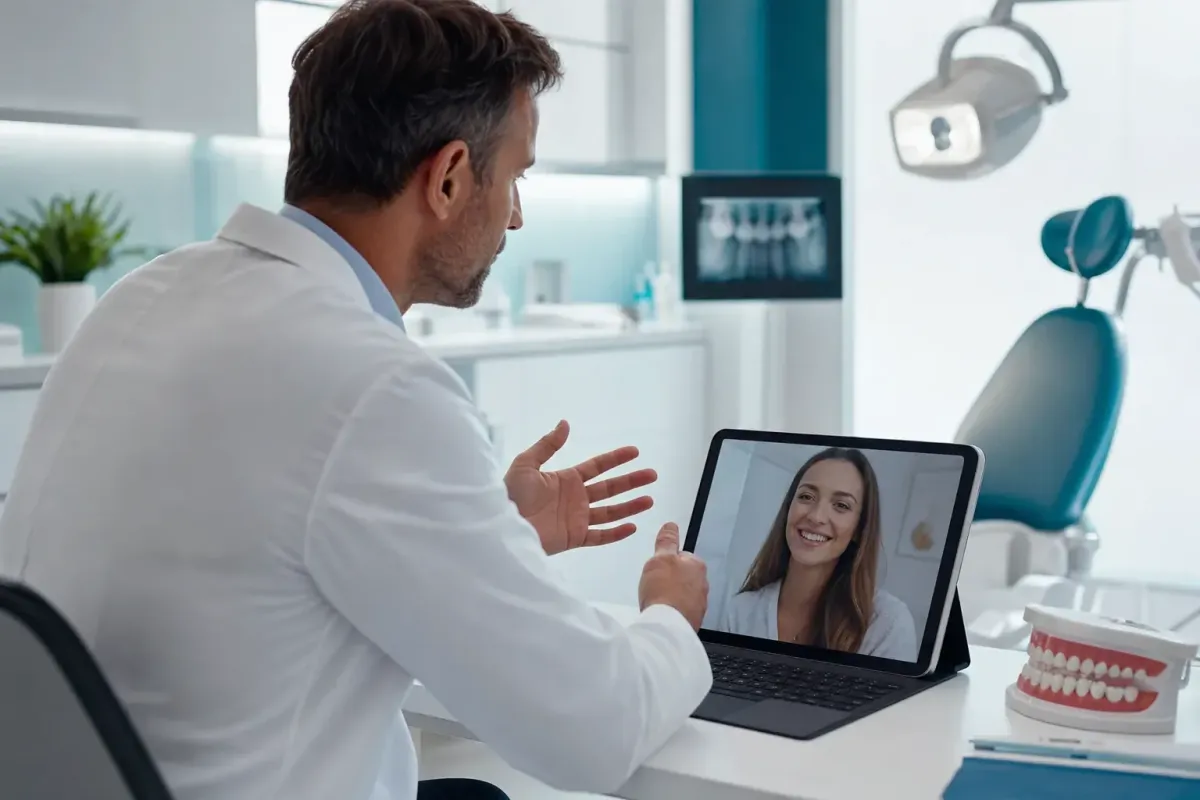
Teledentistry has gone mainstream: roughly 65% of dental providers now offer virtual consultations, and more than 30% of North American dental consultations have been conducted remotely. But the same data that shows virtual care's rise also draws a sharp line around what it cannot do. The hands-on, high-stakes procedures, sedation among them, stay firmly in the operatory.
- The global teledentistry market was roughly USD 1.4 to 2.2 billion in 2024 to 2025, projected to reach about USD 5 to 9 billion by the early-to-mid 2030s at ~15 to 16% CAGR (Grand View; Precedence; Brainy Insights).
- Roughly 65% of general and specialty dental providers now offer virtual consultations (ReAnIn analysis).
- More than 30% of dental consultations in North America have been conducted virtually (SNS Insider).
- Teleconsultation is the largest application at about 60% of the market (Grand View Research).
- Cloud-based delivery leads teledentistry, accounting for over 60% of deployments (ReAnIn; Grand View).
- WHO reports oral diseases affect about 3.5 billion people globally, driving demand for expanded access (WHO, 2024).
- Teledentistry cannot perform hands-on care; sedation and anesthesia remain in-person, high-documentation events, where iSedate's SedationVault applies.
What's in This Guide
1 Teledentistry Market Size & Growth
Teledentistry, the delivery of dental consultation, screening, and monitoring through digital communication, moved from a pandemic-era necessity to a permanent service line. The market data reflects that shift, with analysts broadly agreeing on the shape of the curve even as they differ on the exact dollars.
Most credible estimates place the 2024-to-2025 global market between roughly USD 1.4 billion and USD 2.2 billion, growing at about 15 to 16% annually. The consistency across firms on growth rate, if not on absolute size, signals a genuine, durable trend rather than a fad. The drivers are structural: cost reduction, smartphone and internet penetration, dental-professional shortages in rural areas, and an aging population that benefits from remote access.
Source: Grand View Research teledentistry market | Precedence Research teledentistry market
See iSedate's SedationVault2 Provider & Patient Utilization
Market size measures dollars; utilization measures behavior, and the behavior data shows teledentistry has crossed into mainstream practice.

The patient segment is the fastest-growing, driven by smartphone adoption and the convenience of virtual consultations. On the provider side, dental clinics dominate teledentistry delivery because they can bolt remote consultation onto an existing patient base and staff, using it to improve access, boost retention, and reduce facility overhead. Teledentistry is not replacing the practice; it is extending it.
Source: ReAnIn teledentistry utilization data | SNS Insider on virtual consultation rates
See SedationVault for dentists3 What Teledentistry Does Well
Teledentistry's value is real and specific. Understanding exactly what it does well also clarifies, by contrast, what it does not.
The strengths cluster around access and communication: virtual consultations and triage, follow-up care, remote monitoring, patient education, after-hours access, and reaching rural, underserved, and mobility-limited populations. Increasingly, AI-driven remote screening adds preventive value, with more than 70% of next-generation teledentistry solutions expected to feature AI-based oral-health screening and image-based triage. For a large swath of dental care, communication, assessment, and coordination, remote delivery is genuinely effective.
iSedate Analysis: Where the value line falls
Notice the common thread in every teledentistry strength: they are all information and communication tasks, seeing, assessing, advising, monitoring, educating. That is exactly the category of work that digitizes well remotely. The moment care requires physical intervention on the patient, drilling, extracting, administering and monitoring sedation, the remote model reaches its hard boundary. Teledentistry's success and its limits come from the same source: it moves information brilliantly and cannot move hands.
Calculation and interpretation original to iSedate.
Source: Grand View Research application segmentation | Coherent Market Insights on WHO oral-disease data
See digital patient intake4 The Limits: What Stays In-Person
Every serious teledentistry analysis names the same constraint, and it is not a temporary technology gap. It is structural.
The hard boundary of virtual care. Market researchers consistently list the same limitation: teledentistry cannot perform hands-on dental procedures. Restorative work, surgical extractions, and any treatment delivered under sedation or anesthesia require the patient and clinician to be in the same room. Layered on top are data-privacy concerns, regulatory fragmentation across state lines, and reimbursement variability, but the physical limit is the one that will never be engineered away.
This matters for how a practice should think about its record-keeping. The remote side of care, consultation and monitoring, generates one kind of documentation. The in-person side, especially procedural and sedation care, generates the documentation that carries the most clinical and legal weight. As teledentistry handles more of the routine, communication-heavy visits, the in-person visits that remain are disproportionately the complex, high-liability ones.

Source: ReAnIn on teledentistry limitations | IMARC Group on hands-on care constraints
Compare SedationVault plans and pricing5 Sedation: The In-Person Anchor
Of everything a dental practice does, sedation and anesthesia sit furthest from what teledentistry can touch, and understanding why sharpens the whole picture.
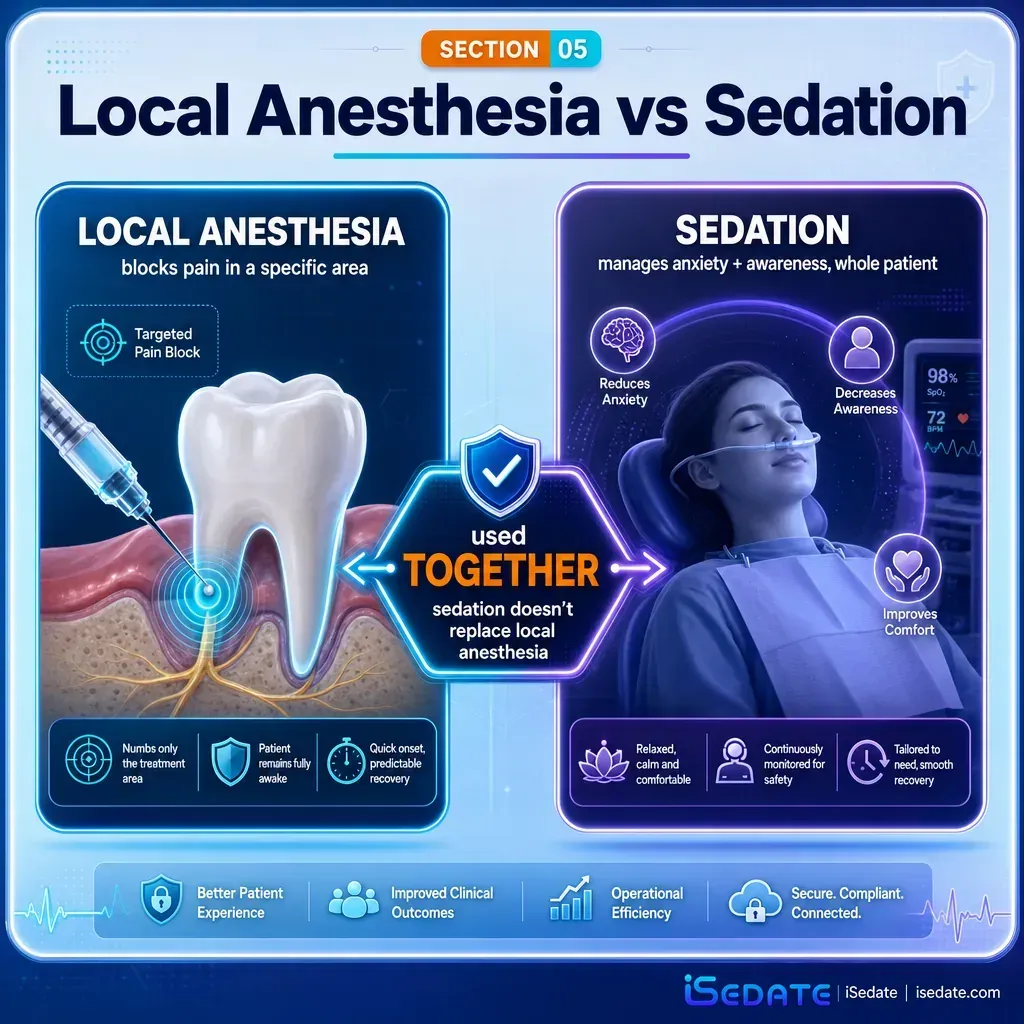
A sedation case requires continuous physical monitoring of vital signs, real-time drug administration, and immediate emergency readiness. None of that can be delivered over video. Teledentistry can play a supporting role around the edges, a virtual consultation to assess a patient's suitability for sedation beforehand, or a follow-up check afterward, but the sedation visit itself is irreducibly in-person, hands-on, and among the most documentation-intensive events in dentistry.
iSedate Analysis: As routine care goes virtual, sedation records matter more
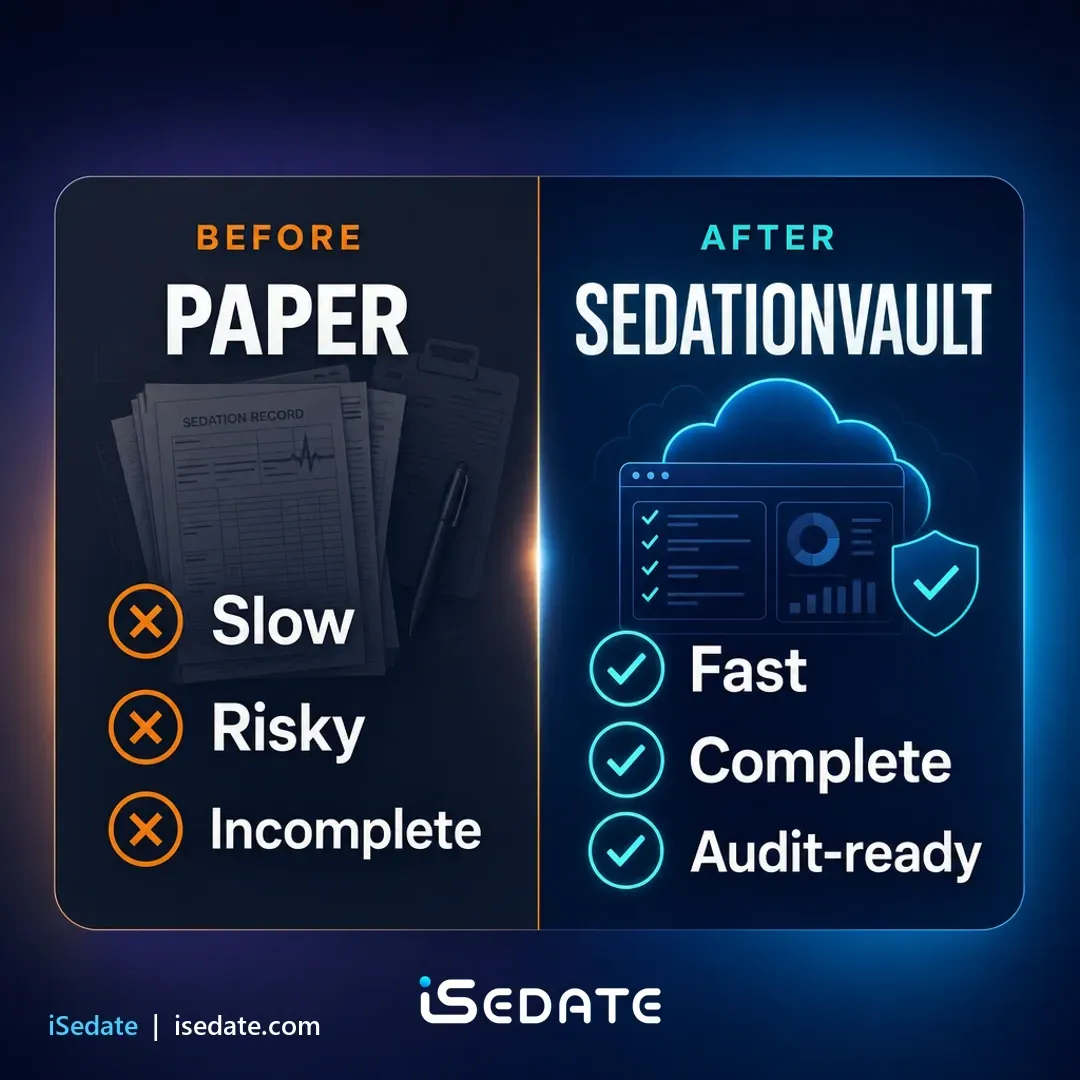
There is a subtle strategic implication in the teledentistry data. If virtual care absorbs a growing share of routine, low-acuity visits, the in-person schedule concentrates toward higher-complexity, higher-liability procedures, including sedation. In other words, the average in-person visit is becoming more clinically weighty even as the total mix shifts online. That raises, not lowers, the importance of rigorous sedation documentation. iSedate's SedationVault addresses precisely this in-person, high-stakes record: it captures vitals from compatible monitors such as Edan, MindRay, and Criticare, logs drug administration, and produces audit-ready reports, then exports a clean PDF into whatever chart the practice already keeps, whether Dentrix, Eaglesoft, or Open Dental. Reference figures for the founders' own practice reflect thousands of documented sedation procedures, a practice-level dataset, not a nationwide claim.
Calculation and interpretation original to iSedate.
The takeaway is not that teledentistry and sedation software compete, they address opposite ends of care. Teledentistry handles the remote, communicative work; a Sedation Intelligence System handles the in-person, high-acuity work. A modern practice increasingly needs both, each doing what the other cannot.
Source: Grand View Research teledentistry scope | IMARC Group on remote-care boundaries
Book a SedationVault demo6 Summary Table: Every Statistic at a Glance
| Statistic | Figure | Source | Year |
|---|---|---|---|
| Global teledentistry market size | ~USD 2.02B | Grand View Research | 2024 |
| Global market projection | ~USD 4.8B by 2030 | Grand View Research | 2030 |
| Global market CAGR | ~15-16% | Multiple firms | 2025-2030 |
| Analyst consensus range (2024-25) | ~USD 1.4-2.2B | Multiple firms | 2024-2025 |
| U.S. teledentistry market size | ~USD 500M | Precedence Research | 2024 |
| North America market share | ~36-46% | Grand View; ResearchNester | 2024 |
| Providers offering virtual consultations | ~65% | ReAnIn | 2024 |
| North American consultations done virtually | 30%+ | SNS Insider | 2024 |
| Medical specialists using telemedicine (half of visits) | 27.4% | CDC NEHRS | 2024 |
| Teleconsultation share of market | 60.2% | Grand View Research | 2024 |
| Cloud-based delivery share | 60%+ | ReAnIn; Grand View | 2024 |
| Software & services share of market | ~65% | ReAnIn | 2024 |
| People affected by oral diseases globally | ~3.5B | World Health Organization | 2024 |
| Next-gen solutions with AI screening | 70%+ | ReAnIn | 2024 |
| Sedation/anesthesia via teledentistry | Not possible | iSedate analysis | 2026 |
Frequently Asked Questions
How big is the teledentistry market?
How many dentists offer teledentistry?
What is teledentistry used for?
What are the limits of teledentistry?
Can sedation be done through teledentistry?
Methodology & Sources
Market research sources: Grand View Research, Precedence Research, Market.us, Coherent Market Insights, SNS Insider, Brainy Insights, ResearchNester, IMARC Group, and ReAnIn for market size, segmentation, and utilization data. Institutional sources: World Health Organization (global oral-disease burden) and the CDC National Electronic Health Records Survey (telemedicine utilization).
Note on market-size variance: teledentistry market estimates cluster reasonably around USD 1.4 to 2.2 billion for 2024 to 2025 at roughly 15 to 16% CAGR, with most firms in close agreement; a small number of outlier forecasts (for example, a 25.5% CAGR projection) sit well outside the consensus and are not used. Utilization figures are drawn from named industry analyses and reflect the most current available data. This article covers teledentistry and virtual care; for dental software, EHR, and compliance data, see the companion reports in this series. The sedation-related interpretation is iSedate's own analysis of where virtual care's structural limits fall. Statistics reflect the most recent available data as of 2026 and will be refreshed annually.
Media & press usage: Journalists and researchers are welcome to cite these statistics with attribution to iSedate and a link to this page. The iSedate Analysis boxes contain original interpretation unique to this article.