







Wrongful Death Verdict & Settlement Statistics (2026): The National Numbers
Wrongful death verdicts make headlines when they reach the millions, but the national data tells a more grounded story. Most cases settle, plaintiffs win a minority of trials, and the median award is a fraction of the outliers. Understanding the real numbers, drawn from government and industry sources rather than headline verdicts, is essential to understanding malpractice risk in fatal cases.
- The Bureau of Justice Statistics reports a median medical malpractice trial award of about $422,000, nearly 16 times the overall tort median.
- The median wrongful death trial award across case types is about $961,000 (BJS), and the 2020 median medical malpractice jury award was about $1.27 million.
- National Practitioner Data Bank analysis shows a median malpractice payment of roughly $295,000 when the patient died.
- Roughly 73 percent of tort cases settle and only about 3 percent go to trial (BJS).
- Plaintiffs win a minority of medical malpractice trials, fewer than one-third, one of the lowest win rates among tort categories.
- In about 9 of 10 medical malpractice trials, the plaintiff alleged the negligence caused permanent injury or death (BJS).
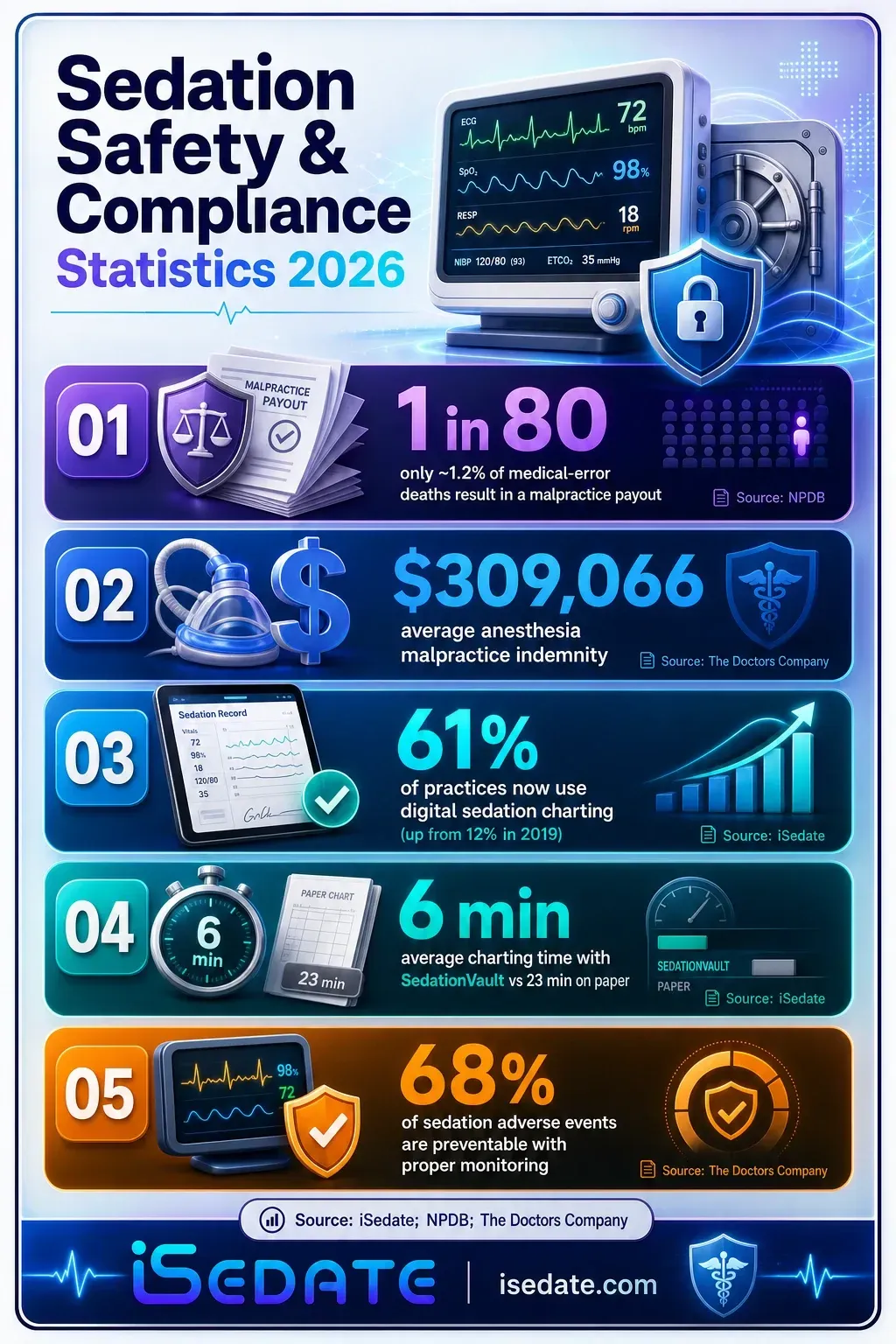
- Only about 5 percent of deaths attributable to medical error result in a malpractice payout, reflecting significant under-litigation.
What's in This Guide
1The Median, Not the Headline
The single most important fact about wrongful death awards is the gap between the headline verdicts and the typical outcome. The multi-million-dollar awards that make the news are real but rare, and the median tells a very different story.
The Bureau of Justice Statistics, the U.S. Department of Justice's statistical agency, found in its Civil Justice Survey of State Courts that the median medical malpractice trial award was about $422,000, nearly 16 times greater than the overall median tort award. The median wrongful death trial award across all case types was about $961,000, and more recent industry data placed the 2020 median medical malpractice jury award at roughly $1.27 million. These medians are large relative to other torts, but they are a small fraction of the outlier verdicts, occasionally in the hundreds of millions, that dominate public perception.
The distinction between median and average is not academic here. Because a handful of enormous verdicts pull the average sharply upward, the average award is a poor guide to what a typical case yields, while the median, the midpoint where half of awards fall below, better represents the usual outcome. Any figure presented as the average wrongful death award should be read with this skew in mind. The government's median figures are the more honest benchmark for what these cases typically produce. For how a wrongful death claim is structured specifically in dentistry, see our companion review of wrongful death lawsuit statistics in dentistry.
Source: Tort Trials and Verdicts in Large Counties, Bureau of Justice Statistics (NCJ 206240)
See how iSedate's SedationVault supports the record
2Most Cases Settle
Trials are the exception, not the rule, in wrongful death litigation. The overwhelming majority of cases resolve through settlement, which shapes both the data and the strategy of these cases.
Bureau of Justice Statistics data shows that about 73 percent of tort cases are disposed of by agreed settlement, while only around 3 percent reach a trial verdict, with the remainder dismissed or otherwise resolved. Both sides usually prefer settlement because a trial adds years, expense, appeal risk, and the real possibility of a zero recovery for the plaintiff or a large verdict for the defense. The median medical malpractice case that did go to trial took about 29 months from filing to disposition, longer than most other tort types, before any appeal. The financial burden of defending a case over that timeline is covered in our review of the cost of a dental malpractice lawsuit.
This settlement dominance has a direct consequence for the data: because settlements are typically private and often confidential, the publicly reported figures come disproportionately from the small share of cases that went to trial, which are not representative of the whole. The trial verdicts that generate headline numbers are a filtered, non-random slice, the cases where neither side was willing to settle, which tend to be either the strongest or the most bitterly contested. This is another reason the true typical outcome is hard to pin down and why government medians are the most reliable anchor available.
Source: Bureau of Justice Statistics, tort settlement and trial rates (NCJ 206240)
See audit-ready PDF reports3The Plaintiff Win Rate
Contrary to the public image of runaway malpractice litigation, plaintiffs actually lose most medical malpractice trials. This win rate is one of the most consistently documented and counterintuitive facts in the data.
The Bureau of Justice Statistics found that plaintiffs prevailed in fewer than a third of medical malpractice trials, and that this rate declined over time to about a fourth by the most recent survey year, one of the lowest plaintiff win rates of any tort category. By comparison, plaintiffs won 60 percent or more of automobile and animal-attack cases. Medical malpractice, including its fatal cases, is genuinely difficult for plaintiffs to win at trial, largely because proving that a departure from the standard of care caused the death, rather than the underlying disease or an unavoidable complication, is a demanding evidentiary burden.
When plaintiffs do prevail, the cases are frequently contested afterward: defendants filed a notice of appeal in about 28 percent of medical malpractice trials with a plaintiff winner. The combination of a low win rate and a high appeal rate means that even a plaintiff verdict is not the end of the road. For providers, the counterintuitive lesson is that trial outcomes turn heavily on the evidence of what happened, which is precisely where the contemporaneous clinical record does its work, and where a strong record can move a case toward defense or dismissal before trial is ever reached.
It is worth dwelling on why causation is so hard to prove in fatal medical cases specifically. A patient who dies was, by definition, already sick or undergoing a procedure carrying inherent risk, so the defense can argue the death resulted from the underlying condition or an unavoidable complication rather than from any negligence. Overcoming that argument requires affirmative evidence that the provider departed from the standard of care and that the departure, not the disease or an accepted risk, caused the death. That evidence lives in the record. Where the record clearly shows appropriate monitoring and timely response, it undercuts the causation theory; where it is silent or inconsistent, it supplies the plaintiff the opening they need.
Source: Bureau of Justice Statistics, medical malpractice plaintiff win and appeal rates (NCJ 206240)
See how compliance documentation works4Death Drives the Severity
The reason medical malpractice awards dwarf other tort awards traces directly to the severity of the injuries at issue. Death and permanent injury are not the exception in these trials; they are the norm.
The Bureau of Justice Statistics found that in about 9 out of 10 medical malpractice trials, the plaintiff alleged that the defendant's negligence caused a permanent injury or death. This is why medical malpractice awards are so much larger than the tort average: the stakes are inherently catastrophic. Damage verdicts of $1 million or more were awarded in about a third of medical malpractice trials, and medical malpractice consistently represents the single largest category among tort cases with awards exceeding $1 million, even though it makes up only about 15 percent of tort trials overall.
This concentration of severity is what makes the fatal medical case a high-stakes event even though such cases are relatively uncommon and hard for plaintiffs to win. When they are won, they are expensive, because a wrongful death or catastrophic permanent injury supports large economic and non-economic damages. For sedation providers, whose adverse events, when they occur, tend to be severe rather than minor, this severity profile is directly relevant: the rare sedation claim is disproportionately likely to be one of these high-severity cases, which is where documentation matters most. The settlement side of these severe cases is examined in our reviews of medical malpractice settlement amount statistics and anesthesia death settlement statistics.
Source: Bureau of Justice Statistics, severity and $1M-plus award data (NCJ 206240)
Explore anesthesia record software
5The Under-Litigation Gap
One of the most surprising findings in the data cuts against the common narrative of excessive litigation. Relative to the amount of harm, medical error is significantly under-litigated, and the death data shows it clearly.
The National Practitioner Data Bank, the federal repository of malpractice payments, recorded roughly 3,046 medical malpractice payments for wrongful death claims in a recent reporting period. Set against widely cited estimates of preventable deaths attributable to medical error, this implies that only about 5 percent of such deaths result in a malpractice payout. Medical malpractice, far from being the flood of litigation it is sometimes portrayed as, is substantially under-litigated relative to the underlying rate of harm. Analysis of NPDB payment data further indicates a median malpractice payment of roughly $295,000 when the patient died.
The under-litigation finding matters for understanding real risk. It means that most adverse outcomes, even serious ones, never become claims, which is consistent with the broader finding that most malpractice incidents are never litigated. But it also means that the cases which do proceed are selected, often the ones with clearer evidence of a departure from the standard of care, or with a record that makes the departure provable. This selection effect places even more weight on documentation, because the presence or absence of a clear record influences whether a potential claim becomes an actual, and winnable, one.
Source: National Practitioner Data Bank Public Use Data File, HRSA
Compare plans and pricing6What Moves an Award
When a wrongful death case does result in a recovery, its size is not random. A set of identifiable factors, some about the deceased and some about the case, determines where in the wide range a given award lands.
The deceased's age and earning capacity drive the economic component: a younger, higher-earning decedent generates larger lost-income damages, which is why the death of a working-age parent produces a larger economic award than the death of a child or a retiree. The strength of the liability evidence drives whether there is any recovery at all and influences settlement leverage. The state's legal framework, particularly whether it caps non-economic damages, sets a ceiling on part of the award. And the jurisdiction's jury tendencies, which vary widely even within a state, shape both verdicts and the settlements negotiated in their shadow. These factors combine to produce the enormous spread the data shows, from the mid-five figures to the multi-millions.
Running through all of them is the evidence, and in a sedation-related death, the evidence is largely the monitoring and treatment record. Whether liability can be established, and therefore whether a case proceeds and at what value, depends heavily on what the record shows about the standard of care. This is where iSedate's SedationVault fits the picture. By pulling vitals directly from compatible monitors such as Edan, MindRay, and Criticare, timestamping every entry, and producing an audit-ready PDF, SedationVault creates the contemporaneous record that determines what can be proven about a sedation encounter. It does not change the clinical outcome or substitute for proper care and emergency preparedness. What it does is ensure that where care met the standard, the record can demonstrate it, which is the single most influential factor in how a fatal claim resolves.
Three facts from the data compound: fatal medical cases are severe (9 of 10 med-mal trials allege permanent injury or death), plaintiffs win a minority of them, and only about 5 percent of error-deaths are litigated at all. Together these mean the cases that do proceed are selected for provability, and the record is what determines provability. A complete, contemporaneous sedation record does not change whether an adverse event occurred, but it heavily influences whether a resulting claim can establish, or refute, a standard-of-care departure, which is the pivot on which these high-severity cases turn.
Contributing sources: BJS Civil Justice Survey; NPDB payment data.
Interpretation original to iSedate.
Source: Bureau of Justice Statistics award-driver data | NPDB payment data, HRSA
Book a demo to see the audit-ready recordEvery Statistic in One Table
| Statistic | Figure | Source | Year |
|---|---|---|---|
| Median medical malpractice trial award | $422,000 | BJS Civil Justice Survey | 2004 |
| Median med-mal jury award, 1992 | $253,000 | BJS | 2004 |
| Median med-mal jury award, 2001 | $431,000 | BJS | 2004 |
| Median wrongful death trial award (all types) | $961,000 | BJS | 2008 |
| Median med-mal jury award, 2020 | $1.27 million | Thomson Reuters / III | 2020 |
| Overall median tort trial award | ~$27,000 | BJS | 2004 |
| Med-mal award vs overall tort median | ~16x | BJS | 2004 |
| Tort cases resolved by settlement | ~73% | BJS | 2000 |
| Tort cases resolved by trial | ~3% | BJS | 2000 |
| Median med-mal case processing time | 29 months | BJS | 2004 |
| Plaintiff win rate, med-mal trials | <33% (about 25%) | BJS | 2004 |
| Med-mal trials alleging permanent injury or death | 9 of 10 | BJS | 2004 |
| Med-mal trials with $1M+ verdicts | ~33% | BJS | 2004 |
| Defendant appeal rate, med-mal plaintiff wins | 28% | BJS | 2004 |
| NPDB wrongful death payments (recent year) | ~3,046 | NPDB (HRSA) | 2024 |
| Median malpractice payment when patient died | ~$295,000 | NPDB analysis | 2024 |
| Medical-error deaths resulting in payout | ~5% | NPDB-based estimate | 2024 |
Frequently Asked Questions
What is the average wrongful death settlement in a medical case?
How often do wrongful death cases go to trial?
How often do plaintiffs win medical malpractice trials?
What percentage of medical error deaths result in a lawsuit payout?
What drives the size of a wrongful death award?
This article draws on primary government and recognized industry sources: the U.S. Department of Justice Bureau of Justice Statistics Civil Justice Survey of State Courts, which reports trial award medians, win rates, and case-processing data from the nation's most populous counties; the National Practitioner Data Bank, the federal repository of malpractice payment reports, for wrongful death payment counts and medians; and Thomson Reuters jury-award data as republished by the Insurance Information Institute. Several BJS figures derive from surveys of the largest counties and from earlier survey years, which are the most recent comprehensive national civil-trial data available and are labeled by year; they describe trial outcomes, which are a non-random minority of all cases, most of which settle privately. Award figures are medians unless noted, because award distributions are highly skewed and averages overstate the typical case; law-firm-compiled averages are identified as such and treated cautiously. This article is educational and is not legal advice. Where iSedate derives an original interpretation, it is labeled as an iSedate Analysis with its inputs shown.