







Dental Anxiety and Phobia Statistics (2026): Prevalence, Demographics, and the Avoidance Cycle
Depending on how it is measured, dental fear affects anywhere from about 15% of adults globally to nearly 73% in a recent US survey, and roughly one-third of young children. Beyond the raw prevalence, the more important story is the avoidance cycle that turns fear into worse oral health and, ultimately, into demand for comfort-focused care. The data below covers the numbers, the demographics, and the cycle.
- A systematic review estimated global adult dental fear and anxiety at about 15.3%, with 12.4% high and 3.3% severe.
- Individual studies range from 4.2% to over 50% depending on the measurement scale, so prevalence must always be read with its method.
- A 2025 US census-matched survey found 72.6% of adults reported some fear of the dentist (45.8% moderate, 26.8% severe).
- About 7.8% of adults in one survey met the threshold for dental phobia specifically, a more intense, avoidance-driving form.
- Roughly 30% of children aged 2 to 6 show dental fear and anxiety; prevalence is higher in women and generally decreases with age.
- The avoidance cycle is measurable: 29.2% of very-afraid people had delayed visiting, poor oral health, and symptom-driven care, versus 11.6% with no fear.
- 71.2% of fearful adults said they would be interested in help addressing their dental fear, underscoring real demand for comfort-focused care.
What's in This Guide
01 How Common Dental Anxiety Really Is
The honest answer is that dental anxiety prevalence spans a huge range, and the range is the first thing to understand. A number as low as 4% and as high as 73% can both be accurate, because they measure different things with different tools. The most rigorous single anchor is a systematic review and meta-analysis of adult dental fear.
That meta-analysis pooled many studies to estimate 15.3% of adults with any dental fear and anxiety, 12.4% with high levels, and 3.3% with severe levels. But the same literature notes that individual studies report figures from 4.2% to over 50%, driven by cultural differences and, crucially, the measurement scale used. At the high end, a 2025 US census-matched survey of just over a thousand adults found 72.6% reported some fear of the dentist, with 45.8% describing it as moderate and 26.8% as severe. These are not contradictions, they reflect a broad, sensitive single-item fear measure versus stricter clinical anxiety scales.
There is not, and any article citing a single number without its measurement method is oversimplifying. A validated single-item fear scale will capture far more people (hence 72.6%) than a strict clinical anxiety scale (hence 15.3%) or a phobia threshold (around 3 to 8%). Always pair a prevalence figure with the tool that produced it. The useful takeaway is that dental fear is genuinely widespread, and the clinically significant slice is a meaningful minority.

Source: Estimated prevalence of dental fear in adults, systematic review (ScienceDirect) | JADA census-matched US survey (ADA)
See the sedation dentistry market overview
02 Anxiety vs Fear vs Phobia
Part of why the numbers vary is that three related but distinct terms often get used interchangeably. Separating them clarifies both the data and the clinical response each calls for.
Fear is the body's response to a danger perceived as present, while anxiety is the anticipation of a danger perceived as less immediate. Dental phobia sits at the severe end: a persistent, intense reaction to specific triggers such as injections or the dental setting, capable of provoking panic, sweating, and trembling, and strongly associated with complete avoidance. In one adult e-survey using the Modified Dental Anxiety Scale, 7.8% of participants met the phobia threshold, while 19.1% reported no dental anxiety at all. The distinction matters clinically: mild anxiety may respond to communication and comfort measures, while phobia often requires a more structured approach, sometimes including sedation.
A study measuring "dental fear" with a broad single-item scale, one measuring "dental anxiety" with the MDAS, and one measuring "dental phobia" against a clinical threshold will report very different prevalences for what sounds like the same problem. When comparing statistics, the term and the tool matter as much as the percentage. This is the single most common source of confusion in dental anxiety data.

Source: Dental Anxiety Levels adult e-survey, MDAS (NCBI) | Factors associated with dental anxiety (Frontiers)
See how dentists use SedationVault
03 Who Is Most Affected
Dental anxiety is not evenly distributed. Two demographic patterns appear consistently across the literature: it is more common in women, and it is common in children, where it tends to decrease with age.
Women consistently report dental anxiety more often than men, in some studies roughly twice as often, and younger adults tend to report it more than older adults. In children, a systematic review pooled the prevalence of dental fear and anxiety among 2- to 6-year-olds at about 30%, meaning roughly one in three young children. Across children and adolescents more broadly, prevalence ranged from about 13.3% to 29.3% depending on the scale, was generally higher in girls than boys, and decreased with increasing age. Children without prior dental visit experience and those with cavities were at higher risk, which points to the role of early experience in shaping lifelong dental attitudes.

Source: Global prevalence of early childhood dental fear, meta-analysis (ScienceDirect) | Dental fear/anxiety in children and adolescents, systematic review (PubMed)
See digital intake and health history capture
04 The Avoidance Cycle
The most consequential finding in the dental anxiety literature is not a prevalence figure at all, it is the self-reinforcing cycle that turns fear into worse outcomes. This cycle is why dental anxiety is a public health issue and not just a matter of patient comfort.
The cycle works like this: fear leads to avoidance of dental care, avoidance allows small problems to become large ones, and the resulting need for more invasive, sometimes painful treatment confirms the patient's worst expectations and deepens the fear. Research quantified it directly: 29.2% of people who were very afraid of the dentist showed the full pattern of delayed visiting, poor self-rated oral health, and symptom-driven treatment seeking, compared with just 11.6% of people with no dental fear. All the relationships the vicious-cycle model predicts, more fear leading to fewer visits, worse oral health, and pain-driven visits, were statistically significant. Highly anxious patients tend to attend only when a problem becomes unavoidable, which is exactly when treatment is most aversive.
Set the two figures side by side: 29.2% of very-afraid people showed the full delayed-visiting, poor-oral-health, symptom-driven pattern, versus 11.6% of people with no fear. That is roughly a 2.5-fold difference, and it captures the cost of the cycle in a single comparison. Fear does not just make appointments unpleasant, it more than doubles the likelihood of the downstream pattern that leads to worse, costlier, and more invasive care. Breaking the cycle, through comfort, communication, and where appropriate sedation, is what converts an avoider into a regular patient.
Source: "The vicious cycle of dental fear" (NCBI). Calculation and interpretation original to iSedate.

Source: The vicious cycle of dental fear (NCBI) | Impact of Dental Anxiety on Dental Status (NCBI)
See how SedationVault documents sedation care
05 From Fear to Demand for Comfort
The final piece connects anxiety to solutions. Anxious patients are not simply lost to dentistry, a large share actively want help, which is what turns this clinical problem into demand for comfort-focused and sedation-based care.
In the 2025 census-matched JADA survey, among the fearful majority, 71.2% said they would be interested in a free treatment to help address their dental fear. Those who declined most often cited skepticism about effectiveness or satisfaction with their existing coping strategies, not indifference to their fear. This matters because it establishes genuine demand: most anxious patients want a path back to care. Sedation is one of the most established of those paths for patients whose anxiety or phobia is severe enough to block treatment otherwise, which is why dental anxiety is repeatedly cited as a primary driver of demand for sedation dentistry.
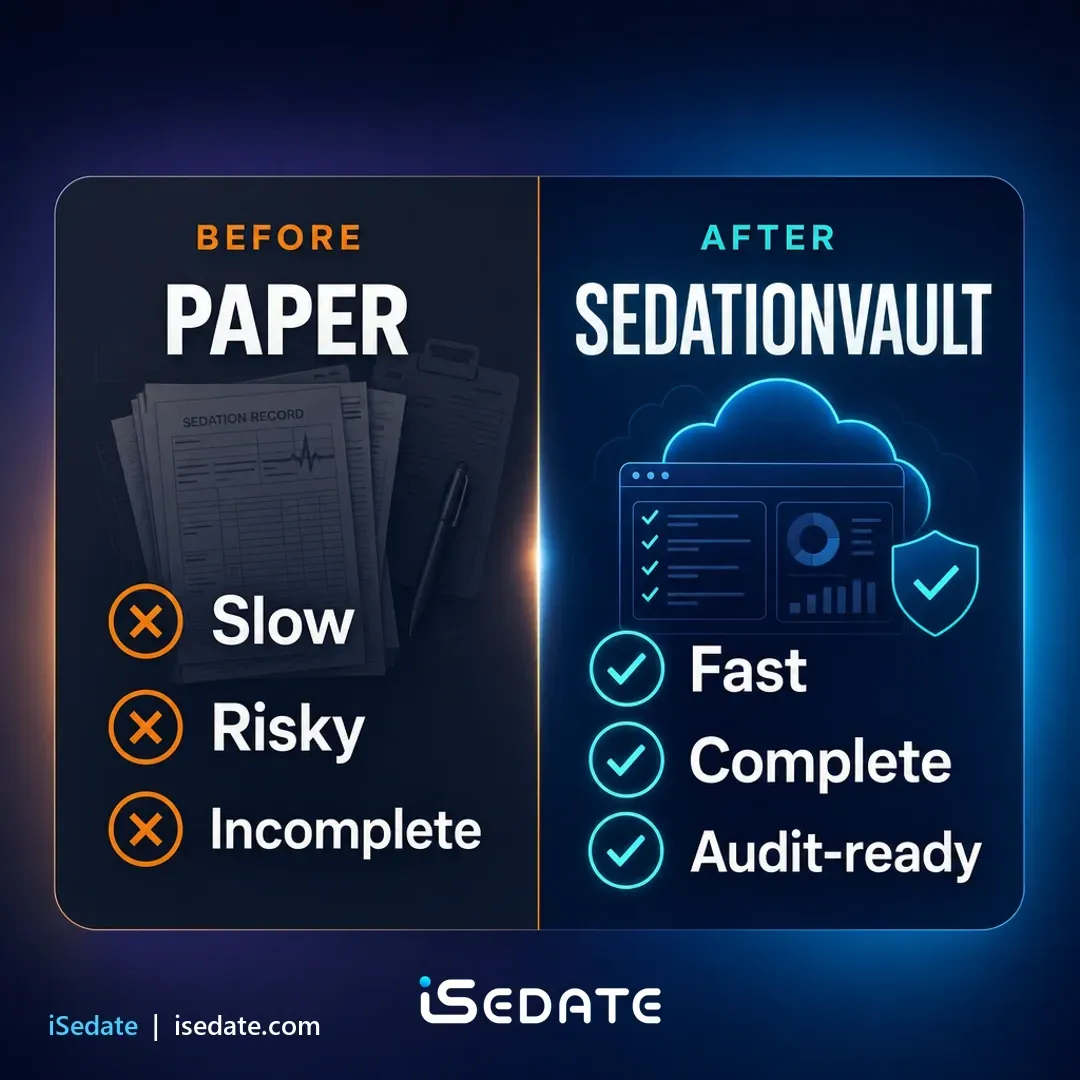
Anxiety creates the demand, and sedation is one answer for the patients whose fear would otherwise prevent care. For a practice offering sedation, that demand also brings responsibility: sedating anxious patients safely means monitoring and documenting every case rigorously. iSedate's SedationVault captures live vitals from compatible monitors, including Edan, MindRay, Criticare, and more (the Edan X10 is a common example), building a continuous, audit-ready record so a practice can serve anxious patients at scale without compromising on safety or documentation. For the market context behind this demand, see our sedation dentistry statistics overview.

Source: Census-matched survey of dental fear and treatment interest (JADA)
Book a Demo
06 Summary Table: Every Statistic
| Statistic | Figure | Source | Year |
|---|---|---|---|
| Global adult dental fear and anxiety | 15.3% | Systematic review & meta-analysis | 2020 |
| Adults with high dental fear and anxiety | 12.4% | Systematic review & meta-analysis | 2020 |
| Adults with severe dental fear and anxiety | 3.3% | Systematic review & meta-analysis | 2020 |
| Reported adult prevalence range (by scale) | 4.2% - >50% | Multiple studies | 2024 |
| US adults reporting some dental fear | 72.6% | JADA census-matched survey | 2025 |
| US adults with moderate fear | 45.8% | JADA census-matched survey | 2025 |
| US adults with severe fear | 26.8% | JADA census-matched survey | 2025 |
| Adults meeting dental phobia threshold | 7.8% | MDAS adult e-survey (NCBI) | 2024 |
| Adults reporting no dental anxiety | 19.1% | MDAS adult e-survey (NCBI) | 2024 |
| Children aged 2-6 with dental fear/anxiety | ~30% | Early childhood meta-analysis | 2024 |
| Children/adolescent prevalence range | 13.3% - 29.3% | Children/adolescent systematic review | 2017 |
| Women vs men dental anxiety | ~2x higher | Multiple studies | 2025 |
| Very-afraid people with full avoidance pattern | 29.2% | Vicious cycle of dental fear (NCBI) | study |
| No-fear people with same pattern | 11.6% | Vicious cycle of dental fear (NCBI) | study |
| Fearful adults interested in fear treatment | 71.2% | JADA census-matched survey | 2025 |
07 Frequently Asked Questions
How common is dental anxiety?
What is the difference between dental anxiety, fear, and phobia?
Who is most affected by dental anxiety?
How does dental anxiety affect oral health?
Do anxious patients want help managing their fear?
All figures trace to peer-reviewed studies and national surveys. Prevalence varies substantially by measurement instrument, so figures are reported alongside their tools and populations where relevant. Sources include:
- "Estimated prevalence of dental fear in adults: a systematic review and meta-analysis" (ScienceDirect / medRxiv)
- "A Census-Matched Survey of Dental Fear and Fear-Treatment Interest in the United States," JADA (2025, n=1,003)
- "Global prevalence of early childhood dental fear and anxiety: a systematic review and meta-analysis" (ScienceDirect)
- "Dental fear/anxiety among children and adolescents: a systematic review" (PubMed)
- "Associations between Dental Anxiety Levels, Self-Reported Oral Health..." MDAS adult e-survey (NCBI)
- "The vicious cycle of dental fear: exploring the interplay between oral health, service utilization and dental fear" (NCBI)
- "Impact of Dental Anxiety on Dental Status" and related oral-health-consequence reviews (NCBI)
Anxious patients want a path back to care, and sedation is one of the most established. iSedate's SedationVault helps practices serve them safely, capturing live vitals and producing audit-ready documentation for every sedation case. To see how it works in your practice, book a demo.