





Dental Patient Intake & Digital Forms Statistics (2026): Adoption, Time Savings & Accuracy
About 81% of patients now prefer digital intake over a paper clipboard, and 76% would pick one provider over another based on it, yet roughly 85% of healthcare organizations still use paper somewhere in their workflow. Digital intake saves time, cuts errors, and patients want it, which makes the paperwork at the front desk one of the clearest upgrade opportunities in a dental practice.
- Digital intake adoption reached about 58% of dental practices in 2025, but roughly 85% of healthcare organizations still use paper somewhere (US Tech Automations; Dialog Health).
- About 74% of dental and outpatient practices adopting digital intake saw measurable front-desk data-entry time reductions within 90 days (ONC 2024 Health IT Dashboard).
- Digital intake saves 10 to 15 minutes of staff time per new patient and cuts check-in from ~25 minutes to 5 to 7 (ADA benchmarks; Dialog Health; Curogram).
- Manual re-entry from paper carries a 12 to 18% error rate, with allergies and insurance IDs the most error-prone fields (HIMSS 2024 Health IT Adoption Report).
- About 81% of patients prefer digital intake, 76% would switch providers for it, and 95% expect it eventually (Lobbie 2024; Software Advice).
- Fully digital administrative processes could save U.S. healthcare up to USD 13.3 billion (CAQH Index).
- Sedation and consent forms are among the highest-stakes intake documents, where accuracy and a defensible audit trail matter most, an area iSedate's SedationVault addresses.
What's in This Guide
1 Digital Intake Adoption
Digital patient intake has crossed the halfway mark in dentistry, but it is far from universal, which is precisely what makes it a competitive opportunity.
The gap between 58% adoption and 85% still-on-paper reflects the messy middle of a technology transition: many practices have digitized some forms while keeping others on the clipboard. The market growth rate, 13 to 14% annually, signals the direction is settled. What is still open is timing, and the practices moving now capture the patient-experience and efficiency advantages before they become table stakes.
See digital intake in SedationVault2 Time & Cost Savings
The operational case for digital intake is the easiest to quantify, because the savings show up directly in staff hours and check-in times.
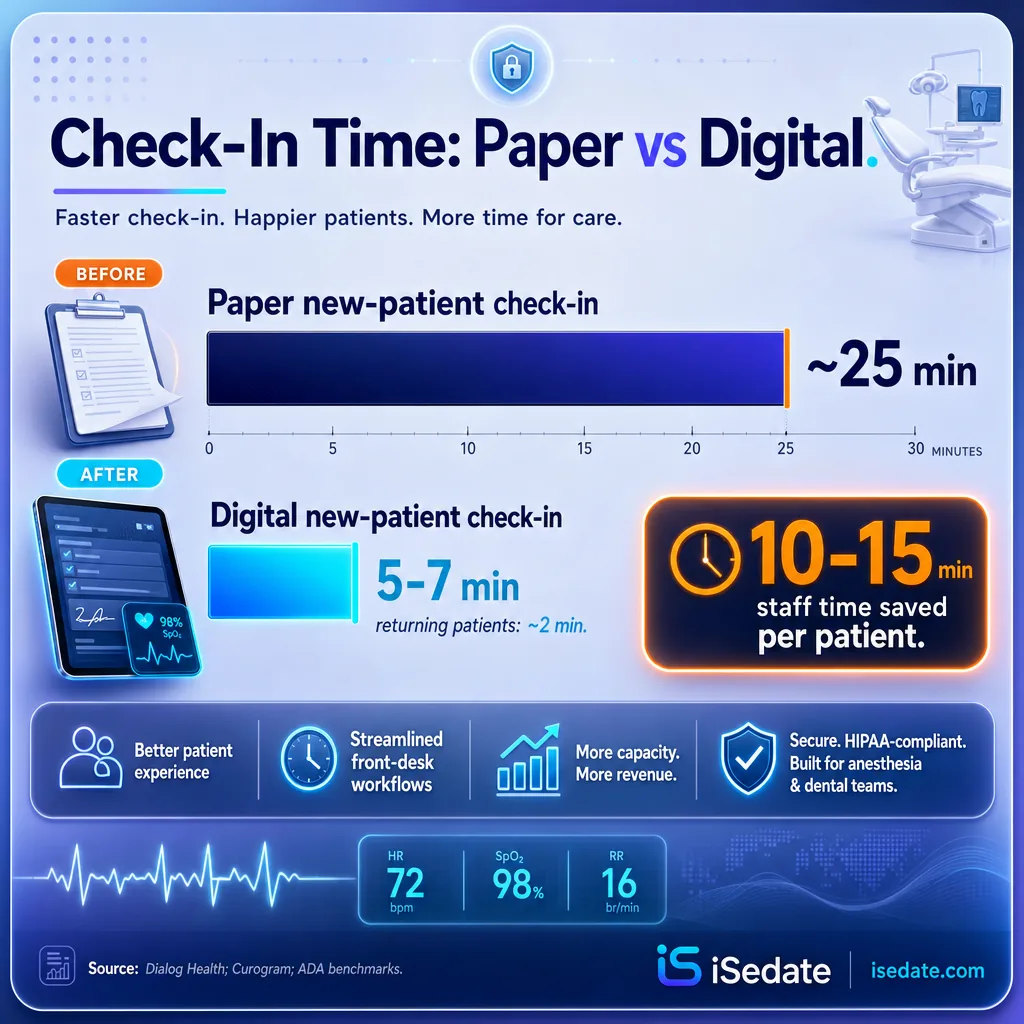
At the practice level, the numbers compound quickly. Manual paper intake consumes roughly 20 to 28 minutes per new patient across data entry and insurance steps, translating to hundreds of dollars in monthly labor cost at typical front-desk wages. Digitizing that reclaims staff time for patient interaction and revenue-generating work rather than transcription. One large health system reported over 134,000 front-desk hours saved annually after moving more than two million patients to digital intake, an enterprise-scale illustration of a per-patient saving any practice can capture proportionally.
iSedate Analysis: The time saving that matters most for sedation practices
For a practice offering sedation, front-desk time is not the only clock that matters. The pre-visit window, when a patient completes health history, medication lists, and consent before arriving, is exactly when a sedation practice most needs complete, accurate information. Digital intake that gathers a thorough medical history and medication list before the appointment gives the clinical team time to review sedation suitability in advance, rather than discovering a contraindication in the chair. The time saving is real, but for sedation the accuracy-in-advance benefit is arguably worth more.
Calculation and interpretation original to iSedate.
3 Accuracy & Error Reduction
The savings that practices most often undercount come not from time but from accuracy, because paper transcription errors carry downstream financial and clinical costs.
The financial impact is larger than most practices realize. Industry analysis attributes a substantial share of claim denials to transcription errors made at the front desk, wrong insurance IDs, transposed dates of birth, missing details, and paper intake's 12 to 18% error rate feeds directly into that denial rate. Structured digital forms cut this at the source: fields are validated at entry, handwriting is removed from the equation, and the data the practice acts on is the data the patient entered, not a staff member's transcription of it.
The most dangerous errors are clinical, not billing. A transposed insurance ID costs money; a missed medication or allergy on a health history can cost far more, especially before a sedation or surgical procedure. The two most error-prone fields in manual re-entry, medication allergies and insurance IDs, are exactly the fields where an error does real harm. This is why accuracy at intake is a patient-safety issue, not just an efficiency one.
4 What Patients Actually Want
The patient-preference data is among the most one-sided in all of dental operations, and it has shifted decisively across every age group.
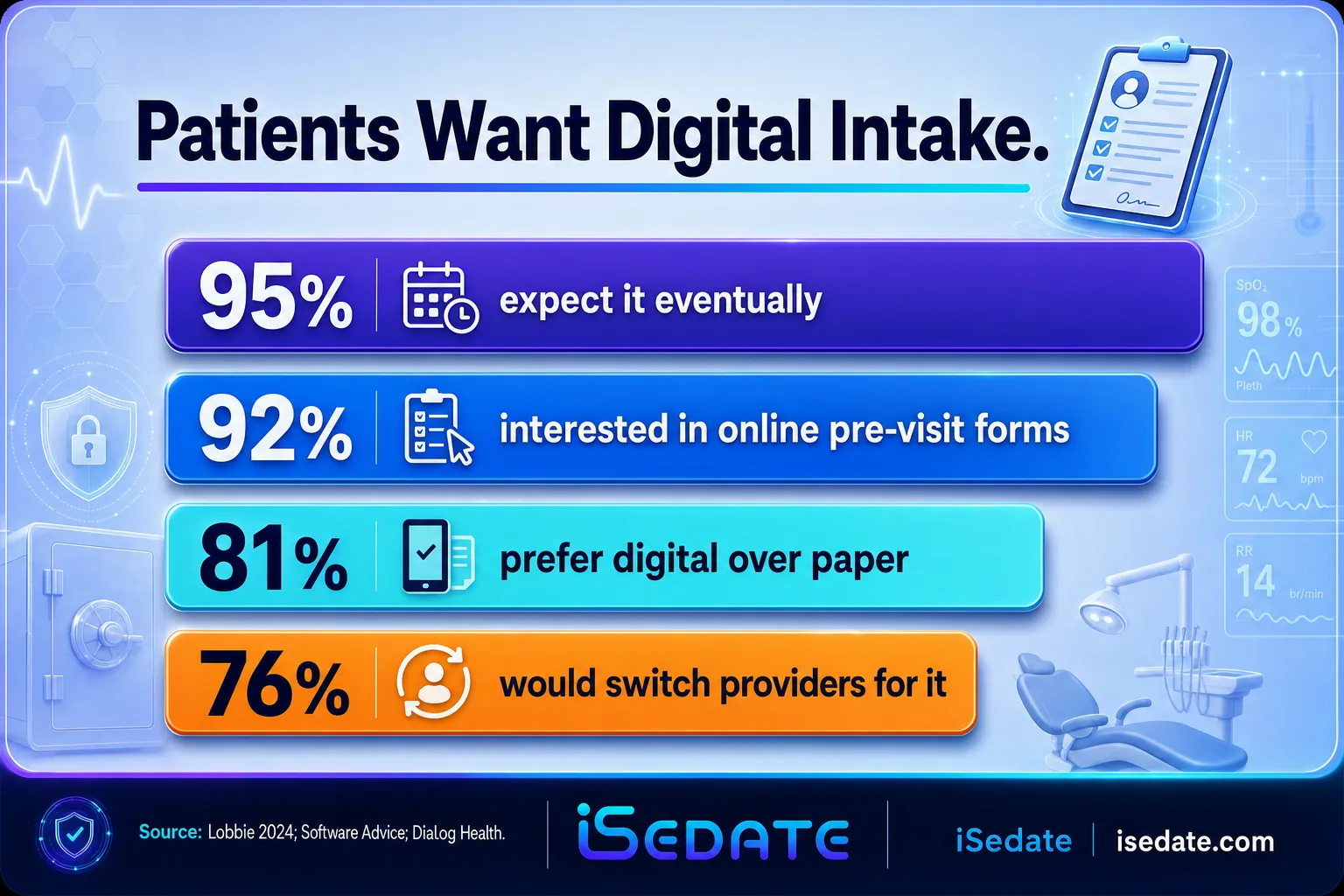
The "our patients are older and prefer paper" objection was reasonable in 2019 and is now largely obsolete. Patient expectations have shifted across all demographics, and a majority, about 92% in one survey, are interested in completing pre-visit questionnaires online rather than by phone or in person. Because 76% would actively switch providers for the digital experience, intake is no longer just an internal efficiency question; it is a patient-acquisition and retention factor. A clipboard at the front desk is now a visible signal, and not a flattering one.
See a modern intake experience5 The HIPAA & Integration Reality
Two practical realities separate digital intake done well from digital intake done carelessly, and both matter for any practice handling health information.
First, HIPAA. Digital intake is HIPAA compliant only when the software is built for it: end-to-end encryption, a signed business associate agreement with every vendor, and audit-trail logging of who accessed each submission. A generic web form, a free-tier form builder or an embedded contact form, is not compliant by default and should never carry patient health information. The convenience of a quick form is not worth the compliance exposure.
Second, integration, where honesty about the current state matters. The industry is moving toward intake that syncs directly into the practice management system, but the reality is uneven: while digital adoption reached 58%, fewer than 25% of those practices have true bidirectional PMS sync. The rest still involve some manual step to move data into the chart.
"Integrates with your PMS" deserves a follow-up question. When any intake or software vendor claims PMS integration, ask precisely what that means: a live two-way sync that writes to the patient record automatically, or an export you upload into the chart. Both can be legitimate, but they are very different in daily practice. The accurate current-state answer for many tools, including specialized ones, is export-and-upload, not live sync, and a vendor that tells you which one it actually offers is being straight with you.
iSedate Analysis: Where SedationVault fits, stated plainly
To be precise about iSedate's SedationVault: it captures its own structured intake and consent information for the sedation workflow, and it produces a clean, audit-ready PDF that a practice uploads into whatever chart it keeps, whether Dentrix, Eaglesoft, or Open Dental. It is an export-and-upload workflow, not a live bidirectional PMS sync, and we say so directly because the integration data above shows how often that distinction is blurred. What SedationVault focuses on is the accuracy and defensibility of the sedation-specific record, capturing vitals from compatible monitors such as Edan, MindRay, and Criticare and producing documentation built to withstand a board audit. Reference figures for the founders' own practice reflect thousands of documented sedation procedures, a practice-level dataset, not a nationwide claim.
Calculation and interpretation original to iSedate.
6 Consent & Sedation Intake
Not all intake forms carry equal weight. A contact-preference form and an informed-consent-for-sedation form are worlds apart in legal and clinical significance, and the digital-forms conversation should reflect that.
Consent documents, privacy acknowledgments, treatment consent, and financial-responsibility agreements, are increasingly collected digitally with e-signature before the patient arrives. For routine care this is a convenience. For sedation and anesthesia, it is a cornerstone of a defensible record. Informed consent for sedation, captured cleanly with a timestamp and signature, is exactly the kind of documentation a board or malpractice carrier examines first, and exactly the kind that is easy to lose or leave incomplete on paper.
iSedate Analysis: Intake accuracy is the front end of sedation safety
Everything in this article converges on a single point for sedation providers: the sedation record does not begin in the operatory, it begins at intake. A complete, accurate medical history and medication list gathered before the visit is what lets a clinician assess sedation suitability safely. Clean informed consent captured before the procedure is what makes the record defensible. And the 12 to 18% error rate of paper transcription is a risk a sedation practice specifically cannot afford on the exact fields, allergies and medications, that determine sedation safety. iSedate's SedationVault treats intake and consent as the front end of a continuous sedation record that runs through vitals capture to audit-ready reporting, rather than as disconnected paperwork.
Calculation and interpretation original to iSedate.
Treated as the opening stage of a Sedation Intelligence System, digital intake and consent stop being administrative overhead and become the foundation of a safe, provable sedation visit.
Book a SedationVault demo7 Summary Table: Every Statistic at a Glance
| Statistic | Figure | Source | Year |
|---|---|---|---|
| Dental practices using digital intake | 58% | US Tech Automations | 2025 |
| Healthcare orgs still using some paper | 85% | Dialog Health | 2025 |
| Practices reporting faster data entry (90 days) | 74% | ONC Health IT Dashboard | 2024 |
| Staff time saved per new patient | 10-15 min | ADA benchmarks | 2026 |
| New-patient check-in time reduction | 25 → 5-7 min | Dialog Health; Curogram | 2025 |
| Returning-patient check-in time | ~2 min | Dialog Health | 2025 |
| Manual paper intake time per patient | 20-28 min | ADA operational benchmarks | 2024 |
| Manual re-entry error rate | 12-18% | HIMSS 2024 report | 2024 |
| Fewer front-desk errors with digital | 35% | Dental Group Practice Assn. | 2024 |
| Patients preferring digital intake | 81% | Lobbie; Software Advice | 2024 |
| Patients who would switch providers for it | 76% | Lobbie | 2024 |
| Patients expecting online intake eventually | 95% | Lobbie | 2024 |
| Patients interested in online pre-visit forms | 92% | Dialog Health | 2025 |
| Practices with true bidirectional PMS sync | <25% | US Tech Automations | 2025 |
| Patient intake software market (2024) | ~$1.7B | Dialog Health | 2024 |
| Potential U.S. admin-digitization savings | $13.3B | CAQH Index | 2024 |
Frequently Asked Questions
How many dental practices use digital patient intake?
How much time does digital intake save?
Do patients prefer digital intake forms?
How accurate is digital intake compared to paper?
Is digital patient intake HIPAA compliant?
Methodology & Sources
Primary and institutional sources: Office of the National Coordinator for Health Information Technology (ONC 2024 Health IT Dashboard), HIMSS 2024 Health IT Adoption Report, the CAQH Index, and American Dental Association operational benchmarks. Survey and industry data: Software Advice, Lobbie (2024 patient-preference survey), Dialog Health, Curogram, the Dental Group Practice Association, and US Tech Automations for adoption, time-savings, and integration figures.
Note on scope and figures: benchmarks vary by practice size, workflow, and vendor, so figures are presented as ranges where sources differ. This article covers patient intake and digital forms; for clinical records accuracy and the paper-to-digital transition of the patient chart, see the companion report on paperless dental records. The distinction between live PMS integration and export-and-upload workflows is noted throughout, as sources frequently blur it. Statistics reflect the most recent available data as of 2026 and will be refreshed annually.
Media & press usage: Journalists and researchers are welcome to cite these statistics with attribution to iSedate and a link to this page. The iSedate Analysis boxes contain original interpretation unique to this article.