





Dental Practice Cybersecurity & Data Breach Statistics (2026): Attacks, Costs & the Records at Risk
In just the first 10 months of 2024, the dental data of more than 88 million people was exposed, according to the U.S. Department of Health and Human Services. Dental practices have become prime targets: rich in patient data, thin on IT security, and unable to afford downtime. The record most exposed by this trend is also the most sensitive, which is exactly why where you store it matters.
- Over 88 million people's dental data was exposed in the first 10 months of 2024 alone (U.S. Department of Health and Human Services).
- The largest dental-sector breach on record, MCNA Dental (2023), exposed 8,923,662 individuals; Delta Dental of California exposed 6,928,932 (HIPAA Journal / Medix Dental).
- Healthcare ransomware attacks surged 58% in 2025, with 636 attacks; secondary providers including dental offices were about 26% of incidents (BlackFog; ekimit).
- In 2024, an estimated 88% of healthcare workers opened phishing emails, the leading attack entry point (ekimit).
- Average healthcare ransomware recovery cost reached about USD 1.02 million in 2025, separate from ransom, with ~19 days average downtime (ekimit).
- Only about 14% of healthcare organizations report fully staffed IT security teams (ekimit).
- Storing sensitive records in HIPAA-compliant cloud, not email or a local server, cuts exposure, the model behind iSedate's SedationVault.
What's in This Guide
1 The Scale: How Much Dental Data Is Exposed
The numbers are larger than most practice owners realize, because breaches are reported one at a time while the cumulative total rarely gets stated plainly. Here it is plainly.
That figure comes from the government body that tracks it. The HHS Office for Civil Rights breach portal, which logs every incident affecting 500 or more patients, consistently shows hundreds of reported breaches per year in the dental and healthcare sector, and countless smaller incidents at individual practices never reach the national count at all. The scale is not a series of unlucky exceptions; it is the baseline threat environment a dental practice now operates in.
The question has changed. Cybersecurity guidance for 2026 puts it bluntly: for a dental practice, the question is no longer whether you are a target, but whether you are a harder target than the practice down the street. Criminal groups use automated tools that find and exploit the easiest victims first. Being marginally better defended than your neighbors is often what determines whether an automated attack moves on.
Source: Group Dentistry Now on HHS dental breach data | Siotek 2026 dental threat landscape
See HIPAA-compliant data protection2 The Largest Dental Breaches
The headline breaches show both the scale and the pattern. Nearly all began not with a brilliant hack of hardened systems, but with a trusted identity or a trusted third party.
| Breach | Individuals Affected | Year | Method |
|---|---|---|---|
| MCNA Dental | 8,923,662 | 2023 | LockBit ransomware |
| Delta Dental of California | 6,928,932 | 2023 | MOVEit supply-chain zero-day |
| Chord Specialty Dental Partners | 173,000+ | 2025 | Data security incident |
| Park Dental / The Dental Specialists | 277,109 | 2024 | Email compromise (MFA bypassed) |
| Rinehart Dentistry | 25,000 | 2025 | Data breach |
The MCNA Dental breach, the largest in the sector's history, unfolded because an intruder moved through the network for roughly a week and a half before detection, long enough to copy hundreds of gigabytes of data out. The Park Dental case is the cautionary tale on authentication: multi-factor authentication was in place but was circumvented, and patient data was sitting in email inboxes, turning one hijacked account into a six-figure breach. The lesson repeated across every major incident is that dwell time and data stored in the wrong places, especially email, are what turn an intrusion into a catastrophe.

Source: Medix Dental on the largest dental breaches | Becker's Dental Review 2025 breaches
See iSedate's SedationVault3 Why Dental Practices Are Targeted
Dental practices are not collateral damage in attacks aimed elsewhere. They are chosen, for reasons that are entirely rational from a criminal's point of view.
The value gap explains the focus: a dental practice holds names, birth dates, Social Security numbers, insurance details, and treatment records, a complete identity package worth far more than a credit-card number. Combine high-value data with thin security staffing and one more factor, urgency, and the targeting logic is complete. A practice cannot afford to be offline; every hour the schedule is locked, revenue is lost. Attackers know this and price ransoms to feel cheaper than extended downtime.
iSedate Analysis: The small-practice security paradox
The data exposes a paradox that hits office-based sedation providers hard. Dental practices hold hospital-grade sensitive data (worth up to USD 1,000 per record) but have hospital-grade security in only about 14% of cases. A solo or small group practice running sedation carries exactly this mismatch: highly sensitive records, including sedation and anesthesia documentation, protected by whatever a small office can manage. The resolution is not to hire a security team most practices cannot afford, but to store the most sensitive records in platforms where enterprise-grade security is built in, rather than on a local server or in an email inbox.
Calculation and interpretation original to iSedate.
Source: ekimit on why dental offices are targeted
See SedationVault for dentists4 How Attacks Happen
Understanding the attack methods matters because nearly all of them are preventable with basic controls, and nearly all of them start with a person, not a machine.

The common entry points are consistent: phishing emails that trick an employee into opening a malicious link, remote-access connections left open without strong authentication, and outdated, unpatched software. A newer threat, business email compromise, involves no malware at all, just a convincing fraudulent email requesting an urgent wire transfer or payment-account change. And third-party risk is rising fast: attacks on healthcare businesses that serve providers rose 30% in 2025, meaning a practice with strong internal security can still be breached through a weaker vendor. The 2024 Change Healthcare attack, which disrupted claims processing for dental offices nationwide for weeks, proved that a single vendor compromise can paralyze practices that were never directly attacked.
Source: BlackFog State of Ransomware 2025 | Dental IT Guide on attack methods
Book a SedationVault demo5 The Cost of a Breach
The financial damage extends well beyond any ransom, and for a small practice it can be existential.
Nearly 19 days of downtime means nearly three weeks operating on paper, rescheduling patients, and working with IT vendors and possibly law enforcement, all while revenue stalls. Paying the ransom is not an escape: only about 2% of organizations that paid recovered all their data, and payment marks a practice as willing to pay, inviting follow-up attacks. On top of recovery costs come HIPAA breach-notification obligations, potential regulatory penalties, class-action lawsuits, and lasting reputational damage. The math is why prevention and resilient storage vastly outperform response.
Source: ekimit on breach recovery costs | Siotek on Change Healthcare cash-flow impact
Compare SedationVault plans and pricing6 Protecting the Most Sensitive Records
The defensive playbook is well established, and the theme running through it is that where and how you store data matters as much as any single security product.
The core controls every source agrees on: tested offsite backups isolated from the network (a USB drive next to the server does not count, ransomware encrypts it too), phishing-resistant multi-factor authentication on every access point, endpoint detection and response software that catches ransomware behavior before it finishes encrypting, current software patching, and ongoing staff security training. Underlying all of them is a storage principle the biggest breaches keep proving: sensitive data sitting in email inboxes or on a single local server is the most exposed data a practice has.
iSedate Analysis: Sedation records deserve the strongest storage
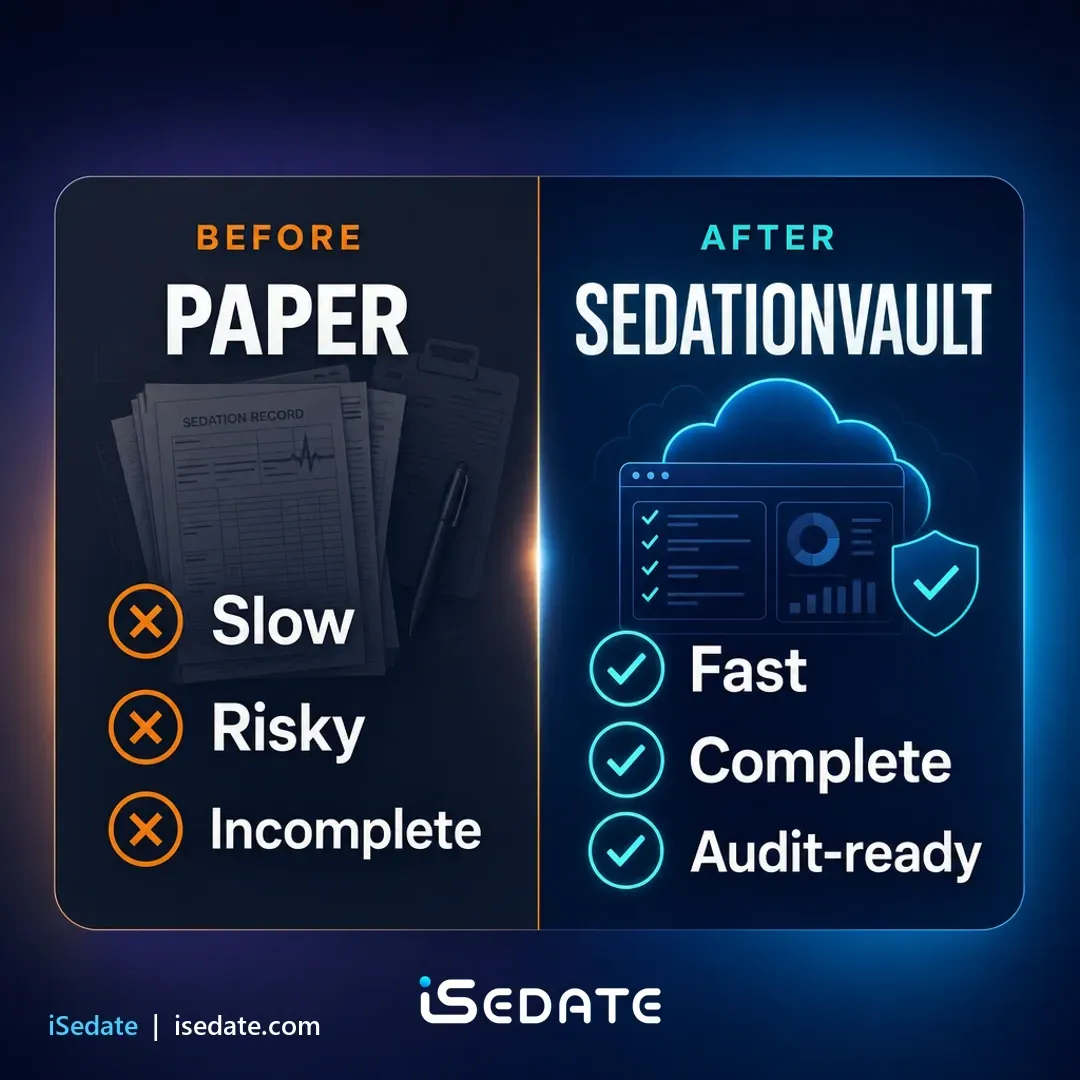
Sedation and anesthesia documentation is among the most sensitive records a practice holds, and by the logic of every breach in this article, it should be among the best protected. A sedation record on paper can be lost or destroyed; one saved as a loose file on a local server or emailed around is exactly the data that turned hijacked accounts into six-figure breaches. iSedate's SedationVault stores sedation records in HIPAA-compliant cloud infrastructure by design, with enterprise-grade security a small practice cannot easily replicate on its own hardware. It captures vitals from compatible monitors such as Edan, MindRay, and Criticare, then exports a clean PDF into the chart the practice already keeps, whether Dentrix, Eaglesoft, or Open Dental, rather than leaving sensitive records scattered in email. Reference figures for the founders' own practice reflect thousands of documented sedation procedures, a practice-level dataset, not a nationwide claim.
Calculation and interpretation original to iSedate.
Treated as a secure, cloud-native Sedation Intelligence System, the sedation record gains the enterprise-grade protection the breach data shows small practices otherwise lack, applied to the record where a breach would do the most harm.
Source: Siotek on dental cybersecurity controls | Dental IT Guide on protection best practices
See secure sedation compliance7 Summary Table: Every Statistic at a Glance
| Statistic | Figure | Source | Year |
|---|---|---|---|
| Dental data exposed (first 10 months) | 88M+ people | HHS | 2024 |
| Largest dental breach (MCNA Dental) | 8,923,662 | HIPAA Journal / Medix | 2023 |
| Delta Dental of California breach | 6,928,932 | HIPAA Journal / Medix | 2023 |
| Chord Specialty Dental Partners breach | 173,000+ | Becker's Dental Review | 2025 |
| Park Dental / Dental Specialists breach | 277,109 | Medix Dental | 2024 |
| Healthcare ransomware attacks | 636 | BlackFog | 2025 |
| Ransomware surge on healthcare | +58% | ekimit | 2025 |
| Secondary providers' share of attacks | ~26% | ekimit | 2025 |
| Healthcare workers who opened phishing emails | 88% | ekimit | 2024 |
| Dark-web value of a complete medical record | Up to $1,000 | ekimit | 2025 |
| Healthcare orgs with fully staffed IT security | ~14% | ekimit | 2025 |
| Average ransomware recovery cost | ~$1.02M | ekimit | 2025 |
| Average ransomware recovery time | ~19 days | ekimit | 2025 |
| Orgs recovering all data after paying ransom | ~2% | ekimit | 2025 |
| Rise in attacks on provider-serving vendors | +30% | ekimit | 2025 |
Frequently Asked Questions
How many dental records have been exposed in data breaches?
Why are dental practices targeted by hackers?
What is the most common way dental practices get hacked?
How much does a dental data breach cost?
How can dental practices protect patient data?
Methodology & Sources
Primary and institutional sources: U.S. Department of Health and Human Services and its Office for Civil Rights breach portal (dental data exposure and breach reporting). Breach documentation and industry analysis: HIPAA Journal, Medix Dental, Becker's Dental Review, Group Dentistry Now, BlackFog (State of Ransomware 2025), ekimit, Siotek, and Dental IT Guide (Darkhorse Tech) for named breach details, attack methods, costs, and defensive controls.
Note on scope: this article focuses on dental-practice-specific cybersecurity and data breaches. For the broader healthcare data breach landscape, HIPAA fines and settlements by year, and OCR enforcement trends, see the companion report on healthcare data breach statistics. Named breach figures reflect the affected-individual counts reported to regulators or documented by HIPAA Journal; some counts were updated months after initial disclosure as investigations concluded. Statistics reflect the most recent available data as of 2026 and will be refreshed annually. This is a sensitive topic; practices seeking to assess their own exposure should consult a qualified dental-IT or cybersecurity professional.
Media & press usage: Journalists and researchers are welcome to cite these statistics with attribution to iSedate and a link to this page. The iSedate Analysis boxes contain original interpretation unique to this article.