







Digital Consent Statistics in Healthcare (2026): Adoption, Legal Validity & Comprehension
Electronic signatures carry the same legal weight as handwritten ones under U.S. law, and a meta-analysis of 63 studies found electronic consent significantly improves both patient understanding and satisfaction. Digital consent is not merely a paperless convenience; done properly, it produces consent that is better understood by the patient and better defended in a dispute. For high-stakes procedures like sedation, that combination is the whole point.
- Electronic signatures are legally valid for medical consent in the U.S. under the ESIGN Act (2000) and UETA, with the same legal weight as handwritten signatures (ESIGN Act; UETA).
- A meta-analysis of 63 studies (over 6,200 patients) found e-consent significantly improved patient satisfaction and knowledge gain versus paper, each at P less than 0.00001 (Acta Neurochirurgica, 2023).
- A systematic review of 40 studies across 13 countries and 15 surgical specialties found roughly two-thirds of communication-focused interventions improved comprehension (BJS Open, 2023).
- Interactive consent with test or teach-back features shows the strongest comprehension gains (updated systematic review).
- There is no uniform global legal framework for e-consent; the U.S. explicitly permits it, while some jurisdictions restrict it (BMC Health Services Research, 2025).
- Defensible e-consent must prove who signed, what, when, and that the record stayed intact, all requiring an audit trail (HIPAA e-signature guidance).
- Sedation consent is among the highest-stakes consent documents, where comprehension and a defensible audit trail matter most, an area iSedate's SedationVault addresses.
What's in This Guide
1 Is Digital Consent Legally Valid?
The first question every practice asks about digital consent is whether it will hold up. In the United States, the answer is settled and has been for over two decades.
Under the federal Electronic Signatures in Global and National Commerce Act (ESIGN) of 2000 and the Uniform Electronic Transactions Act (UETA), adopted by most states, an electronic signature is legally enforceable provided it reflects the signer's intent, the signer consented to do business electronically, the signature is attributable to that person, and the signed record is preserved. For medical consent specifically, valid e-consent requires clear evidence of informed consent, robust authentication to prevent fraud, and an audit trail for any future dispute. On top of these, HIPAA imposes stricter security expectations: the e-signature process must protect patient data through secure, authenticated methods.
HIPAA does not name a specific e-signature technology. A common misconception is that HIPAA blesses a particular product or standard. It does not. Instead it requires you to safeguard protected health information through administrative, physical, and technical controls, and to document how your e-signature process meets those obligations, anchored by a risk analysis. The practical implication: not every e-signature tool is HIPAA-appropriate, and a free general-purpose signing service is usually not the right choice for clinical consent.
2 The Comprehension Evidence
The most important finding in the digital-consent literature is not about convenience, it is about understanding. Consent is only ethically meaningful if the patient comprehends what they are agreeing to, and here the evidence strongly favors digital.
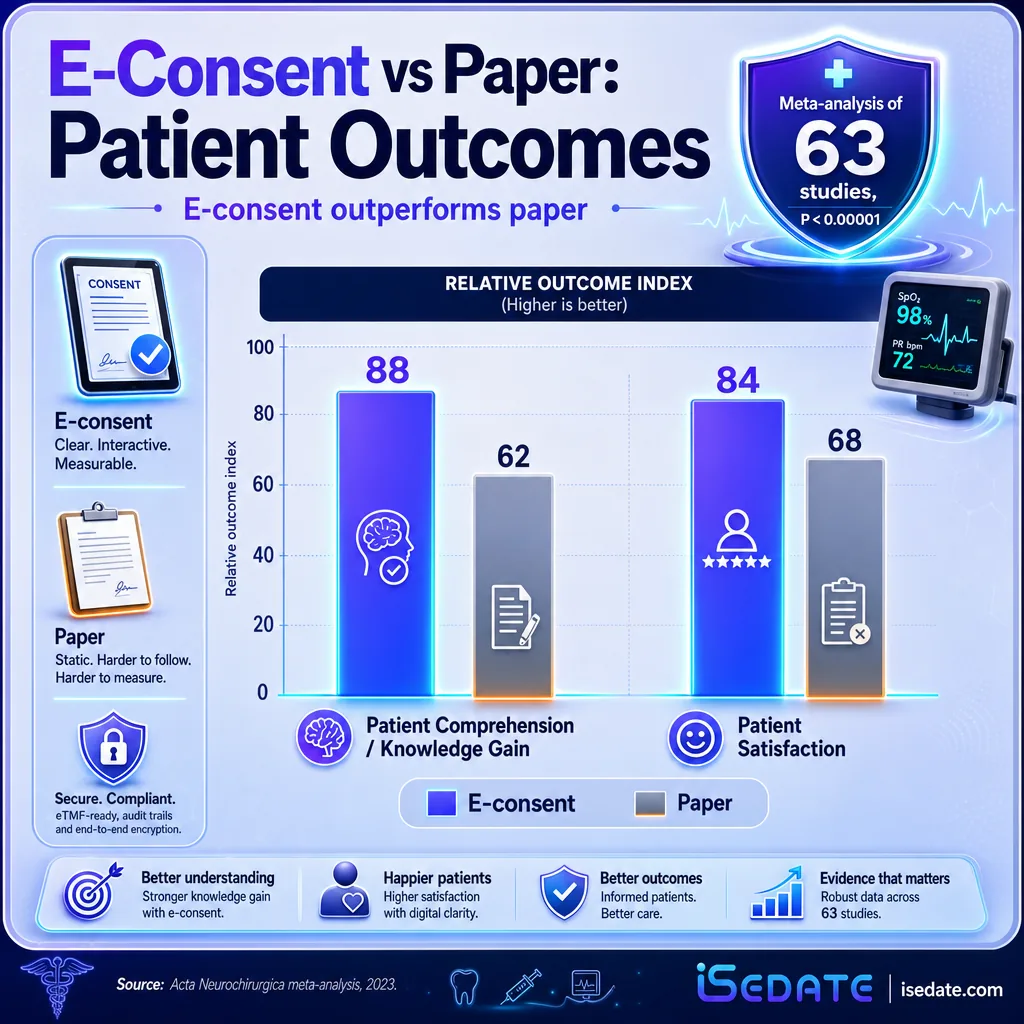
The pattern across the literature is consistent: electronic and interactive consent tools improve how much patients actually understand and retain, not just how quickly they sign. The strongest gains come from interactive formats with test or teach-back components, where the patient demonstrates understanding rather than passively viewing information. This matters because comprehension is the legal and ethical heart of informed consent. A signature on a form the patient did not understand is a weak consent; a signature backed by demonstrated understanding is a strong one.
iSedate Analysis: Comprehension is a liability shield, not just an ethic
The comprehension data has a direct medico-legal reading. Inadequate informed consent is a recurring theme in malpractice claims, and researchers explicitly note that better electronic consent has the potential to reduce the medico-legal ramifications of inadequate consent. So improving comprehension is not only the right thing ethically, it is a risk-reduction measure. A patient who genuinely understood the risks of sedation, and whose understanding is documented, is far less able to later claim they were not properly informed. Digital consent that improves comprehension is quietly one of the better liability investments a sedation practice can make.
Calculation and interpretation original to iSedate.
3 What Makes E-Consent Defensible
Legal validity and clinical benefit both depend on one underlying capability: the ability to prove, after the fact, exactly what happened. This is where digital consent decisively outperforms paper.
The four pillars of a defensible electronic consent are identity (verify the signer), intent (capture clear, informed agreement), integrity (ensure the document cannot be altered unnoticed after signing), and retention (keep the record confidential, intact, and retrievable). A complete audit trail, timestamps, signer authentication, and a tamper-evident record, is what ties them together. Paper consent fails on most of these by default: a signed paper form proves little about when it was signed, whether the patient understood it, or whether it was later altered, and it can be misfiled or lost entirely.
A signature is not the same as a defensible consent. Practices sometimes assume that any signature, wet or electronic, protects them. It does not. What protects a practice in a dispute is the surrounding evidence: proof of identity, proof of informed intent, proof the document was unaltered, and a retrievable audit trail with timestamps. A scanned image of a paper signature captures the mark but little of the context. This is the specific area where purpose-built digital consent is not just more convenient than paper, it is materially more defensible.
4 Adoption & the Legal Patchwork
Adoption of electronic consent has grown substantially over the past decade, accelerated by the pandemic, but it is uneven, and the reasons are as much legal as technical.
A 2025 scoping review found the legal landscape fragmented: the United States and Singapore explicitly permit e-consent, others allow it only under vague or pilot provisions, and several jurisdictions still restrict it. Even where it is permitted, physicians have flagged unresolved questions about the validity of electronic signatures in specific contexts. The encouraging news for U.S. practices is that they sit in the clearest-permitted category: ESIGN, UETA, and HIPAA together provide a workable, well-established basis. Adoption in the U.S. is therefore a matter of choosing the right compliant tool, not waiting for legal clarity that already exists. Even major institutions have formalized this, requiring that consent records move into HIPAA-compliant, audit-ready systems rather than general-purpose signing tools.
See iSedate's SedationVault5 Remote & Telehealth Consent
The growth of remote and virtual care has made one capability essential: obtaining valid, documented consent when the patient is not physically present. Digital consent is what makes this possible.
As telehealth and remote pre-visit workflows expand, consent increasingly needs to be captured before the patient arrives, or without an in-person encounter at all. Electronic consent handles this natively, allowing a patient to review information and provide legally valid, authenticated consent remotely, with the same audit trail as an in-office signature. This is particularly relevant for procedures with a meaningful pre-visit component. A sedation case, for example, involves consent and health-history review that ideally happens before the day of the procedure, giving the clinical team time to assess suitability.
iSedate Analysis: Consent before the chair, for sedation specifically
For sedation, the timing of consent is a safety feature, not just a convenience. Capturing informed consent and a complete health history digitally, before the appointment, gives the clinician time to review the patient's suitability for sedation, flag interacting medications, and address questions, rather than rushing consent minutes before administering a sedative. Remote-capable digital consent lets the highest-stakes conversation happen when there is time to have it properly. Paper consent signed in the operatory moments before the procedure is the weakest version of this; documented, comprehension-checked consent captured in advance is the strongest.
Calculation and interpretation original to iSedate.
6 Why Sedation Consent Is Different
Not all consent carries the same weight. Consent for a routine cleaning and consent for deep sedation occupy entirely different tiers of clinical and legal risk, and the digital-consent case is strongest exactly where the stakes are highest.
Informed consent for sedation and anesthesia is among the most scrutinized documents in a dental or oral surgery practice. After any adverse sedation event, it is one of the first records a licensing board or malpractice carrier requests. It must demonstrate that the patient understood the specific risks of sedation, that consent was given voluntarily and in advance, and that the whole process is documented and retrievable. Every weakness of paper consent, uncertain timing, no proof of comprehension, risk of loss or alteration, is most dangerous precisely here.
iSedate Analysis: Consent as the opening entry in the sedation record
The evidence in this article points to a clear conclusion for sedation providers: digital consent improves comprehension (strengthening the consent's ethical and legal validity) and produces a defensible audit trail (strengthening the record), which is exactly what a high-stakes sedation consent needs. iSedate's SedationVault treats consent as the opening entry in a continuous sedation record, captured digitally with the documentation and audit-readiness the procedure demands, then carried through vitals capture from compatible monitors such as Edan, MindRay, and Criticare to an audit-ready report, and exported as a clean PDF into whatever chart the practice already keeps, whether Dentrix, Eaglesoft, or Open Dental. Reference figures for the founders' own practice reflect thousands of documented sedation procedures, a practice-level dataset, not a nationwide claim.
Calculation and interpretation original to iSedate.
Treated as the first documented step of a Sedation Intelligence System, informed consent stops being a form to file and becomes the foundation of a defensible, patient-centered sedation record, understood by the patient and provable by the practice.
Book a SedationVault demo7 Summary Table: Every Statistic at a Glance
| Statistic / Fact | Figure | Source | Year |
|---|---|---|---|
| U.S. laws validating e-signatures for consent | ESIGN Act + UETA | Federal / state law | 2000+ |
| E-consent studies in meta-analysis | 63 | Acta Neurochirurgica | 2023 |
| Randomized controlled trials included | 44 (n=6,244) | Acta Neurochirurgica | 2023 |
| Satisfaction improvement (e vs paper) | P < 0.00001 | Acta Neurochirurgica | 2023 |
| Knowledge-gain improvement (e vs paper) | P < 0.00001 | Acta Neurochirurgica | 2023 |
| Systematic review studies | 40 (13 countries) | BJS Open | 2023 |
| Interventions improving comprehension | ~two-thirds | BJS Open | 2023 |
| Elements of a defensible e-consent | 4 (who/what/when/intact) | HIPAA e-signature guidance | 2025 |
| Uniform global e-consent legal framework | None exists | BMC Health Services Research | 2025 |
| Jurisdictions explicitly permitting e-consent | U.S., Singapore (among others) | BMC Health Services Research | 2025 |
| Projected global digital health investment | ~$657B | Digital health market data | 2025 |
| Strongest comprehension format | Interactive / teach-back | Updated systematic review | 2020+ |
| HIPAA-specified e-signature technology | None (controls-based) | HIPAA guidance | 2025 |
| Institutions moving consent to compliant systems | Formalized (e.g. major universities) | Institutional policy | 2025 |
| Sedation consent scrutiny after adverse event | Among first records requested | iSedate analysis | 2026 |
Frequently Asked Questions
Are electronic signatures legally valid for medical consent?
Does electronic consent improve patient understanding?
What makes a digital consent legally defensible?
Is there a single legal standard for e-consent worldwide?
Why does digital consent matter for sedation dentistry?
Methodology & Sources
Peer-reviewed sources: systematic review and meta-analysis of e-consent in surgery (Acta Neurochirurgica, 2023; 63 studies, 44 RCTs); systematic review of digital consent technology in surgery (BJS Open, 2023; 40 studies); scoping review of digitalizing informed consent (BMC Health Services Research, 2025); and an updated systematic review of interventions to improve consent comprehension. Legal and compliance sources: the ESIGN Act (2000), the Uniform Electronic Transactions Act (UETA), and published HIPAA e-signature compliance guidance.
Note on scope and interpretation: much of the strongest comprehension evidence comes from surgical and procedural settings, which are the closest analog to sedation and anesthesia consent; findings are applied to the sedation context by analogy and are labeled as iSedate interpretation where relevant. Legal statements describe the U.S. framework (ESIGN, UETA, HIPAA) and are general information, not legal advice; consent requirements vary by state and specialty, and practices should confirm their own obligations with qualified counsel. This article covers digital and informed consent specifically; for general patient intake and digital forms, see the companion report on dental patient intake. Statistics reflect the most recent available data as of 2026 and will be refreshed annually.
Media & press usage: Journalists and researchers are welcome to cite these statistics with attribution to iSedate and a link to this page. The iSedate Analysis boxes contain original interpretation unique to this article.