







HIPAA Violation Statistics (2026): The Most Common Violations & Why They Happen
Over its enforcement history, HHS Office for Civil Rights has resolved more than 31,000 HIPAA cases and imposed penalties totaling about USD 144.9 million, yet the violations behind those numbers are strikingly repetitive. A small set of failures, led by inadequate risk analysis, appears again and again. Understanding which violations actually get cited, and why, is the most efficient way for any practice to stay out of OCR's crosshairs.
- OCR has resolved over 31,000 HIPAA cases and settled or penalized 152 for a cumulative ~USD 144.9 million (HHS Enforcement Highlights).
- The most common complaint type overall is impermissible uses and disclosures of PHI, followed by lack of safeguards and lack of patient access (HHS).
- Inadequate risk analysis is the single most-cited violation in recent enforcement, appearing in roughly 90% of Security Rule matters (Shook Hardy & Bacon analysis of OCR actions).
- OCR's Right of Access Initiative has produced 50+ enforcement actions since 2019, including a USD 170,000 penalty against a dental practice in 2024 (HIPAA Journal; OCR).
- In 2022, about 55% of OCR financial penalties were imposed on small practices (HIPAA Journal).
- Enforcement shifted toward the Security Rule: 14 of 22 actions in 2024 resolved security failures (HIPAA Journal).
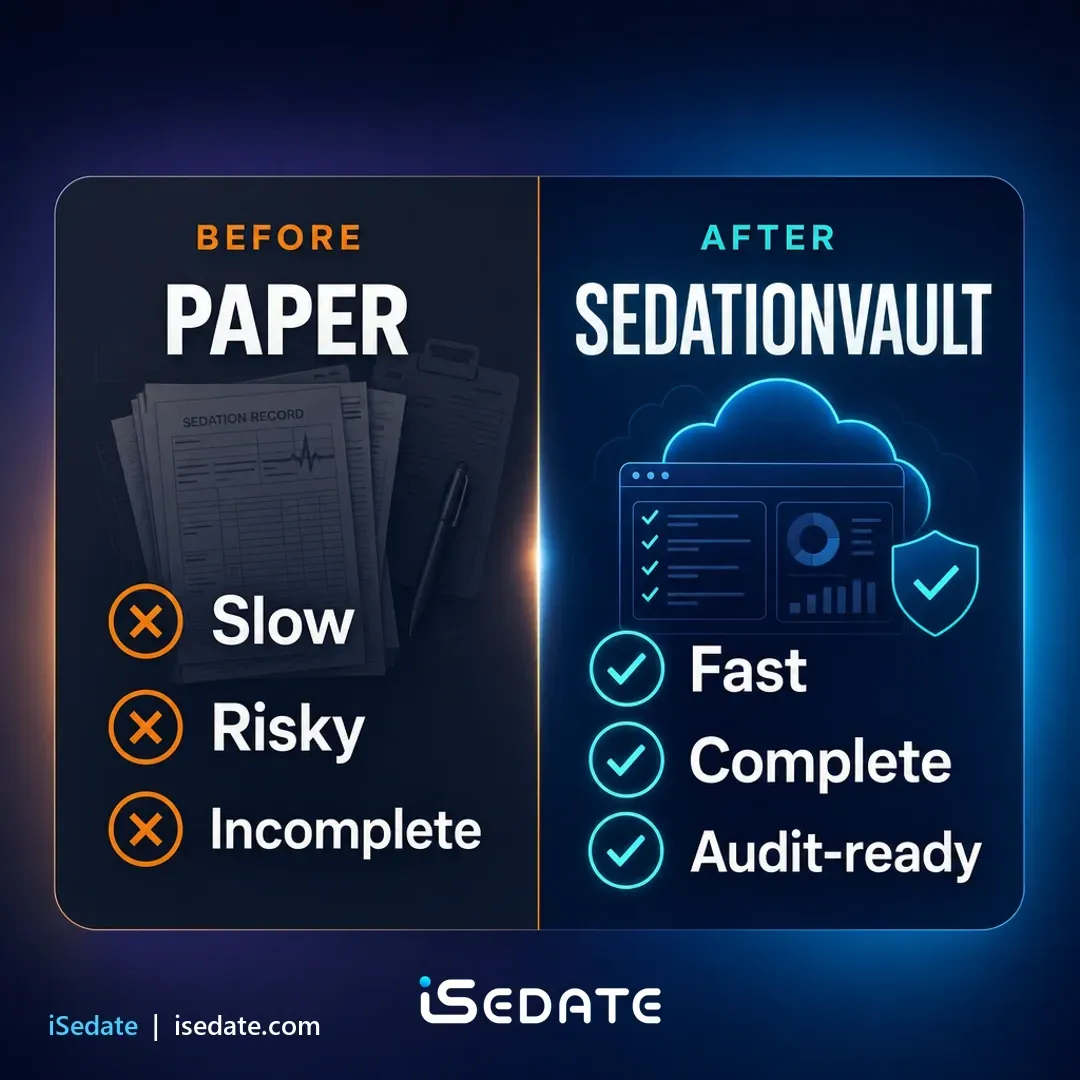
- Nearly every common violation is preventable with documentation, secure systems, and training, the foundation of provable compliance in iSedate's SedationVault.
What's in This Guide
1 The Scale of HIPAA Enforcement
Before the specific violations, the overall shape of enforcement. The numbers show an agency that investigates constantly but penalizes selectively, which changes how a practice should think about risk.
The financial penalties are the visible tip of a much larger enforcement iceberg. The vast majority of OCR resolutions involve required corrective action and technical assistance, not fines, and OCR frequently investigates without pursuing a penalty at all. One analysis noted that since 2024, formal penalties reached only a tiny fraction of regulated entities. The practical takeaway is not that fines are rare enough to ignore, but that the far more common outcome, a mandatory corrective action plan after a breach, still imposes real cost and disruption, and is triggered by the same underlying failures that produce the headline fines.
Source: HHS OCR Enforcement Highlights
See provable sedation compliance2 The Most Common Violation Types
HHS publishes the compliance issues most frequently alleged in complaints, cumulatively, and the ranking has been remarkably stable over time.
| Rank | Most Frequently Alleged Compliance Issue |
|---|---|
| 1 | Impermissible uses and disclosures of PHI |
| 2 | Lack of safeguards of PHI |
| 3 | Lack of patient access to their own PHI |
| 4 | Lack of administrative safeguards of electronic PHI |
| 5 | Use or disclosure of more than the minimum necessary PHI |

There is an important distinction hidden in this data, and missing it leads to confusion. The ranking above reflects what patients and others complain about most often. What OCR actually cites when it imposes a financial penalty is a related but different list, dominated by Security Rule failures, especially risk analysis. In other words, impermissible disclosure generates the most complaints, but inadequate risk analysis generates a large share of the fines. A practice needs to guard against both: the everyday disclosure and access issues that draw complaints, and the systemic security gaps that draw penalties.
Source: HHS OCR most-alleged compliance issues
See HIPAA-compliant records3 Why Risk Analysis Dominates
If there is one violation to understand above all others, it is the failure to conduct a proper risk analysis. It is the thread running through most major enforcement actions.
The reason risk analysis dominates is structural. A HIPAA-compliant risk analysis, an enterprise-wide assessment of threats to the confidentiality, integrity, and availability of electronic PHI, is the foundational Security Rule requirement on which nearly everything else rests. In OCR's own audits, most entities were not fully compliant with it: they either failed to conduct one, did not do it often enough, or produced one that was not comprehensive or accurate. And because risk analysis is the first thing OCR examines when investigating a hacking-related breach, a breach almost automatically surfaces the missing analysis. The failure and the penalty are tightly linked.
iSedate Analysis: The compliance lesson hiding in the risk-analysis data
The dominance of risk-analysis failures carries a clear, generalizable lesson: OCR penalizes the absence of provable, documented process more than it penalizes bad luck. A breach alone is often not what draws the fine, the fine comes from being unable to show you had done the required work beforehand. This is the compliance equivalent of the provable-safety principle that runs through sedation documentation. In both cases, the protection is not just doing the right thing, but being able to demonstrate, with records, that you did. A practice that documents its process is defensible; one that cannot show its work is exposed, whether the subject is a security risk analysis or a sedation record.
Calculation and interpretation original to iSedate.
Source: Shook Hardy & Bacon OCR enforcement analysis | HIPAA Journal on the Risk Analysis Initiative
See iSedate's SedationVault4 The Right of Access Story
The second major enforcement theme is one many practices underestimate: a patient's right to timely access to their own records. OCR has made this a signature priority.
Under the Privacy Rule, a covered entity must provide a patient access to their PHI within 30 days of a request (with one 30-day extension permitted for a written reason), in the requested format, and for a reasonable, cost-based fee. OCR treats delays here as seriously as security breaches, and it favors these cases precisely because they are straightforward to investigate and rarely challenged in court. That combination, easy to prove and hard to contest, is why access violations have produced a steady stream of penalties against practices of every size. The good news is that this is among the most preventable of all violations: a clear records-request process and staff training largely eliminate the risk.
Access violations are "low-hanging fruit" for OCR. Regulators have essentially said so. Right of Access cases require few investigative resources and the findings are unlikely to face legal challenge, which makes them attractive enforcement targets. For a practice, that means an ignored or fumbled records request is one of the easiest ways to attract a penalty, and one of the easiest to avoid. Do not let a slow front desk turn a routine records request into a federal matter.
Source: Healthcare Law Insights on Right of Access enforcement
See instant record retrieval5 Small & Dental Practices Are Targets
Perhaps the most dangerous myth in HIPAA compliance is that OCR only pursues large health systems. The data flatly contradicts it.
OCR applies the same compliance standard to a solo practice as to a national hospital chain, and it has stated plainly that covered entities cannot claim ignorance of the rules as a defense. Smaller providers are most often cited for exactly the failures a small office is prone to: missing risk-assessment documentation, weak overall compliance management, and gaps in security-awareness training, often surfacing after a phishing attack that minimal staff training failed to prevent. The 2024 dental-practice access penalty is a concrete reminder that dental offices are squarely within scope.
iSedate Analysis: Why the small-practice pattern matters for sedation offices
Office-based sedation providers are precisely the profile OCR's data flags: small practices, holding highly sensitive PHI, often without dedicated compliance staff. The violations that most commonly catch small practices, undocumented risk assessments, thin training, and disorganized records, are all documentation and process failures rather than exotic technical ones. That is actually encouraging, because process and documentation are fixable without a security department. Choosing systems that build documentation and audit-readiness into daily workflow, rather than bolting compliance on afterward, is how a small sedation practice closes the exact gaps OCR cites most.
Calculation and interpretation original to iSedate.
Source: HIPAA Journal on small-practice enforcement | HIPAA violation statistics on small providers
See SedationVault for dentists6 The Preventable Pattern
The most encouraging finding in all of this data is how repetitive and preventable the violations are. The same handful of failures accounts for the overwhelming majority of enforcement.
Across OCR's enforcement history, the recurring causes are consistent: missing or incomplete risk analysis, unauthorized access to records by staff (snooping on family, coworkers, or notable patients), lack of encryption on devices and transmissions, impermissible disclosures without authorization, late or missing breach notifications past the 60-day rule, and missing business associate agreements with vendors handling PHI. Not one of these is an unforeseeable, sophisticated attack. They are process, documentation, and configuration failures, the kind that discipline and the right systems prevent.
iSedate Analysis: Compliance as a byproduct of good systems
The through-line of every violation category is documentation and provability. Impermissible disclosure, access failures, missing risk analysis, absent audit trails, each is, at root, a failure to control and record how PHI is handled. This is why iSedate's SedationVault is built so that compliance is a byproduct of using it, not a separate chore: sedation records are captured in HIPAA-compliant cloud storage with access controls and audit-ready documentation, vitals are recorded automatically from compatible monitors such as Edan, MindRay, and Criticare, and the finished record exports as a clean PDF into whatever chart the practice already keeps, whether Dentrix, Eaglesoft, or Open Dental. It cannot make a practice fully HIPAA compliant on its own, no single tool can, but it addresses the sedation record specifically the way the enforcement data says records should be handled: documented, controlled, and provable. Reference figures for the founders' own practice reflect thousands of documented sedation procedures, a practice-level dataset, not a nationwide claim.
Calculation and interpretation original to iSedate.
For a detailed look at what these violations actually cost, including year-by-year fines, penalty tiers, and the largest settlements on record, see the companion report on HIPAA fine and settlement statistics.
Book a SedationVault demo7 Summary Table: Every Statistic at a Glance
| Statistic | Figure | Source | Year |
|---|---|---|---|
| HIPAA cases OCR has resolved (cumulative) | 31,000+ | HHS OCR | 2024+ |
| Cases with settlement or penalty | 152 | HHS OCR | 2024+ |
| Cumulative penalty total | ~$144.9M | HHS OCR | 2024+ |
| Criminal referrals to DOJ | 2,419 | HHS OCR | 2024+ |
| Most common complaint type | Impermissible use/disclosure | HHS OCR | 2024 |
| Most-cited penalty violation | Inadequate risk analysis (~90%) | Shook Hardy & Bacon | 2025 |
| Security Rule share of 2024 actions | 14 of 22 | HIPAA Journal | 2024 |
| Right of Access Initiative actions | 50+ | HIPAA Journal / OCR | 2019-2026 |
| Right of Access penalty vs a dental practice | $170,000 | Healthcare Law Insights | 2024 |
| Record-access deadline (Privacy Rule) | 30 days (+30 ext.) | HIPAA Privacy Rule | 2024 |
| Breach-notification deadline | 60 days | Breach Notification Rule | 2024 |
| Penalties imposed on small practices (2022) | 55% | HIPAA Journal | 2022 |
| OCR enforcement actions in 2025 | 21 | HIPAA Journal | 2025 |
| Large breaches from hacking/IT incidents | 80%+ | HIPAA Journal / OCR | 2025 |
Frequently Asked Questions
What is the most common HIPAA violation?
How many HIPAA complaints has OCR investigated?
Why do risk-analysis failures cause so many HIPAA penalties?
Are small and dental practices actually fined for HIPAA violations?
What are the most common causes of HIPAA violations?
Methodology & Sources
Primary and institutional sources: U.S. Department of Health and Human Services Office for Civil Rights (OCR) Enforcement Highlights (cumulative case totals, penalty totals, and most-alleged compliance issues) and the HIPAA Privacy, Security, and Breach Notification Rules. Enforcement analysis: HIPAA Journal (annual enforcement totals and initiatives), Shook Hardy & Bacon (violation-type frequency in recent actions), Healthcare Law Insights (Right of Access enforcement), and additional HIPAA violation compilations for cause categories.
Note on scope: this article covers HIPAA violation types, causes, and enforcement patterns. For year-by-year fine totals, penalty tiers and caps, and the largest named settlements on record, see the companion report on HIPAA fine and settlement statistics. The distinction between the most-complained-about issues and the most-penalized issues is drawn directly from OCR data and is important to interpret correctly. Enforcement figures reflect the most recent available OCR data as of 2026; cumulative totals grow over time. This is general information, not legal advice; practices should consult qualified HIPAA counsel for their own compliance obligations.
Media & press usage: Journalists and researchers are welcome to cite these statistics with attribution to iSedate and a link to this page. The iSedate Analysis boxes contain original interpretation unique to this article.