





IV Sedation Dentistry Statistics (2026): Usage, Safety, and Effectiveness
IV sedation is the fastest-acting and most effective form of dental sedation, with midazolam achieving roughly 89% to 94% effectiveness for anxiety control, and large oral surgery series report adverse event rates near 0.1% with careful monitoring. It is also the most potent, which is why training, titration, and continuous monitoring matter more here than anywhere else. The data below covers usage, effectiveness, safety, and how IV compares to other options.
- Midazolam, the most common IV agent, achieves about 89% to 94% effectiveness for anxiety control.
- In a head-to-head trial, IV sedation had the fastest onset (3.4 minutes) and highest satisfaction (92% very satisfied).
- A Mayo Clinic review of 17,634 sedations found a 0.1% adverse event rate and 0% mortality.
- A 7-year office series reported under 3% complications and a mortality rate near 1 in 1.7 million.
- IV sedation carries the highest adverse-effect rate among common types, with about 10% transient respiratory depression in one trial, underscoring the need for monitoring.
- Midazolam produced complete procedural amnesia in about 78% of patients in one study.
- Deep sedation is different from moderate IV sedation and is generally not recommended for routine dental practice.
What's in This Guide
01 What IV Sedation Is and How Often It's Used
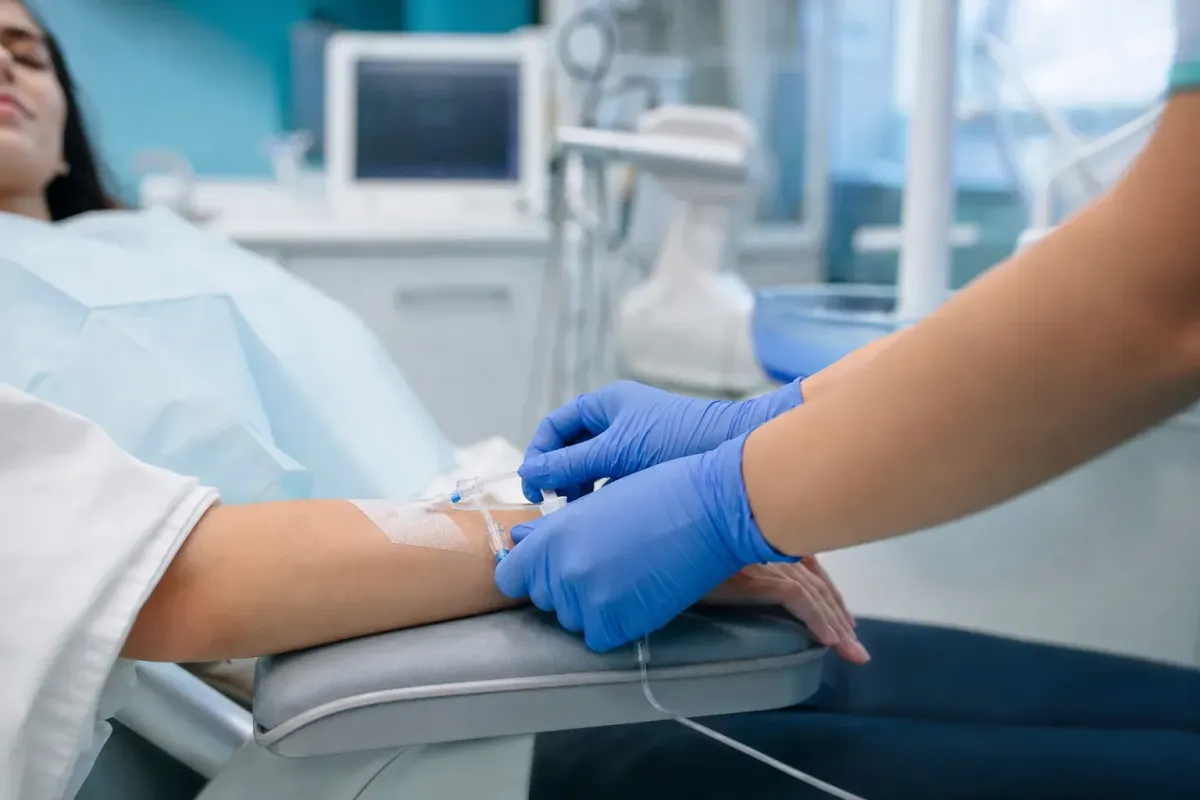
Intravenous sedation delivers sedative medication directly into the bloodstream, giving the provider precise, titratable control over the depth of sedation. In dentistry it is typically aimed at moderate, or conscious, sedation, where the patient remains able to respond and protect their own airway. It is most often reserved for anxious patients and longer or more invasive procedures.
A retrospective service evaluation of 100 consecutive patients treated under IV midazolam in general dental practice found that over half were treated because of anxiety, with a mean midazolam dose of 7.8 mg and an average treatment time of about one hour and twenty-five minutes. The authors noted that demand for adult conscious sedation in primary care is increasing, as more extensive dental treatments become possible in the office and access to hospital-based care remains variable. IV sedation sits at the higher-capability end of in-office sedation, which is exactly why its data on effectiveness and safety deserves close attention.
Dental anxiety creates broad demand for sedation, but not every anxious patient needs IV sedation. It tends to be the choice when anxiety is high, the procedure is long or complex, or lighter options have not worked. That targeting is why IV volumes are lower than nitrous or oral sedation but the clinical stakes per case are higher, placing a premium on monitoring and documentation.

Source: Adult IV sedation in general dental practice (British Dental Journal)
See IV sedation charting software
02 Effectiveness: The Fastest, Strongest Option
On pure effectiveness, IV sedation consistently outperforms other in-office options. Its advantage comes from direct delivery and titratability, which produce a fast, reliable, and adjustable effect.
A systematic review identified midazolam as the most commonly used IV sedation agent and reported effectiveness for anxiety control in the range of 89% to 94%. In a randomized controlled trial comparing three sedation methods, IV sedation had the quickest onset at 3.4 minutes, versus 5.2 minutes for nitrous oxide and 12.7 minutes for oral midazolam, and produced the greatest anxiety reduction. It also delivers strong amnestic effects: one study reported complete procedural amnesia in about 78% of patients, meaning most retained no memory of the treatment, which is often desirable for highly anxious or phobic patients. This combination of speed, depth, and amnesia is why IV sedation is the go-to for the hardest cases.

Source: RCT comparing sedation protocols for dental anxiety (NCBI)
See the dental anxiety data behind sedation demand
03 Safety and Adverse Event Rates
This is where the data is both reassuring and demanding of respect. In experienced hands with proper monitoring, IV sedation's safety record is excellent. The large series make this clear.
The large-series evidence is strong: a Mayo Clinic review of 17,634 oral and maxillofacial surgery sedations from 2004 to 2019 found an adverse event rate of about 0.1% and a mortality rate of 0%. A separate seven-year office practice series reported under 3% complications, no emergency hospital transports, and one death for a mortality rate of roughly 1 in 1.7 million. An urban OMS training program reviewing 1,167 IV sedations found adverse reactions in 0.69% of cases, all promptly addressed, with no permanent morbidity or mortality. By comparison, the mortality rate attributed to general anesthesia complications overall is often cited between 1 in 100,000 and 1 in 200,000 cases, which puts the well-monitored IV sedation numbers in favorable context.
The data says otherwise, with an important condition. IV sedation delivered at a moderate level by trained providers with continuous monitoring is remarkably safe, as the large series show. The risk rises with depth: broader analyses across all dentists estimate that deaths and brain injuries linked to deep sedation or general anesthesia most likely exceed one per month nationally, and airway compromise is a leading factor. The lesson is not that IV sedation is unsafe, it is that safety depends on staying at the appropriate level, selecting patients well, and monitoring continuously.

Source: Mayo Clinic 17,634 sedations (Journal of Oral and Maxillofacial Surgery) | Safety of IV sedation, 7-year office practice (JOMS)
See how SedationVault supports safe sedation
04 How IV Compares to Oral and Nitrous
IV sedation does not exist in isolation, and the honest picture includes its tradeoffs against the lighter options. The same randomized trial that showed IV's effectiveness also showed its cost in side effects.
In the head-to-head trial, IV sedation led on satisfaction at 92% very satisfied, ahead of nitrous oxide at 84% and oral midazolam at 76%, and it led on speed and anxiety reduction. But it also carried the highest rate of adverse effects, with about 10% of IV patients experiencing transient respiratory depression, while oral midazolam had the mildest side effects, mainly mild drowsiness. This is the central tradeoff: IV sedation is the most powerful and effective tool, and that same potency is why it demands the most monitoring. Nitrous and oral sedation, covered in their own analyses, trade some effectiveness for a gentler safety profile, which is why matching the method to the patient and procedure matters.
Line up the trial's numbers by method. Onset speed, anxiety reduction, and satisfaction all rank IV first, nitrous second, oral third. Adverse-effect rate ranks in the same order, with IV highest. The effectiveness and the risk climb together, which is the core insight of sedation practice: the more capable the technique, the more the outcome depends on monitoring and documentation rather than on the drug alone. That is precisely why the strongest option benefits most from continuous vitals capture and a complete record.
Source: RCT comparing oral midazolam, nitrous oxide, and IV sedation (NCBI). Calculation and interpretation original to iSedate.

Source: RCT comparing sedation protocols (NCBI)
See how oral surgeons use SedationVault
05 Why Monitoring Matters Most Here
Every statistic in this article points to the same practical conclusion: IV sedation's excellent safety record is not automatic, it is produced by monitoring, training, and documentation. The numbers that look reassuring come from settings that do these things well.
The safest series share common threads: highly trained anesthetic teams, careful patient selection, appropriate agent choice, and continuous monitoring of oxygenation, ventilation, and circulation. Because respiratory depression is IV sedation's most common serious adverse effect, and because airway compromise is the leading factor in anesthetic mishaps, catching a ventilation change early is what separates a non-event from an emergency. That early detection depends on monitoring being continuous and on the record being complete enough to guide real-time decisions and to demonstrate the standard of care afterward.
IV sedation is the setting where recording every parameter matters most. iSedate's SedationVault captures live vitals from compatible monitors, including Edan, MindRay, Criticare, and more (the Edan X10 is a common example), building the IV sedation record continuously as the case proceeds and producing a one-click, audit-ready PDF. For the most powerful sedation technique, that continuous capture supports both real-time safety and the documentation that a defensible practice depends on. For the broader market context, see our sedation dentistry statistics overview.

Source: How safe is deep sedation or general anesthesia in dental care (JADA) | Techniques to administer oral, inhalational, and IV sedation (NCBI)
Book a Demo
06 Summary Table: Every Statistic
| Statistic | Figure | Source | Year |
|---|---|---|---|
| Midazolam IV effectiveness for anxiety control | 89-94% | Lee et al. systematic review | 2019 |
| IV sedation mean onset time | 3.4 min | RCT (NCBI) | 2025 |
| Nitrous oxide mean onset time | 5.2 min | RCT (NCBI) | 2025 |
| Oral midazolam mean onset time | 12.7 min | RCT (NCBI) | 2025 |
| IV sedation "very satisfied" | 92% | RCT (NCBI) | 2025 |
| Nitrous oxide "very satisfied" | 84% | RCT (NCBI) | 2025 |
| Oral midazolam "very satisfied" | 76% | RCT (NCBI) | 2025 |
| IV transient respiratory depression | ~10% | RCT (NCBI) | 2025 |
| Complete procedural amnesia (IV midazolam) | ~78% | Zanette et al. | 2014 |
| Mayo Clinic adverse event rate (17,634 sedations) | 0.1% | Mayo Clinic OMFS review | 2020 |
| Mayo Clinic mortality | 0% | Mayo Clinic OMFS review | 2020 |
| 7-year office series complication rate | <3% | JOMS 7-year office study | 2005 |
| 7-year office series mortality | ~1 in 1.7 million | JOMS 7-year office study | 2005 |
| OMS training program adverse reactions (1,167 cases) | 0.69% | Urban OMS training program study | 2011 |
| Mean midazolam dose (general practice) | 7.8 mg | BDJ service evaluation | 2024 |
| Mean treatment time under IV sedation | ~1h 25m | BDJ service evaluation | 2024 |
07 Frequently Asked Questions
How effective is IV sedation for dental anxiety?
Is IV sedation safe in dentistry?
What is the most common IV sedation drug in dentistry?
How does IV sedation compare to oral and nitrous sedation?
Is deep sedation the same as IV sedation?
All figures trace to peer-reviewed studies and clinical series. Safety rates reflect specific populations and settings, most often oral and maxillofacial surgery practices with trained anesthesia teams, and should not be generalized beyond comparable conditions. Sources include:
- Lee et al. systematic review on IV sedation agents (midazolam effectiveness)
- Randomized controlled trial comparing oral midazolam, nitrous oxide, and IV sedation for dental anxiety (NCBI, 2025)
- "Safety of Outpatient Procedural Sedation Administered by Oral and Maxillofacial Surgeons: The Mayo Clinic Experience in 17,634 Sedations" (JOMS)
- "Safety of Intravenous Sedation Administered by the Operating Oral Surgeon: The First 7 Years of Office Practice" (JOMS)
- "Safety of Deep Sedation in an Urban Oral and Maxillofacial Surgery Training Program" (JOMS)
- "How safe is deep sedation or general anesthesia while providing dental care?" (JADA)
- "Adult intravenous sedation in general dental practice" (British Dental Journal)
- Zanette et al. on amnestic effects; "Techniques to administer oral, inhalational, and IV sedation" (NCBI)
IV sedation is the most powerful sedation tool, and the most dependent on continuous monitoring and documentation. iSedate's SedationVault captures live vitals and builds an audit-ready record for every IV sedation case. To see how it works in your practice, book a demo.