






Local Anesthetic Systemic Toxicity (LAST) Statistics (2026): Incidence, Recognition, and Rescue
Local anesthetic systemic toxicity is the most serious complication of the most common drug in dentistry. It is rare, roughly 0.27 per 1,000 local anesthetic administrations in dental data, but it can progress from a metallic taste to seizures and cardiac arrest. Since the introduction of lipid emulsion rescue, outcomes have improved substantially. The statistics below cover incidence, warning signs, risk factors, and treatment.
- LAST prevalence in dental anesthesia is reported at about 0.27 per 1,000 local anesthetic administrations.
- In the nerve-block literature, LAST occurs in roughly 0.03% of blocks, about 1 in 5,000.
- Pediatric LAST is estimated near 0.76 per 10,000 procedures, but infants and neonates are about 54% of reported pediatric cases.
- CNS symptoms usually come first: tinnitus, metallic taste, perioral numbness, then seizures.
- About 1 in 5 patients present with cardiovascular signs first, skipping the usual warning phase.
- 20% lipid emulsion is the antidote: about 1.5 mL/kg bolus, then 0.25 mL/kg/min.
- Resuscitation is modified: lidocaine must not be used as an antiarrhythmic in LAST.
What's in This Guide
01 How Often LAST Happens
LAST is genuinely rare, which is both reassuring and a challenge: rare events are the ones teams are least practiced at recognizing. The reported rates vary by setting and technique, so the honest picture is a range rather than a single number.
A dental anesthesia review reported LAST prevalence at approximately 0.27 per 1,000 local anesthetic administrations, describing it as possibly the most lethal adverse event associated with dental local anesthesia. In the wider regional anesthesia literature, systemic toxicity has been estimated to occur in about 0.03% of peripheral nerve blocks, roughly 0.27 episodes per 1,000 blocks, with some settings reporting rates as high as 1 in 500 and epidural figures near 4 in 10,000. In children the estimated rate is about 0.76 cases per 10,000 procedures. These numbers are small, but dentistry's enormous volume of local anesthetic use, detailed in our local anesthesia in dentistry statistics, means the absolute number of at-risk administrations is very large.

Source: Lipid emulsion therapy of LAST due to dental anesthesia (JDAPM, NCBI) | LAST management with intralipid and ASRA 2020 updates (NCBI)
See how SedationVault documents every case
02 How It Happens
Understanding the two pathways to toxic blood levels explains why prevention focuses on the specific habits it does. LAST is not an allergic reaction, it is a concentration problem.
LAST occurs when the blood concentration of local anesthetic reaches a toxic range, either by direct intravascular administration or by gradual absorption from tissue. At toxic concentrations, local anesthetics block voltage-gated sodium channels in the central nervous system and myocardium; as levels climb further, potassium channel blockade prolongs the QT interval and arrhythmias follow, which can end in cardiac arrest. Speed of absorption depends chiefly on the vascularity of the injected area. In dentistry the intravascular route is a real concern because highly vascular injection sites and nerve block techniques carry a measurable rate of inadvertent vessel entry, which is precisely why aspiration before injection is a core safety habit.
It is easy to think of LAST as purely an accident of needle placement, but the total quantity administered across a visit is equally important. Toxicity is dose-related, so a long appointment with repeated top-ups can accumulate toward a toxic level even without any single intravascular injection. This is why the safe practice is to calculate the patient's maximum dose by weight before starting, track cartridges used during the visit, and record what was given.

Source: Mechanisms and efficacy of IV lipid emulsion for LAST (NCBI)
See anesthesia record software
03 Recognizing LAST
Recognition is where outcomes are won or lost. The classic progression gives a warning window, but that window is not guaranteed, and knowing both patterns is essential.
The textbook sequence begins with central nervous system excitation: ringing in the ears, a metallic taste, numbness or tingling around the mouth, blurred vision, dizziness, confusion, agitation, and slurred speech, progressing to muscle twitching and seizures, then to depression with drowsiness, coma, and respiratory arrest. Cardiovascular effects typically follow, including bradycardia, arrhythmias, hypotension, and cardiac arrest. Two caveats matter enormously in practice. First, roughly one in five patients present with cardiovascular signs first, with no neurologic warning. Second, sedated or anesthetized patients may not be able to report the early subjective symptoms at all, which delays diagnosis until hemodynamic changes appear, one more reason continuous monitoring matters at deeper levels of sedation, as covered in our general anesthesia in dentistry statistics.
Not reliably. About one in five LAST cases begin with cardiovascular signs rather than the familiar tinnitus and metallic taste, and a sedated patient may be unable to report early symptoms even if they occur. Onset can also be delayed rather than immediate, particularly with larger cumulative doses. Waiting for the classic warning sequence before considering LAST is therefore unsafe. Any unexplained neurologic or cardiovascular change after local anesthetic administration should raise the possibility, prompting immediate assessment rather than watchful waiting.

Source: Local Anesthetic Systemic Toxicity clinical review (EMCrit IBCC) | LAST problem-based learning discussion (ASRA)
See live vitals charting
04 Who Is at Higher Risk
LAST risk is not evenly distributed. Both patient characteristics and drug choices shift the odds, and knowing the higher-risk profiles guides dose planning and vigilance.
Although pediatric LAST is rare overall, infants and neonates make up roughly 54% of reported pediatric cases, and in one systematic review of pediatric lipid emulsion treatment nearly 43% of patients were under one year old. Older adults are also disproportionately affected, with reduced muscle mass, slower circulation, decreased renal function, and multiple coexisting conditions cited as contributors. Drug choice matters too: bupivacaine carries greater cardiotoxic risk than ropivacaine or lidocaine, while in dentistry lidocaine and articaine are the dominant agents and have comparatively favorable profiles. Additional risk factors include hepatic or cardiac impairment, low body weight, and any circumstance where large total doses are used. For children specifically, weight-based dosing discipline is paramount, a theme that runs through our pediatric sedation statistics.

Source: Lipid emulsion treatment for pediatric LAST, systematic review (NCBI) | LAST following inadvertent IV infusion in infants (NCBI)
See how dentists use SedationVault
05 Lipid Emulsion Rescue
The single biggest change in LAST outcomes came from a specific antidote. Lipid emulsion therapy transformed a frequently catastrophic event into one that is often survivable with prompt treatment.
Since around 2010, 20% intravenous lipid emulsion has been the definitive treatment for LAST, often called lipid rescue therapy. It works as a lipid sink, sequestering lipophilic local anesthetic away from its receptor targets while also improving cardiac perfusion, conduction, and contractility. Under ASRA guidance, treatment is a bolus of roughly 1.5 mL/kg of 20% emulsion followed by an infusion near 0.25 mL/kg/min, continued for at least 10 minutes after hemodynamic stability, with a typical ceiling around 10 mL/kg in the first 30 minutes. Critically, resuscitation for LAST differs from standard ACLS: lidocaine must not be given as an antiarrhythmic because it would worsen the underlying toxicity, calcium channel blockers and beta blockers are avoided, and epinephrine is used in reduced doses. In refractory cases, extracorporeal support may be required.
Consider the arithmetic of readiness. At roughly 0.27 events per 1,000 administrations, a clinician giving thousands of cartridges a year may go an entire career without seeing a severe case, yet if one occurs the response window is minutes and the correct protocol is counterintuitive, because the drug used routinely for arrhythmias is precisely the one that must be withheld. Rarity does not reduce the preparation required, it increases it, because nothing about daily practice reinforces the right reflex. That is why the practical safeguards are procedural rather than instinctive: know the patient's maximum dose before starting, track and document what has been given, keep lipid emulsion available, and rehearse the protocol as a team.
Sources: ASRA lipid emulsion guidance; dental LAST prevalence data. Interpretation original to iSedate.

Source: Local anesthetics, adverse events and dental practice (Oral Health Group) | LAST under anesthesia, management essentials (Medscape)
Book a Demo
06 Summary Table: Every Statistic
| Statistic | Figure | Source | Year |
|---|---|---|---|
| LAST prevalence, dental local anesthesia | 0.27 per 1,000 | JDAPM dental LAST review | 2019 |
| LAST incidence, peripheral nerve blocks | ~0.03% (0.27/1,000) | ASRA-based case review (NCBI) | 2025 |
| Approximate block-based rate | ~1 in 5,000 | Clinical review (EMCrit IBCC) | 2025 |
| Reported upper-range block incidence | Up to 1 in 500 | Scoping review (NCBI) | 2024 |
| Epidural procedure incidence | ~4 per 10,000 | Scoping review (NCBI) | 2024 |
| Pediatric LAST rate | 0.76 per 10,000 | Pediatric case report review (NCBI) | 2023 |
| Infants/neonates share of pediatric cases | ~54% | Pediatric case report review (NCBI) | 2023 |
| Pediatric LE cases under 1 year old | ~43% | Pediatric LE systematic review | 2024 |
| Bupivacaine share of pediatric LAST cases | ~67% | Pediatric LE systematic review | 2024 |
| Patients presenting with CVS signs first | ~1 in 5 | Clinical review (EMCrit IBCC) | 2025 |
| Lipid emulsion bolus dose | 1.5 mL/kg (20%) | ASRA guidance | 2020 |
| Lipid emulsion infusion rate | 0.25 mL/kg/min | ASRA guidance | 2020 |
| Typical lipid emulsion maximum | ~10 mL/kg / 30 min | ASRA guidance | 2020 |
| Lidocaine maximum dose (with epinephrine) | 7 mg/kg | Clinical references | current |
| Contraindicated in LAST resuscitation | Lidocaine as antiarrhythmic | ASRA / Medscape | current |
07 Frequently Asked Questions
What is local anesthetic systemic toxicity (LAST)?
How common is LAST in dentistry?
What are the first warning signs of LAST?
How is LAST treated?
How can dental practices prevent LAST?
All figures trace to peer-reviewed studies, clinical references, and professional society guidance. LAST incidence figures come from different settings, dental administration, peripheral nerve blocks, epidurals, and pediatric procedures, which are not directly comparable; they are presented separately rather than combined. Dosing figures reflect published guidance and are included for context, not as a substitute for current protocols or clinical judgment. This article is informational and not a treatment protocol; practices should follow current ASRA guidance and their own emergency procedures. Sources include:
- Rhee et al., "Lipid emulsion therapy of local anesthetic systemic toxicity due to dental anesthesia" (JDAPM, 2019)
- "Successful LAST Management With Intralipid," including 2020 ASRA updates (NCBI)
- "Mechanisms and Efficacy of Intravenous Lipid Emulsion Treatment for Systemic Toxicity From Local Anesthetics" (Frontiers in Medicine)
- "Lipid emulsion treatment for local anesthetic systemic toxicity in pediatric patients: A systematic review" (NCBI)
- "Local Anesthetic Systemic Toxicity Following Inadvertent Intravenous Levobupivacaine Infusion in Infants" (NCBI)
- American Society of Regional Anesthesia and Pain Medicine (ASRA) LAST guidance and checklist
- "Local anesthetics, adverse events and dental practice" (Oral Health Group)
LAST is the serious-complication counterpart to the everyday data in our local anesthesia in dentistry statistics. For the wider safety picture, see our sedation-related adverse event statistics and board audit and sedation compliance statistics, or the full landscape in our sedation dentistry statistics overview.
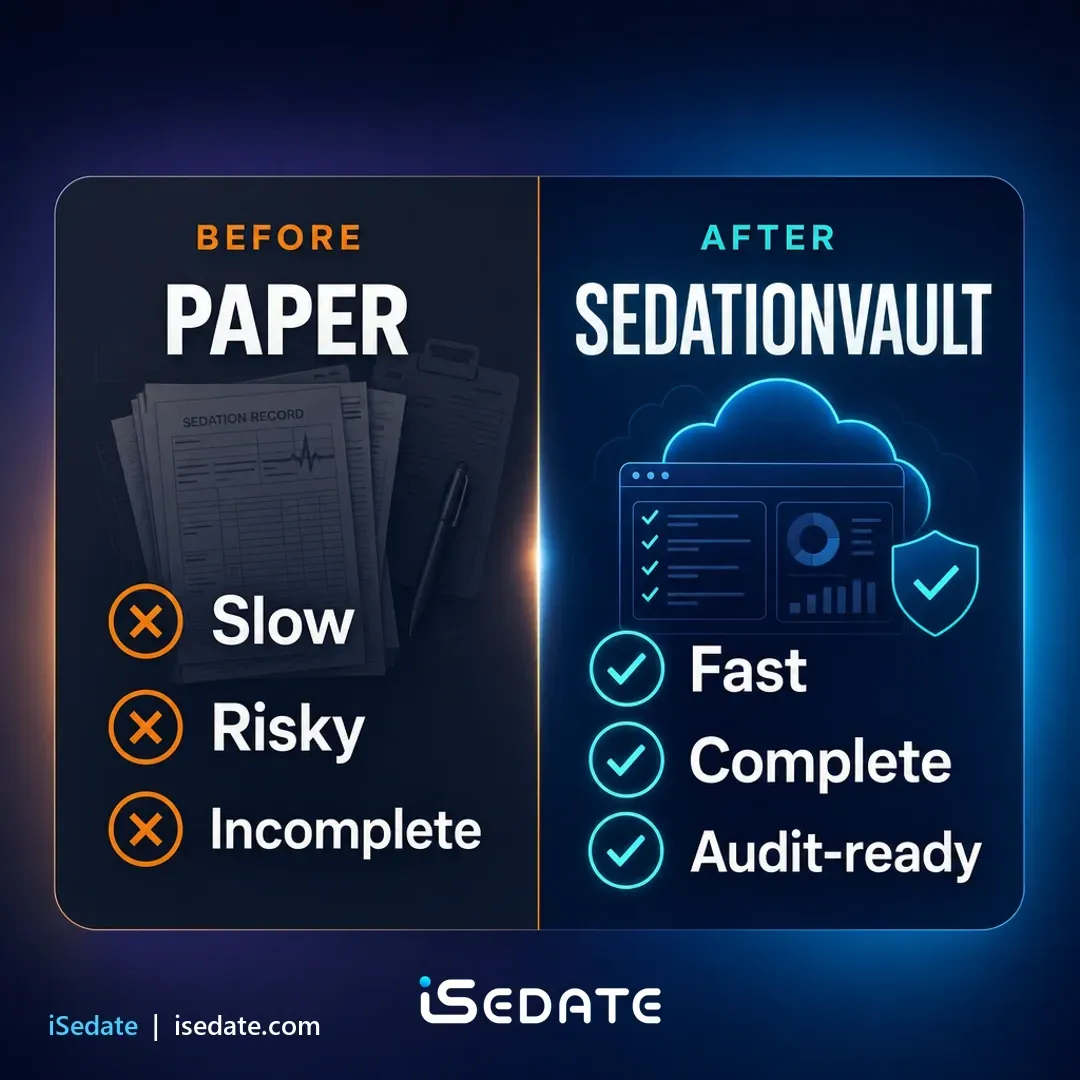
Knowing the dose given, and having it recorded as the visit unfolds, is a frontline defense against dose-related toxicity. iSedate's SedationVault captures live vitals from compatible monitors, including Edan, MindRay, Criticare, and more (the Edan X10 is a common example), and builds a continuous, audit-ready record for every sedation case. To see how it works in your practice, book a demo.